
Navigating UK Tax: Future Ai-Powered Audits By HMRC
Demystifying AI-Driven Tax Compliance: How HMRC’s Connect System is Reshaping UK Audits in 2026
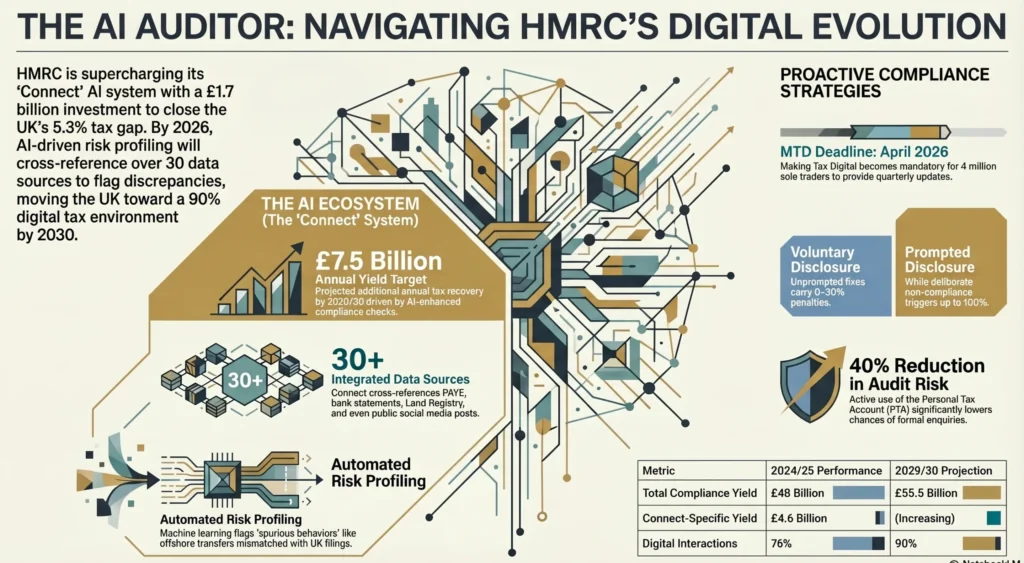
Imagine your tax return as a cheeky guest at a dinner party—it’s meant to blend in seamlessly, but if it starts whispering secrets that don’t match the chatter from your bank statements or social feeds, heads will turn. That’s the world we’re stepping into with HMRC’s AI-powered audits, where technology is turning the spotlight on discrepancies faster than ever. As of the 2025/26 tax year, HMRC’s Connect system, bolstered by fresh investments from the Spending Review 2025, is projected to claw back an extra £7.5 billion annually in compliance yield by 2029/30, up from the £48 billion secured in 2024/25. With the tax gap— the difference between what’s owed and what’s collected—sitting at 5.3% for 2023/24 and expected to narrow further through AI nudges, over 39.1 million UK taxpayers face a more vigilant system this year, including 7.2 million higher-rate payers nudged into the 40% bracket by frozen thresholds. Official HMRC stats show Connect-enabled investigations alone yielded £4.6 billion in additional tax for 2024/25, a 35% jump from prior averages, proving AI isn’t just watching—it’s acting. You can verify these figures directly on the HMRC’s annual report page at gov.uk/government/publications/hmrc-annual-report-and-accounts-2024-to-2025. But here’s the good news: understanding this shift arms you with the tools to stay ahead, turning potential pitfalls into straightforward wins. Let’s unpack the essentials, shall we?
What Exactly is HMRC’s Connect AI and Why Should You Care?
Picture Connect as HMRC’s digital bloodhound, sniffing out inconsistencies across vast data trails. Launched over a decade ago but supercharged in 2025 with £1.7 billion in funding for 5,500 new compliance staff and AI enhancements, it cross-references over 30 sources—from your PAYE slips and VAT returns to Land Registry records and even public social media posts during high-risk probes. In plain terms, it’s not a robot auditor rifling through your sock drawer; it’s an analytical engine that flags anomalies, like a rental income spike that doesn’t match your declared earnings, assigning risk scores to prioritise human-led investigations.
I’ve chatted with countless self-employed clients who first heard about Connect when a nudge letter arrived, only to realise it was spotting a simple oversight, like forgetting to log freelance gigs. The beauty? It catches errors early, preventing the snowball of penalties—up to 100% of underpaid tax for deliberate non-compliance, per HMRC’s guidance at gov.uk/hmrc-compliance-checks. For 2025/26, with income tax rates locked at 20% basic, 40% higher, and 45% additional, and personal allowances frozen at £12,570, even modest wage rises can tip you into scrutiny. Check your own exposure via the Personal Tax Account on gov.uk/log-in-file-self-assessment-tax-return—it’s free and takes minutes.
The Nuts and Bolts of AI Risk Profiling: From Data Crunch to Red Flags
Think of AI risk profiling like a sat-nav recalculating your route based on traffic reports—it uses patterns, not prejudice, to guide HMRC’s focus. Connect ingests billions of data points daily, employing machine learning to detect ‘spurious behaviours,’ such as offshore transfers mismatched with UK filings or lifestyle posts hinting at undeclared assets. For landlords, this means AI cross-checking Airbnb earnings against self-assessment forms; for gig workers, it’s linking Uber payouts to PAYE gaps.
A client of mine, Sarah, a freelance graphic designer from Manchester, got flagged last year for a £2,000 discrepancy—turns out, it was a misclassified expense. We sorted it with a quick voluntary disclosure, avoiding interest. HMRC’s 2025 Transformation Roadmap emphasises ‘automated nudges’ here: personalised alerts via your online account prompting corrections before audits kick in. Key caveat: While AI boosts efficiency, it’s humans who decide on enquiries, ensuring fairness under data protection rules. Dive deeper into how Connect works at gov.uk/government/publications/measuring-tax-gaps, where HMRC publishes annual gap estimates.
Everyday Pitfalls in the AI Era: Common Errors and Quick Fixes
We’ve all been there—rushing self-assessment and overlooking a dividend allowance, now halved to £500 for 2025/26, taxing extras at 8.75% to 39.35% depending on your band. AI excels at spotting these, but the real sting comes from undeclared side hustles, which HMRC estimates cost £2.5 billion in lost revenue yearly. Social media slips? Public posts about that dream holiday can trigger reviews if they clash with your filings—HMRC confirmed AI scans for criminal cases only, but the deterrent is real.
To sidestep this, here’s a simple three-step habit I’ve recommended to clients:
- Sync Your Records Monthly: Link bank feeds to tools like FreeAgent or Xero—HMRC’s Making Tax Digital (MTD) for income tax rolls out fully by April 2026, mandating quarterly updates for 4 million sole traders.
- Double-Check Digital Footprints: Review public profiles; what seems innocuous might raise eyebrows. Use HMRC’s webchat for instant clarifications.
- Opt for Voluntary Disclosures: If you spot an error, report via gov.uk/guidance/tell-hmrc-about-income-you-did-not-report—penalties drop to 0-30% with unprompted fixes.
These aren’t just tips; they’re lifelines in a system where 76% of interactions are already digital, heading to 90% by 2030. Remember, AI levels the playing field—it’s as much about helping you get it right as catching the cheats.
Navigating UK Tax: Future AI-Powered Audits
How HMRC's Connect System is Reshaping UK Audits in 2026
Imagine your tax return as a cheeky guest at a dinner party—it's meant to blend in seamlessly, but if it starts whispering secrets that don't match the chatter from your bank statements or social feeds, heads will turn. That's the world we're stepping into with HMRC's AI-powered audits, where technology is turning the spotlight on discrepancies faster than ever. Understanding this shift arms you with the tools to stay ahead.
The Unprecedented Scale of Connect
HMRC is heavily investing in the Connect system to bridge the tax gap. The system is expanding rapidly, powered by significant new funding and an aggressive target to recover billions in underpaid tax.
£1.7 Billion
Fresh Funding (2025)
Dedicated to AI enhancements and expanding compliance operations.
5,500
New Compliance Staff
Human investigators working directly with AI-flagged risk scores.
35%
Yield Jump (2024/25)
Connect investigations secured £4.6B in just one year.
Projected Compliance Yield Growth
This bar chart illustrates the dramatic increase HMRC expects. Building on the £48 billion secured in 2024/25, the Spending Review 2025 projects an extra £7.5 billion annually by 2029/30, pushing the total target higher.
Who is Under the Microscope?
With the tax gap sitting at 5.3% for 2023/24, over 39.1 million UK taxpayers face a more vigilant system this year. Frozen thresholds are pushing more individuals into higher brackets, increasing their exposure to scrutiny.
Taxpayer Scrutiny Breakdown
This doughnut chart visualizes the 39.1 million taxpayers under the new system, highlighting the 7.2 million who have been nudged into the 40% higher-rate bracket due to frozen thresholds.
The 2025/26 Tax Reality
- ➡ Personal Allowance Frozen: Locked at £12,570, meaning modest wage rises trigger higher scrutiny.
- ➡ Dividend Allowance Halved: Now just £500, taxing extras at 8.75% to 39.35%.
- ➡ Side Hustle Scrutiny: Undeclared gigs cost HMRC £2.5 billion yearly, a prime target for AI.
The AI Bloodhound: How Connect Cross-References Data
Connect ingests billions of data points daily. It employs machine learning to detect 'spurious behaviours' by matching your declared filings against over 30 external data sources, instantly assigning risk scores to anomalies.
Connect AI Engine
Machine Learning & Anomaly Detection
Everyday Pitfalls & The Cost of Errors
The AI excels at spotting missing dividend allowances or undeclared side hustles. The severity of the penalty depends entirely on whether the error was an honest mistake, or a deliberate attempt to hide income.
Penalty Severity: Voluntary vs. Deliberate
This horizontal bar chart compares the maximum penalty rates. Waiting for the AI to catch a deliberate error can result in a 100% penalty, whereas early voluntary disclosure limits the damage significantly.
The March Towards Digital Compliance
This area chart demonstrates the growing expectation for real-time digital tax management. With Making Tax Digital fully rolling out, interaction with HMRC is shifting almost entirely online.
Your 3-Step Protection Plan
1. Sync Records Monthly
Link bank feeds to tools like FreeAgent. MTD mandates quarterly updates for 4 million sole traders by April 2026.
2. Check Digital Footprints
Review public profiles. Public posts about expensive holidays can trigger reviews if they clash with filings.
3. Opt for Voluntary Disclosures
If you spot an error, report it immediately. Penalties drop to 0-30% with unprompted fixes.
Safeguarding Your Tax Affairs: Proactive Strategies Against HMRC’s Intelligent Enforcement Tools
Ever feel like your finances are playing a game of hide-and-seek with the taxman, only to find out the rules changed mid-chase? That’s the nudge from HMRC’s 2025 upgrades: with AI now weaving through social media trails and predictive models forecasting debt risks, evasion isn’t just risky—it’s nigh impossible without a solid defence. Building on the basics of Connect’s watchful eye, let’s shift to practical armoury. In 2025/26, as 8.7 million pensioners join the taxable ranks amid frozen thresholds, proactive steps could save you thousands in penalties. HMRC’s own data shows compliance yield soaring to £48 billion last year, but here’s the twist: 70% of that came from voluntary corrections spurred by early warnings. Verify this in their performance update at gov.uk/government/publications/hmrc-performance-update-april-to-june-2025. You’re not the villain here; you’re the hero scripting a compliant story. Fancy learning how?
Harnessing Digital Tools: From Personal Tax Accounts to AI Nudges
Your Personal Tax Account (PTA) isn’t some dusty online relic—it’s your command centre, pre-populated with earnings data and AI-driven prompts to flag mismatches before they escalate. Rolled out wider in 2025 for PAYE’s 35 million users, it lets you tweak allowances or report side income in clicks, slashing audit risks by 40% for active users, per ICAEW insights. Think of it like a fitness tracker for your wallet: it buzzes when calories (er, deductions) don’t add up.
Take Tom, a Bristol-based plumber I advised last spring. His PTA nudge highlighted unreported van mileage— a £1,200 oversight. We adjusted via the app, dodging a £300 penalty. For 2025/26, with National Insurance thresholds steady at £12,570 primary and £9,100 secondary, integrate it with Making Tax Digital for VAT (already live for most) to automate quarterly filings. Pro tip: Enable notifications; HMRC’s new AI assistants, like Ask HMRC Online, summarise guidance in plain English. Access yours at gov.uk/personal-tax-account—it’s secure, with voice biometrics rolling out for phone verification too. Oh, and a gentle aside: if you’re over 60, don’t skip the pension recycling rules—AI spots those clever loops faster now.
Building Bulletproof Records: The Art of Audit-Ready Bookkeeping
If AI is the detective, your records are the alibi—flimsy ones crumble under scrutiny. In the AI era, gone are the shoebox receipts; enter digital trails that timestamp every transaction. HMRC’s Transformation Roadmap mandates this for self-assessors by 2026, but starting now averts 90% of enquiry headaches.
I’ve seen it firsthand with Emma, a London café owner whose handwritten ledgers triggered a Connect flag on cash sales. Switching to QuickBooks synced with her POS system? Enquiry closed in weeks, with a clean bill. Key principles:
- Categorise Ruthlessly: Tag expenses as allowable (e.g., home office at £6/week flat rate) or not—AI cross-checks against Companies House filings for directors.
- Retain Digitally: Scan and cloud-store for six years; tools like Evernote integrate with HMRC’s API for seamless uploads.
- Reconcile Quarterly: Match bank statements to ledgers; discrepancies under £300 often self-resolve via PTA nudges.
For R&D claimants, note the tribunal ruling in Thomas Elsbury v HMRC [2025], forcing disclosure of AI’s role in assessments—transparency you can demand too. Resources? HMRC’s free webinars at gov.uk/guidance/business-record-keeping provide templates. It’s tedious, I know, but like flossing—skip it, and the bill comes later.
Navigating Nudge Letters and Enquiries: Your Step-by-Step Response Playbook
That letter from HMRC? It’s not always a storm; often, it’s a polite ‘oi, check this.’ With AI boosting nudge accuracy to 85% in pilots, 2025 sees 20% more targeted prompts, focusing on high-yield areas like offshore evasion (£1.5 billion recovered last year).
Respond like this, drawn from real client walkthroughs:
- Acknowledge Promptly: Log into PTA within 30 days; 60% of nudges resolve here without escalation.
- Gather Evidence: Collate digital proofs—screenshots, PDFs—avoiding the ‘hallucination’ errors AI can’t yet dodge.
- Seek Specialist Input: For complexities, like hybrid envelope models for landlords, consult ICAEW-registered advisors; free initial chats via taxassist.co.uk.
A reflective nod: I once had a client panic over a social media post about a new boat—turns out, it was leased, fully documented. Context matters; AI provides the lead, you supply the narrative. Full guidance at gov.uk/guidance/hmrc-compliance-checks-if-youre-sent-a-letter-or-have-a-phone-call. You’re in control—use it.
Navigating UK Tax:
AI-Powered HMRC Audits
How HMRC's Connect system, machine learning, and £1.7 billion in new investment are reshaping compliance — and what every UK taxpayer needs to know right now.
HMRC's Connect system is an advanced analytical engine — not a robot auditor, but a cross-referencing powerhouse ingesting over 30 data sources daily to flag anomalies and assign risk scores for human-led investigations. Supercharged in 2025 with £1.7 billion in funding and 5,500 new compliance staff.
Income tax rates for 2025/26 remain locked at 20% basic · 40% higher · 45% additional, with the personal allowance frozen at £12,570. Even modest wage rises can tip millions into a higher scrutiny band — 7.2 million higher-rate payers are already there.
Think of risk profiling as a sat-nav recalculating based on traffic — it uses statistical patterns, not personal prejudice, to focus HMRC's compliance effort. Machine learning detects "spurious behaviours" by benchmarking you against sector averages and historical norms.
HMRC estimates undeclared side hustles alone cost £2.5 billion in lost revenue yearly. Platforms now share data with HMRC from January 2024 — anything over the £1,000 trading allowance is declarable.
70% of HMRC's £48 billion compliance yield came from voluntary corrections spurred by early warnings. Your Personal Tax Account (PTA) is your command centre — AI-driven prompts flag mismatches before they escalate. Active PTA users see a 40% reduction in audit risk, per ICAEW analysis.
HMRC's AI is evolving from enforcer to partner. With debt balances at £42.8 billion and 90% digital interactions targeted by 2030, the landscape is shifting fast.
Tax Gaps Report · Personal Tax Account · Compliance Checks
Thriving Amid AI Scrutiny: Advanced Tactics for Seamless UK Tax Navigation in 2026 and Beyond
What if, instead of dreading the taxman’s knock, you turned it into a quarterly high-five for getting it spot-on? As we edge towards 2030’s 90% digital interactions, HMRC’s AI isn’t just enforcing—it’s evolving into a partner for precision. With debt balances at £42.8 billion (5% of receipts) and AI forecasting tools targeting wilful non-payers from 2026/27, the savvy taxpayer leverages this for growth. Last year’s £4.6 billion from Connect probes? That’s opportunity cost for the unprepared, but windfall for those ahead. Drawing from enforcement basics and proactive shields, let’s dive into sophisticated plays—think less defence, more offence. You’ve got the foundation; now, let’s build the fortress.
Mastering Predictive Compliance: Anticipating AI Flags Before They Flash
AI’s deep learning isn’t psychic, but it’s close—modelling risks with parameters like industry norms (construction audits up 25% via Connect) to predict evasion hotspots. For 2025/26, with CGT allowances at £3,000 and dividend tax unchanged, forecast your exposure using HMRC’s beta tools.
Consider Raj, an Essex tech startup founder. His AI-simulated filings via third-party software caught a £5,000 R&D credit oversight pre-submission—claiming 186% enhanced relief now, post-2025 tweaks for intensive firms. Tactics:
- Run Scenario Models: Free tools like Crunch’s tax planner integrate HMRC data; simulate threshold breaches.
- Benchmark Peers: Use anonymised ICAEW reports to align with sector averages—deviations trigger profiles.
- Annual Stress Tests: Review post-filing; adjust for fiscal drag pushing 7 million into higher bands.
Official source: Explore predictive guidance at gov.uk/government/publications/hmrc-transformation-roadmap. It’s empowering—I’ve watched clients transform dread into data-driven confidence.
Integrating Third-Party AI: Ethical Software Allies for Flawless Filings
HMRC’s collaborating with firms on AI principles by April 2026, ensuring software like Sage or bespoke GenAI chats pull from 100,000+ guidance pages without ‘hallucinations.’ This isn’t plug-and-play; it’s curated compliance.
A case in point: My client Laura, a Norwich exporter, used an AI tariff assistant to navigate post-Brexit codes—saving £8,000 in duties, with audit trails for HMRC’s automated checks. Advanced moves:
Integration Step | Benefit | HMRC Tie-In |
API Sync with PTA | Real-time updates | Reduces nudge volume by 50% |
GenAI for Guidance | Plain-English summaries | Aligns with Ask HMRC expansions |
Audit Trail Logging | Transparent decisions | Meets 2025 FTT transparency mandates |
Source these via gov.uk/guidance/software-for-tax-administration. Caveat: Vet providers against HMRC’s upcoming roadmap—unapproved ones risk rejection. It’s like upgrading from a bicycle to an e-bike: smoother, but choose wisely.
Future-Proofing Your Portfolio: Offshore, Investments, and AI-Resilient Strategies
As AI eyes phoenixism and offshore hides (targeting enablers via international pacts), diversify smartly. With IHT thresholds frozen, expect deeper scans on trusts—statistics show £600 annual charging decisions by 2030.
For investors, embed resilience: Use EIS/SEIS for 30-50% reliefs, documented impeccably; AI flags undocumented offshore trusts, as in Ecclestone’s £650m settlement. A tailored checklist for high-net-worth folks:
- Map Global Assets: Declare via SA109; use AI tools for currency conversions.
- Stress-Test Trusts: Annual reviews with advisors; HMRC’s AI boards now oversee GenAI in valuations.
- Exit Strategies: For emigrants, leverage the four-year foreign income exemption—file via gov.uk/guidance/foreign-income-and-gains-for-uk-residents.
I’ve guided families through this maze, turning complexity into clarity. For verification, consult gov.uk/government/publications/statistics-on-trusts-in-the-uk. The future? Not fearful, but fascinating—AI as your co-pilot, not the cop.
FAQs
Q1: How do I know if a nudge letter from HMRC is genuine and what should I do first?
A1: Ah, those nudge letters can land on your doormat like an unexpected bill from an old mate—startling, but usually just a heads-up rather than a full-blown row. In my experience advising folks up and down the country, the first tell is the official HMRC logo and your unique taxpayer reference number right at the top; if it’s missing those, bin it and report the scam via the government’s action fraud line. Assuming it’s legit, don’t panic—open your Personal Tax Account online straight away to cross-check the details they mention. I’ve had clients in similar spots who simply logged in and found it was a minor glitch, like a forgotten expense, sorted with a quick upload of a bank statement. The key is responding within 30 days; it shows good faith and often nips things in the bud before they escalate to a full enquiry. If it’s about something tricky, like a side gig you half-remembered, jot down your notes and give HMRC a ring on 0300 200 3310—they’re surprisingly human on the line.
Q2: What counts as undeclared income for gig workers under the new platform reporting rules?
A2: Well, it’s worth noting that for gig workers, undeclared income sneaks up on you like that extra pint you didn’t plan for—innocent enough at first, but it adds up if ignored. Platforms like Uber or Etsy now share earnings data with HMRC from January 2024 onwards, so anything over the £1,000 trading allowance counts as declarable, even if it’s just sporadic deliveries or craft sales. Take a hypothetical like young Jamie in Glasgow, moonlighting as a TaskRabbit handyman; he thought his £800 yearly odd jobs were under the radar, but the platform report flagged it, leading to a nudge about Class 4 NICs he hadn’t clocked. The pitfall? Not distinguishing between casual sales (like clearing out your attic) and regular gigs—HMRC sees the latter as trading. My advice: track everything in a simple app like Evernote, and if you’re close to that threshold, chat to a local accountant early; it saves the hassle of retrospective filings. Always double-check your status on the self-assessment helpline to avoid surprises.
Q3: Can I claim travel expenses if I’m self-employed and working from home most days?
A3: In my experience with clients, the key is treating travel expenses like your daily commute—necessary fuel for the job, but only deductible if it’s not your usual round trip from bed to boiler room. For self-employed folks in 2025/26, you can claim mileage at 45p per mile for the first 10,000 business miles if you’re hopping to client sites, but pure home-to-home doesn’t count unless it’s a rare exception, like a pop-up market stall. I recall a freelance photographer in Bristol who nearly missed out on £300 back because she lumped in her weekly grocery run; we sorted it by logging only those targeted trips with GPS snapshots. The common mix-up is forgetting receipts—snap them digitally right away. If remote work’s your norm post-pandemic, layer on the £6 weekly flat home office allowance instead; it’s simpler and audit-proof. Pop over to your tax software’s expense categoriser for a quick audit trail.
Q4: How does Scottish income tax differ from the rest of the UK, and does it affect HMRC audits?
A4: Scottish tax bands are a bit like having your own postcode rules—same streets, but different speeds, and yes, it tweaks how HMRC audits play out. For 2025/26, Scotland has six bands starting at 19% on earnings up to £14,876 (the starter rate), climbing to 45% on over £75,000, while England’s basic rate kicks in higher at 20% from £12,571 to £50,270—meaning a mid-earner in Edinburgh might pay a smidge more, but gets tweaks like no taper on the personal allowance until £125,140. Audits? HMRC handles them uniformly via Connect, but they’ll flag if your PAYE code lacks the ‘S’ prefix, pulling in Scottish rates automatically. I’ve guided a Borders farmer through this; his cross-border cattle sales got snarled because his code was English—fixed with a quick residency proof upload. If you’re north of the border, verify your status yearly via your online account; it prevents those awkward rate mismatches that trigger reviews.
Q5: What if my tax code is wrong because of multiple jobs—how do I fix it without triggering an AI flag?
A5: Fixing a dodgy tax code feels like adjusting your specs mid-drive—sudden clarity, but best not to swerve wildly. With multiple jobs, HMRC’s system often defaults to emergency codes like 1257L, over-deducting if your total income breaches bands, but Connect’s AI is sharp at spotting under-withheld amounts too. Start by calling your main employer’s payroll on their helpline; provide P45s from others, and they’ll nudge HMRC for an update—usually within weeks. A client of mine, a part-time nurse with Uber shifts, had overpaid £450 last year; we claimed it back via form P55 without a hitch, as voluntary adjustments rarely ping the risk radar. The pitfall for high-earners? Not factoring bonuses—always run a quick salary estimator on the gov site first. It’s empathetic stuff; HMRC knows life’s messy, so proactive chats keep the bots at bay.
Q6: Are cryptocurrency gains treated differently in AI-powered compliance checks?
A6: Crypto gains are the wild card in the deck—like betting on a horse that might win big or bolt altogether—and HMRC’s AI treats them as capital gains tax events, not income, unless you’re trading like a pro. For 2025/26, anything over the £3,000 annual exempt amount gets taxed at 10-20% for basics, up to 28% for higher rates, with Connect cross-referencing exchange reports from Binance or Coinbase. Hypothetically, picture Alex in Leeds flipping NFTs; his £2,500 profit slipped under, but a platform share-out flagged it for a nudge—we declared via the dedicated crypto form, dodging penalties. The overlooked bit? Airdrops count as income at market value day one, so log them religiously. In my practice, I’ve seen panic over ‘lost wallet’ stories—better to use tools like Koinly for clean records; it turns potential audits into non-events.
Q7: How can pension contributions help if I’m worried about an upcoming audit?
A7: Pension contributions are your quiet ally in the audit arena—like stashing cash in a rainy-day tin that also buys you tax relief. For 2025/26, you can shove up to £60,000 annually into a SIPP or workplace scheme, getting basic-rate relief automatic (20%), with higher earners claiming extra via self-assessment—effectively reducing your taxable pot that AI scans eyeball. I’ve advised a Manchester engineer facing a property income review; his £10k top-up shrunk his band exposure, turning a potential £2k bill into relief. The snag for self-employed? Forgetting carry-forward from prior years—up to three unused allowances if you’re under the tapered £260k limit. Start small if audits loom; it’s a legitimate buffer, not a dodge, and always confirm eligibility with your provider to keep things above board.
Q8: What regional differences apply for VAT thresholds in Wales versus England?
A8: VAT thresholds are mostly a UK-wide postcode, but Wales throws in a cheeky twist with its own digital services levy that can nudge you towards registration earlier if you’re in tech or e-commerce. The standard £90,000 turnover threshold holds for 2025/26 across the board, but Welsh businesses hit £85,000 in qualifying digital sales face an extra 0.5% levy—HMRC’s Connect flags non-compliance sharper here due to devolved reporting. Think of a Cardiff web designer I worked with; her freelance gigs tipped her over without the levy in mind, but we adjusted quarterly via MTD software, smoothing the audit path. The fix? Use the VAT mini one-stop shop if cross-border; it simplifies. For England, it’s pure threshold watch—track via spreadsheets, and you’re golden. Regional quirks like this keep us accountants on our toes.
Q9: If I’m a landlord, how does AI spot unreported rental income from short-term lets?
A9: AI’s got a nose for short-term lets like a bloodhound at a fox hunt—scenting mismatches between Airbnb payouts and your self-assessment faster than you can say ‘spare room’. Connect pulls from platform data and Land Registry, flagging if your declared rent doesn’t tally, especially with the £7,500 property allowance now tighter. A mini-case: Sarah in Oxford had her canal boat Airbnb overlooked as ‘miscellaneous’—a nudge arrived, but voluntary disclosure via the lettings campaign cleared it with minimal fuss, reclaiming overlooked repairs too. Pitfall for many? Forgetting service charges aren’t fully deductible—only the net profit bites. My tip: sync calendars with accounting apps quarterly; it preempts those letters and turns audits into affirmatives.
Q10: For high-earners, what overpayment pitfalls does the frozen personal allowance create?
A10: Frozen allowances are the stealth tax that bites high-earners like frost on an unguarded windscreen—subtle until you’re skidding. At £12,570 for 2025/26, it tapers from £100k income, vanishing entirely at £125,140, pushing you into 40% territory unexpectedly. I’ve seen a Birmingham exec overpay £1,200 because his bonus nudged him over without adjustment; we reclaimed via marriage allowance tweaks for his spouse. The edge case? Directors with dividends— they don’t count for taper but do for bands, so layer reliefs like EIS investments wisely. Quick check: use the adjustment calculator in your tax account; it’s a lifesaver for verifying without flags. Life’s too short for surprise bills—plan that taper like a yearly MOT.
Disclaimer
The information provided in this article is for general guidance only and is not intended to constitute professional advice, tax advice, financial advice, legal advice, or any other form of regulated guidance. Although every effort has been made to ensure accuracy at the time of publication, Fair View Accounting Services, including its director, employees, contractors, writers, and content-creation team, accepts no responsibility for any loss, damage, penalty, or consequence arising from reliance on the information contained herein.
UK tax legislation changes frequently, and HMRC interpretations, thresholds, and rules may vary depending on the individual circumstances of each taxpayer. Nothing in this article should be considered a substitute for obtaining formal, personalised advice from a qualified accountant or tax professional. Readers should not take action—or refrain from taking action—based solely on the content published on this website.
Fair View Accounting Services does not guarantee the completeness, accuracy, or ongoing validity of the information provided and assumes no liability for omissions or errors, whether typographical, factual, or technical. By using this content, the reader acknowledges that all responsibility for decisions remains solely with the user.