

Imagine you’ve finally found your dream home, your deposit is ready, and you’ve downloaded your latest SA302s, only for your mortgage lender to request an Accountant’s Certificate instead. It’s a common moment of frustration for many of the 4.568 million self-employed individuals in the UK. You’ve worked hard to build your business, and it’s natural to feel concerned when standard tax documents don’t seem to satisfy a lender’s requirements.
We understand that the gap between tax reporting and mortgage lending can feel like a minefield. This guide will show you exactly how to bridge that gap by explaining what this certificate is, why lenders require it, and how to secure a professionally verified statement that reflects your true financial position. We’ll explore the difference between HMRC calculations and professional sign-offs, identify which lenders are currently accepting these documents, and outline the specific qualifications your accountant needs to help you cross the finish line with confidence.
Key Takeaways
- Understand how an Accountant’s Certificate validates your financial standing to help lenders accurately assess mortgage affordability for self-employed applicants.
- Identify the specific professional qualifications, such as ICAEW or ACCA, that your accountant must hold to ensure your paperwork is accepted by major UK lenders.
- Learn the critical differences between a standard HMRC SA302 and a bespoke certificate, particularly regarding the inclusion of dividends and retained profits.
- Follow a practical preparation checklist to organise your bookkeeping and VAT returns, ensuring your mortgage application stays on schedule.
- Discover how modern cloud accounting integration simplifies the verification of your figures for a faster and more reliable finance application.
What is an Accountant’s Certificate and Why is it Required?
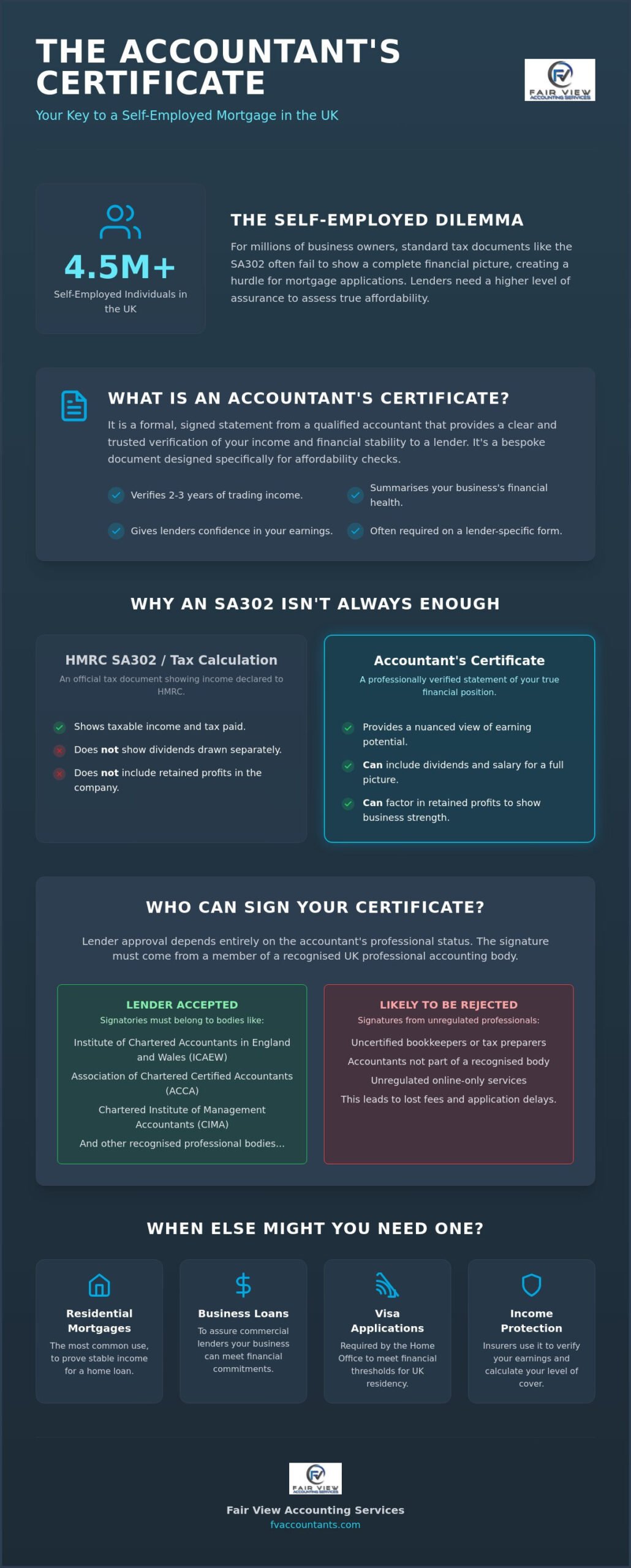
At its core, an Accountant’s Certificate is a formal, signed statement from a qualified professional that verifies your financial standing and income. For the 4.568 million self-employed individuals in the UK as of early 2026, this document is often the difference between a mortgage offer and a rejection. It serves as a high-level summary of your earnings, typically covering the last two or three years of trading, and provides a lender with a verified snapshot of your business’s health.
Lenders require this because traditional PAYE evidence, like a P60, doesn’t exist for business owners. While HMRC documents like the SA302 show what you’ve paid tax on, they don’t always tell the whole story. An Accountant’s Certificate offers a more nuanced view, especially for limited company directors who might keep profits within the business rather than drawing them all as salary or dividends. It’s vital to distinguish this from ‘certified accounts’. While certified accounts are a full set of financial statements, the certificate is a specific form or letter, often provided by the lender themselves, that focuses purely on the figures needed for affordability checks.
The Role of the Certificate in UK Mortgage Applications
This document acts as a vital bridge between your company’s performance and your personal borrowing power. High-street banks like Santander, Nationwide, or Halifax often find that tax returns alone don’t reflect a director’s true earning potential. By providing a professionally signed certificate, you give mortgage underwriters the reassurance they need regarding the consistency and sustainability of your income. It allows them to see beyond the taxable income figure and consider the broader financial strength of your enterprise. Determining Who Can Sign an Accountant’s Certificate is crucial here, as most major lenders will only accept signatures from members of recognised professional bodies.
Common Scenarios Where You Will Need One
Whilst mortgages are the most common reason for requesting this verification, several other professional scenarios require this level of financial proof. You’ll likely encounter a request for an Accountant’s Certificate in these situations:
- Residential Mortgages: You’re a limited company director or sole trader needing to prove stable income to secure a home loan.
- Business Loans and Commercial Leases: Landlords and commercial lenders require a certificate to ensure your business can meet long-term financial commitments.
- Visa and Residency Applications: If you’re self-employed and applying for certain UK visas, the Home Office may require a certified statement of your earnings to meet financial thresholds.
- Income Protection Insurance: Some insurers use these certificates to verify the level of cover you’re entitled to based on your actual earnings.
By preparing these documents in advance, you reduce the risk of delays in your application. Underwriters appreciate the clarity that a qualified accountant provides, as it simplifies their assessment of your financial reliability.
Just as you protect your financial health with professional certification, looking after your physical well-being is essential during major life transitions; you can learn more about Ready Health for accessible private medical services.
Who Can Sign an Accountant’s Certificate in 2026?
The signature on your Accountant’s Certificate isn’t just a formality. It’s a professional guarantee that mortgage underwriters rely on to release hundreds of thousands of pounds. Whilst many business owners work with talented bookkeepers or tax preparers, most major UK lenders require a signature from a professional who holds a specific ‘Qualified’ status. If the signatory doesn’t belong to a recognised regulatory body, your mortgage application will likely be rejected during the initial document check, leading to lost valuation fees and missed property opportunities.
Lenders like NatWest, Halifax, and Santander Select maintain strict lists of which professional bodies they trust. This isn’t about the accuracy of your numbers alone; it’s about the regulatory oversight and professional indemnity insurance that a qualified accountant provides. Using an uncertified professional or an unregulated online service often results in a “hard” rejection from the bank’s automated systems. Ensuring your professional is correctly qualified is the first step toward a successful application. Our team of qualified chartered accountants provides the recognised certification required by all major UK lenders, helping you avoid these common pitfalls.
Recognised UK Professional Accounting Bodies
In 2026, the vast majority of high-street banks and building societies, including the Saffron Building Society and Skipton, will only accept certificates from members of specific organisations. The Institute of Chartered Accountants in England and Wales (ICAEW) is often viewed as the gold standard, but the Association of Chartered Certified Accountants (ACCA) is equally respected across the industry. Other accepted bodies include the Chartered Institute of Management Accountants (CIMA) and the Institute of Chartered Accountants of Scotland (ICAS). Before you proceed, it’s vital to check that your accountant holds a valid practising certificate, as being “exam-qualified” without a license to practice is usually insufficient for mortgage purposes.
What Lenders Look for in the Signatory
Underwriters perform a “due diligence” check on the person signing your Accountant’s Certificate. They verify the firm’s registration number against the professional body’s directory and confirm that the firm has adequate professional indemnity insurance. This protects the lender if the financial figures are later found to be grossly inaccurate. They also require the accountant to have direct oversight of your financial records. “Online-only” services that sign off on figures without a thorough review of your bookkeeping or VAT returns are frequently flagged by lenders like Lloyds and Barclays. A local or specialised firm that understands your business structure provides the level of credibility that underwriters need to approve high-value loans.
While an SA302 is a vital piece of the mortgage puzzle, it often fails to provide the complete financial picture that modern lenders require. An SA302 is simply a tax calculation from HMRC that confirms the income you’ve officially declared for a specific tax year. In contrast, an Accountant’s Certificate is a bespoke document that offers a deeper, more current analysis of your business’s performance. For many of the 1.8 million homeowners facing fixed-rate mortgage expiries in 2026, relying solely on historical tax data can be a significant hurdle, especially if your business has grown rapidly since your last filing.
One of the most critical advantages of a certificate is how it handles retained profits. As a limited company director, you might choose to keep a portion of your earnings within the business to fund future growth or manage tax liabilities. An SA302 only reflects the salary and dividends you’ve actually drawn. A qualified accountant can use the certificate to verify your “share of net profit after tax,” which effectively demonstrates a much higher level of affordability to a lender. This professional validation ensures you aren’t penalised for being fiscally responsible with your company’s cash flow. As a limited company director, staying on top of your corporation tax deadlines uk obligations is equally critical, since HMRC’s updated 2026 penalty regime means even a single day’s delay can trigger an immediate £200 fine.
When an SA302 is Not Enough
HMRC documents are inherently backwards-looking, sometimes reflecting data that is nearly two years old. If you’ve recently changed your business structure, such as moving from a sole trader to a limited company, an SA302 won’t accurately represent your current status. Lenders also frequently require a forecast of future earnings to ensure long-term stability. Since an SA302 cannot predict future performance, an Accountant’s Certificate becomes the essential tool for bridging this information gap. This is particularly relevant given the 2026 trend of lenders moving towards manual underwriting to better support the self-employed.
The Benefit of Professional Verification
A professional certificate allows your accountant to provide context that a standard tax form cannot. If your business experienced a temporary dip in profits due to a one-off capital investment, your accountant can explain this to the underwriter. We can also include “add-backs” like depreciation. Because depreciation is a non-cash expense, adding it back to your net profit can significantly increase your calculated borrowing capacity. This level of detail ensures that your mortgage application is based on your actual financial strength rather than just a narrow tax figure. By aligning your annual accounts, tax returns, and the certificate, we create a consistent and robust case for your lender.
How to Secure Your Certificate: A Preparation Checklist
Securing an Accountant’s Certificate is a methodical process that requires careful coordination between you, your accountant, and your mortgage broker. To ensure your property purchase stays on track, you should treat this document as a priority rather than an afterthought. Following a structured checklist helps eliminate the administrative friction that often leads to mortgage delays. Our qualified team is ready to guide you through each stage to ensure your application is robust and professional.
- Step 1: Contact your accountant early. You should reach out as soon as you begin the mortgage process. Early communication allows us to flag any potential issues, such as missing tax overviews or pending filings, before they become roadblocks.
- Step 2: Ensure all bookkeeping is up-to-date. Accurate records are the foundation of a swift verification process. We recommend you maintain a clear trail of all business transactions and ensure your VAT returns are filed correctly. Understanding the full scope of VAT in UK compliance obligations for 2026, including the current registration threshold and Making Tax Digital requirements, can help ensure your records are ready for professional certification.
- Step 3: Provide the specific lender’s template. Banks like Santander, HSBC, or NatWest often have their own proprietary forms with unique questions. Providing the exact template from the outset prevents the need for time-consuming revisions later.
- Step 4: Review the draft figures. Before the final sign-off, we will review the figures with you to ensure they accurately reflect your true income. This is the moment to confirm that dividends, salary, and any relevant retained profits are correctly captured to maximise your borrowing potential.
The Information You’ll Need to Provide
To produce a precise certificate, your accountant requires a comprehensive data set. You will generally need to provide your last 2-3 years of finalised statutory accounts and the corresponding personal tax year overviews from HMRC. If your business has experienced significant changes in turnover or expenses during the current trading year, you should prepare a brief explanation. This transparency allows the accountant to provide the necessary context to the lender’s underwriters, reinforcing the stability of your income.
Timeline and Expectations
You should allow at least 5-10 working days for a thorough certification process. This window allows your accountant to verify the figures against your filed accounts and ensure the document meets the lender’s specific criteria. The ‘final sign-off’ is a critical stage; whilst many lenders now accept digital signatures via secure platforms like DocuSign, some traditional building societies may still require a physical, wet-ink signature. Confirming these requirements with your broker early on will prevent last-minute stress during the exchange of contracts.
If you are ready to move forward with your mortgage application, our team can help you prepare a recognised Accountant's Certificate that meets your lender’s specific requirements and supports your financial goals.
How Fair View Accounting Services Simplifies Your Mortgage Proof
At Fair View Accounting Services, we recognise that the final stages of a mortgage application are often the most stressful part of buying a home or refinancing. Our team of Qualified Chartered Accountants is dedicated to removing this administrative burden from your shoulders. We provide the recognised Accountant’s Certificate required by all major UK lenders, ensuring your financial standing is presented with absolute precision and professional authority. Because we hold the necessary qualifications from bodies like the ICAEW and ACCA, our signatures carry the weight needed to satisfy strict underwriting requirements.
We’ve designed a streamlined process that prioritises both speed and accuracy. By integrating cloud technology like Xero and QuickBooks into our daily workflow, we verify your figures with modern efficiency. This digital-first approach means we don’t just rely on historical filings; we evidence your current performance with real-time data. We also act as a proactive link in your finance chain. Our team communicates directly with your mortgage broker to ensure the certificate aligns perfectly with specific lender criteria, whether you’re applying to a high-street bank or a specialist building society.
Our support goes beyond simply filling in a form. We take a proactive approach to your personal tax planning, ensuring your income structure is optimised for borrowing before you even submit an application. By balancing your salary, dividends, and retained profits, we help you demonstrate the true affordability of your mortgage whilst maintaining your tax efficiency.
Partnering with a Tech-Savvy Chartered Firm
Precision is the cornerstone of our service. Our use of industry-leading tools like Dext and IRIS ensures your data is accurate and ‘audit-ready’ at all times. This technological edge allows us to generate the necessary reports for your certificate without the typical delays associated with traditional firms. You gain the peace of mind that comes from having a regulated firm stand behind your financial claims, protecting your professional reputation and your property goals. You can learn more about our professional standards in our guide on Chartered Accountants: How They Protect Your Business.
Get Your Accountant’s Certificate Today
Onboarding with Fair View for your certification needs is a straightforward and transparent process. Once we’ve reviewed your up-to-date bookkeeping and statutory accounts, we work diligently to meet your mortgage deadlines. We understand that in the property market, timing is everything. We’re committed to maintaining absolute accuracy whilst working within the tight windows often required by lenders and solicitors. If you’re ready to secure your finance with a professionally verified statement, Contact Fair View Accounting Services for your Accountant’s Certificate today. Our team is here to ensure your mortgage application is a success.
Secure Your Mortgage with Professional Certification
Your path to securing a UK mortgage as a business owner depends on the clarity and authority of your financial evidence. We’ve explored how a qualified signature from an ICAEW or ACCA professional ensures your application meets the stringent standards of high-street lenders. You now understand that an Accountant’s Certificate provides a more comprehensive view of your affordability than a standard SA302, particularly when accounting for dividends and retained profits.
Preparation is your greatest asset. By maintaining up-to-date bookkeeping and engaging with your accountant early in the process, you eliminate the administrative friction that often causes delays. Our team of regulated Chartered Accountants combines deep expertise in UK lender requirements with modern cloud-accounting integration to provide the rapid turnaround your property purchase demands. We bridge the gap between your complex business finances and the lender’s need for stability and precision.
If you’re ready to take the next step toward your new home, we’re here to provide the steady, professional support you need. Secure your professionally verified Accountant’s Certificate with Fair View Accounting Services and move forward with confidence. Your financial goals are within reach, and we’re committed to helping you achieve them with absolute clarity and peace of mind.
Frequently Asked Questions
Can any accountant sign an Accountant’s Certificate?
No, most UK lenders only accept signatures from accountants who hold a practising certificate from a recognised professional body. This includes organisations such as the ICAEW, ACCA, and CIMA. If your accountant is unqualified or doesn’t have the correct regulatory oversight, your mortgage application will likely be rejected during the initial document review because the lender lacks the necessary professional guarantee.
How much does it typically cost to get an Accountant’s Certificate?
Fees vary across the industry depending on the complexity of the verification and the depth of the data required. Some firms charge a flat fee for the administration, whilst others include it as part of their annual compliance package. You should check with your professional provider for their specific fee structure before they begin the work to avoid any unexpected costs during your mortgage application.
Will a lender accept an Accountant’s Certificate if my accounts aren’t audited?
Yes, most small and medium-sized businesses in the UK are exempt from statutory audits. Lenders understand this and accept a certificate based on un-audited accounts, provided they are prepared by a qualified professional. The certificate itself acts as the necessary layer of verification that the lender requires to trust the figures you’ve provided for your affordability assessment.
How long is an Accountant’s Certificate valid for?
Most lenders require financial documents to be dated within three months of the mortgage submission. If your property search takes longer than 90 days, you may need to request an updated Accountant’s Certificate to ensure the figures remain current. Staying in close contact with your accountant ensures you can refresh these documents quickly if your initial mortgage offer expires before completion.
What happens if my accountant refuses to sign the lender’s form?
Accountants sometimes refuse to sign specific lender forms if the wording requires “absolute” guarantees that exceed their professional indemnity insurance. If this occurs, we can often provide a standard reference letter that includes the same financial data but uses wording approved by professional bodies. Most high-street lenders are familiar with these alternative formats and will accept them as a valid substitute.
Do I need an Accountant’s Certificate if I am a sole trader?
Yes, sole traders often require one if their standard tax returns don’t provide enough detail for a lender’s specific affordability checks. Whilst an SA302 is the standard for sole traders, a certificate can help if you’ve recently changed your business model or if your income has increased significantly since your last tax filing. It provides the underwriter with a more up-to-date view of your trading performance. Professionals in the beauty sector, for example, can enhance their business value by using eduBELLE to access advanced nail technician training and AI-driven analysis tools.
Can I use an Accountant’s Certificate for a Buy-to-Let mortgage?
Yes, lenders frequently request these for Buy-to-Let applications from self-employed individuals and limited company directors. Even if the mortgage is primarily based on the property’s rental yield, the lender still needs to verify your personal financial stability. A professionally signed certificate confirms your income and ensures you meet the lender’s secondary affordability criteria for property investors.
What is the difference between a certificate and a reference?
An Accountant’s Certificate is usually a specific form provided by a lender that asks for precise financial figures over several years. A mortgage reference is a more general letter written by your accountant that confirms your income and how long you’ve been a client. Both serve to verify your financial standing, but the certificate is typically more detailed and is the format preferred by major UK banks.
Disclaimer
The information provided in this article is for general guidance only and is not intended to constitute professional advice, tax advice, financial advice, legal advice, or any other form of regulated guidance. Although every effort has been made to ensure accuracy at the time of publication, Fair View Accounting Services, including its director, employees, contractors, writers, and content-creation team, accepts no responsibility for any loss, damage, penalty, or consequence arising from reliance on the information contained herein.
UK tax legislation changes frequently, and HMRC interpretations, thresholds, and rules may vary depending on the individual circumstances of each taxpayer. Nothing in this article should be considered a substitute for obtaining formal, personalised advice from a qualified accountant or tax professional. Readers should not take action or refrain from taking action based solely on the content published on this website.
Fair View Accounting Services does not guarantee the completeness, accuracy, or ongoing validity of the information provided and assumes no liability for omissions or errors, whether typographical, factual, or technical. By using this content, the reader acknowledges that all responsibility for decisions remains solely with the user.