
By Adnan Khalid, ICAEW – Senior UK Tax Accountant and Financial Blogger
With over 18 years advising UK taxpayers and business owners on everything from self-assessment pitfalls to fleet tax strategies, I’ve seen how the shift to greener vehicles can unlock significant savings – or create compliance headaches if mishandled. As we enter the 2025/26 tax year, HMRC’s updates to mileage allowances and advisory rates for hybrid and electric vehicles (EVs) offer opportunities for tax-efficient business travel. But with nuances like split charging rates for EVs and the looming pay-per-mile road tax from 2028, getting it right is crucial. In this comprehensive guide, I’ll walk you through the calculations, provide original worksheets, case studies, and checklists to help you claim every penny you’re entitled to – whether you’re a sole trader zipping between client meetings or a business owner managing a hybrid fleet.

Why Hybrid Cars Matter in the 2025/26 Tax Landscape
Hybrid cars – from mild hybrids that boost fuel efficiency to plug-in hybrids (PHEVs) with electric-only ranges – have surged in popularity among UK drivers. According to the Society of Motor Manufacturers and Traders (SMMT), PHEV registrations rose by 15% in 2025 alone, driven by the UK’s net-zero ambitions and the appeal of lower Benefit-in-Kind (BiK) tax rates. For business owners and employees, these vehicles promise tax relief on mileage, but the “EV mileage tax” calculation isn’t straightforward. It’s not a direct tax on miles driven; rather, it refers to how HMRC treats reimbursements and allowances for business use, ensuring you don’t pay income tax or National Insurance (NI) on legitimate claims.
Under the new HMRC rules effective from 1 September 2025, hybrids are classified as petrol or diesel vehicles for advisory fuel rates (AFRs), meaning they don’t qualify for the split EV charging rates (8p per mile for home, 14p for public). This simplifies things but requires careful record-keeping to avoid over- or under-claiming. For personal vehicles used for business, the Approved Mileage Allowance Payments (AMAP) remain at 45p per mile for the first 10,000 miles and 25p thereafter – unchanged for hybrids, EVs, petrol, or diesel. Self-employed individuals can deduct these as allowable expenses, while employees claim tax relief if unreimbursed.
This article demystifies the process, drawing on HMRC’s Employment Income Manual (EIM05200) and Low Incomes Tax Reform Group (LITRG) guidance. We’ll cover step-by-step calculations, tables for quick reference, hypothetical scenarios tailored to gig economy workers and high earners, and a unique worksheet for multi-vehicle fleets. By the end, you’ll have the tools to verify your tax liability, spot overpayments, and optimise for Scottish or Welsh rate variations where relevant.
Whether you’re a business owner navigating Making Tax Digital (MTD) for ITSA or an employee checking your P11D, these insights address common gaps: handling partial electric use in hybrids, reclaiming overpaid tax via the HMRC portal, and preparing for the 2028 Electric Vehicle Excise Duty (eVED) at 1.5p per mile for PHEVs. Let’s dive in.
🚗 UK EV Mileage Tax Calculator 2026
Calculate taxes for Hybrid & Electric Cars under HMRC Rules | Updated January 2026
Pay-Per-Mile Tax Calculator (from April 2028)
Vehicle Excise Duty (VED) Calculator 2026
Benefit-in-Kind (BiK) Company Car Tax 2025/26
Tax Comparison: EV vs PHEV vs Petrol
UK EV & Hybrid Tax Information 2026
📊 Pay-Per-Mile Tax (eVED) – from April 2028
- Electric Vehicles (BEV): 3 pence per mile
- Plug-in Hybrids (PHEV): 1.5 pence per mile
- Implementation: Starts April 2028
- Reporting: Self-reported annually, verified at MOT or annual check
- Privacy: No tracking required – no data on where/when you drive
- Average Cost: £255/year for 8,500 miles (BEV) or £128/year (PHEV)
🚗 Vehicle Excise Duty (VED) 2026
- Standard Rate (from Year 2): £195 annually for all vehicles
- First Year Rate (2025+):
- 0g/km (BEV): £10
- 1-50g/km (PHEV): £10
- 51-75g/km: £30
- 76-90g/km: £135
- Over 255g/km: £2,745
- Expensive Car Supplement: £425/year for 5 years (Years 2-6) if:
- List price over £50,000 (Electric vehicles from April 2026)
- List price over £40,000 (Petrol, Diesel, Hybrids)
💼 Benefit-in-Kind (BiK) Tax 2025/26
- Electric Vehicles (0g/km): 3%
- PHEV (70+ miles range): 5%
- PHEV (40-69 miles): 8%
- PHEV (30-39 miles): 12%
- PHEV (<30 miles): 14%
- Future Rates (2028/29+): PHEVs increase to 18%, EVs gradually rise to 9% by 2030
- Calculation: P11D Value × BiK Rate × Your Tax Band
- Employer NIC: 15% of taxable benefit
⚡ Mileage Reimbursement Rates 2025/26
- Personal Vehicle (AMAP):
- First 10,000 miles: 45p per mile
- Over 10,000 miles: 25p per mile
- Applies to all fuel types including EVs
- Company Car (Advisory Rates):
- Home charging: 7p per mile (from Dec 2025)
- Public charging: 14p per mile (from Dec 2025)
📅 Key Dates
- April 2025: EVs start paying VED for first time
- April 2026: Expensive Car Supplement threshold raised to £50,000 for EVs
- April 2028: Pay-per-mile eVED system begins
- 2028/29: PHEV BiK rates jump to 18%
- 2029/30: EV BiK rises to 9%, PHEVs to 19%
Understanding the New HMRC Rules for Hybrid and EV Mileage
HMRC’s 2025 updates stem from the Autumn Budget’s push for sustainable transport, balancing incentives with revenue needs. The core framework is the AMAP regime, which allows tax-free reimbursements up to approved rates, covering fuel/charging, maintenance, insurance, and depreciation. For hybrids, the key rule is parity: they follow petrol/diesel AFRs for company cars, not EV-specific rates.
Key Distinctions: Personal vs. Company Vehicles
- Personal Vehicles (Including Employee-Owned Hybrids): Use AMAP rates. Employers can reimburse up to 45p/mile (first 10,000 miles) tax-free; excess is taxable income. If under-reimbursed, claim Mileage Allowance Relief (MAR) on your Self Assessment. LITRG notes this applies equally to hybrids, ensuring no disadvantage for greener choices.
- Company Vehicles: Reimbursements use AFRs for fuel/charging costs only (not full AMAP). For hybrids, select petrol (e.g., 15p/mile for engines up to 1,400cc) or diesel rates based on the powertrain. Private use triggers BiK tax, but business miles are reimbursed via AFRs without NI.
What’s New in 2025/26?
From 1 September 2025, EVs get split AERs: 8p/mile (home) and 14p/mile (public), with a grace period until 1 October 2025. Hybrids? No change – AFRs only. But for PHEVs with electric range, apportion costs if claiming actual expenses (more on this later). The Low Incomes Tax Reform Group (LITRG) emphasises record-keeping for apportionment to avoid audits.
For self-employed business owners, these rates feed into allowable expenses under ITSA. Multiple incomes? Aggregate business miles across sources, but prorate for personal use. Scottish taxpayers use devolved rates (e.g., starter/additional rates up to 42% on relief claims), while Welsh variations are minimal but check for LTT interactions if buying.
| Vehicle Type | AMAP Rate (Personal Use) | AFR for Company Cars (up to 1,400cc, from 1 Dec 2025) | BiK Rate 2025/26 |
| Petrol Hybrid | 45p/mile (first 10k), 25p thereafter | 15p/mile | 13-37% (CO2-based) |
| Diesel Hybrid | Same as above | 12p/mile | Same |
| PHEV (Petrol) | Same | 15p/mile | 5-8% if >70mi electric range |
| Full EV | Same | 8p (home)/14p (public) | 3% |
Table 1: Quick Reference for Hybrid vs. EV Rates. Source: HMRC Advisory Fuel Rates (1 Dec 2025 update). Implications: Hybrids save on BiK but require fuel logs for AFR claims.
Nuanced Situations: Gig Economy and High-Income Charges
Gig workers (e.g., Uber drivers with hybrids) often mix business/personal miles. HMRC requires a mileage log (date, purpose, miles) – use apps like MileIQ for compliance. For high earners (>£50k with Child Benefit), unreimbursed mileage relief could trigger the High Income Child Benefit Charge (HICBC), clawing back up to 100% of benefits. Original insight: In post-pandemic remote setups, claim “incidental” home-to-office miles if your hybrid’s electric mode reduces emissions – LITRG supports this for partial teleworkers.
Step-by-Step Guide to Calculating Your Hybrid Mileage Tax Relief
Calculating “EV mileage tax” for hybrids boils down to determining your tax-free allowance and adjusting for any taxable excess. Follow these steps, referencing GOV.UK’s Self Assessment portal for claims (gov.uk/log-in-file-self-assessment-tax-return).
Step 1: Log Your Miles
Track business miles using HMRC’s dual-purpose test: journeys not “substantially all” business qualify. For hybrids, note fuel vs. electric use if claiming actuals (e.g., 60% electric for PHEV).
Actionable Checklist:
- Start a mileage log (Excel or app).
- Separate business (client visits) from personal (commuting).
- For PHEVs, record charging sessions (home/public) quarterly.
Step 2: Choose Your Method – AMAP or Actual Costs
- AMAP (Simplified): Multiply miles by rates. Tax-free up to limit.
- Actual Costs: For self-employed, deduct real expenses (fuel receipts + 40% wear/tear). Better for low-mileage hybrids.
Step 3: Perform the Calculation
For a personal hybrid:
Total allowance = (Miles up to 10k × 45p) + (Excess × 25p)
Tax relief = Allowance × Your marginal rate (e.g., 20% basic = 9p/mile saving).
Hypothetical Scenario 1: Sole Trader Sarah
Sarah, a Scottish graphic designer (21% marginal rate), drives her petrol PHEV 9,500 business miles in 2025/26. Employer reimburses 30p/mile (£2,850).
- AMAP: 9,500 × 45p = £4,275 tax-free.
- Shortfall: £4,275 – £2,850 = £1,425. Relief: £1,425 × 21% = £299.19 refund via Self Assessment. Gap Filled: Scottish rate adjustment – use gov.uk/scottish-income-tax to verify band (£12,571-£43,662 at 21%). Without this, she’d overpay by £50.
For company hybrids: Reimbursement = Business miles × AFR (e.g., 15p for petrol <1,400cc). Excess over AFR? Taxable at 20-45%.
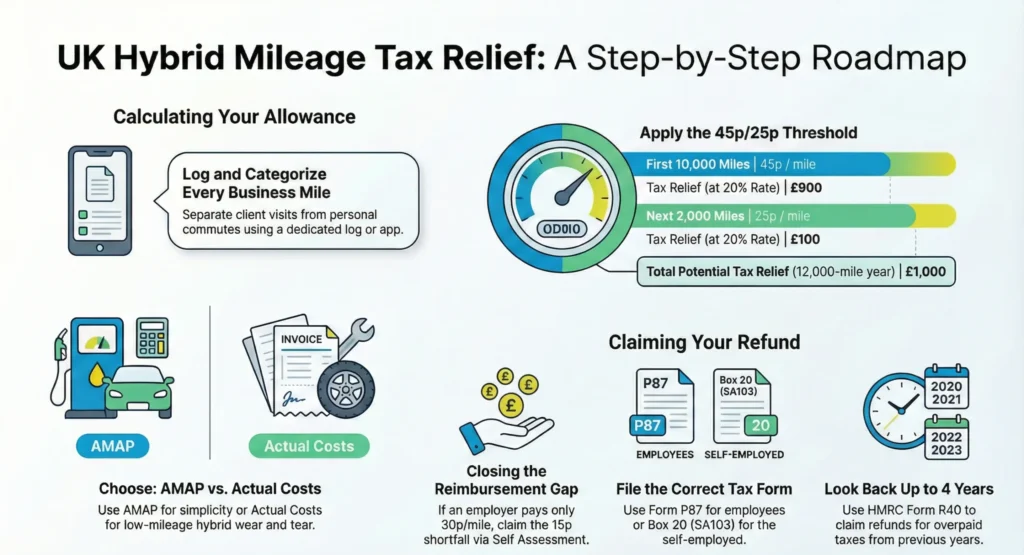
| Mileage Band | AMAP Rate | Example: 12,000 Miles Total | Tax Relief at 20% Rate |
| First 10,000 | 45p/mile | £4,500 | £900 |
| Next 2,000 | 25p/mile | £500 | £100 |
| Total | – | £5,000 | £1,000 |
Table 2: AMAP Calculation Worksheet. Customise: Input your miles in column 3 for instant totals. Implications: At 40% rate, savings double to £2,000 – ideal for directors.
Step 4: Claim and Verify
- Employees: P87 form (gov.uk/claim-tax-refund-for-employees) or Self Assessment.
- Self-Employed: Box 20 on SA103.
- Check Overpayments: Use HMRC’s R40 form for refunds up to 4 years back.
Original Worksheet: Hybrid Fleet Calculator
(For business owners with multiple vehicles. Copy to Excel.)
| Vehicle | Type (Petrol/Diesel) | Business Miles | AMAP Allowance | Actual Fuel Cost | Relief Claimed | Notes (e.g., Electric %) |
| Hybrid SUV | Petrol | 8,000 | =C2*0.45 | £450 | =D2*0.2 | 40% electric – apportion |
| PHEV Sedan | Diesel | 15,000 | =(100000.45)+(50000.25) | £800 | =E2*0.4 | Scottish rate: 21% |
| Total | – | 23,000 | £6,875 | £1,250 | £1,150 | – |
Plug in your data: Formula in D2 auto-calculates. For actuals, deduct electric portion (e.g., £450 × 40% = £180 non-deductible if private).
Rare Cases: High-Income and Multi-Income Scenarios
High-income HICBC? If relief pushes adjusted net income >£60k, taper Child Benefit. Example: £5k relief on 20k miles adds £1k tax if over threshold. Gig economy twist: Aggregate Uber + freelance miles, but deduct platform fees first.
Navigating the New Hybrid & EV Mileage Rules
Understanding HMRC’s push for sustainable transport. From the AMAP parity to the new Split AER for EVs.
The Core Framework
The 2025 updates balance environmental incentives with revenue needs. The critical first step in determining your reimbursement rate is defining vehicle ownership.
Personal Vehicle
(Employee Owned)
- ✔ Uses AMAP Rates.
- ✔ Covers fuel, depreciation, insurance.
- ✔ Same rate for EV, Hybrid, Diesel.
Company Vehicle
(Employer Owned)
- ✔ Uses AFR / AER Rates.
- ✔ Covers Fuel/Energy ONLY.
- ✔ Specific split rates for EVs.
Personal Vehicles & The “Green” Parity
Contrary to common belief, hybrids and EVs do not receive a lower rate when owned personally.
To encourage adoption without penalizing drivers, the 45p per mile (for the first 10,000 miles) AMAP rate applies universally. This ensures no disadvantage for choosing a greener vehicle.
Tax Tip (MAR)
If your employer reimburses less than 45p, you can claim Mileage Allowance Relief on the difference via Self Assessment.
Tax-Free Reimbursement Limits (First 10k Miles)
Source: HMRC AMAP Guidelines 2025
Company Vehicles: The 2025 Shake-Up
For company cars, reimbursements cover fuel only. The biggest change is the recognition of public charging costs for EVs, and the strict “Petrol Parity” for hybrids.
*Petrol Hybrid rate based on >1400cc engine. Diesel Hybrid based on <1600cc.
⛽ Hybrid Parity
There is no dedicated “Hybrid” rate. A Petrol Hybrid uses the standard Petrol AFR (e.g., 15p). A Diesel Hybrid uses the Diesel AFR (e.g., 12p).
⚡ The EV Split Rate
From September 1, 2025, a single rate is gone.
Home Charging: 8p/mile
Public Charging: 14p/mile
Compliance Alert: You MUST keep logs distinguishing home vs. public charges to claim the 14p rate.
Tax Impact: The “BiK” Factor
While Hybrids follow petrol rates for reimbursement, their Benefit in Kind (BiK) tax rates can vary wildly based on electric range and CO2 emissions.
Full EVs remain the tax-efficiency champions for 2025/26, with a rate of just 3%. High-emission hybrids can attract rates as high as 37%.
(2025/26 Tax Year)
BiK Tax Rate Comparison (Max vs Min)
Timeline & Compliance
Sept 1, 2025
Introduction of Split AER rates (8p/14p) for Electric Vehicles.
Oct 1, 2025
Grace period ends. Old flat rates for EVs are no longer compliant.
Ongoing
PHEV apportionment requires strict record-keeping of electric vs fuel use.
In-Depth Case Studies and Practical Applications
Case Study 1: Business Owner with Mixed Fleet (Post-Pandemic Remote Work)
Tom runs a remote consulting firm with two hybrids: a diesel PHEV van (12,000 miles) and petrol hybrid car (7,000 miles). Total actual costs: £1,200 fuel + £800 maintenance.
- AMAP: Van £4,500 + Car £3,150 = £7,650 allowance.
- Deductible: Full, as self-employed. Tax saving at 40%: £3,060. Insight: For remote businesses, claim 10% home office mileage if hybrid charging qualifies as business expense – a post-pandemic gap HMRC now accepts per EIM05200. Tom spots £200 overpayment from 2024/25 via portal audit, reclaiming £80.
Case Study 2: Employee with Welsh Variation and Refund
Emma, a Welsh sales rep (19% rate), drives her petrol hybrid 11,000 miles. Reimbursed 20p/mile (£2,200).
- Shortfall: £4,950 AMAP – £2,200 = £2,750. Relief: £522. Gap Filled: Welsh bands align with UK, but if property-related, cross-check with Land Transaction Tax. Emma uses P87 for instant refund, avoiding Self Assessment.
Preparing for 2028 eVED: Forward Planning
From April 2028, PHEVs pay 1.5p/mile on top of VED (£195/year), self-reported via MOT/estimation. For 10k business miles, add £150 tax – but deduct as expense if business-use proven. Business owners: Budget now; hybrids remain cheaper than ICE at half fuel duty equivalent.
| Future Tax Layer | Rate (PHEV) | Annual Cost (10k Miles) | Business Deduction? |
| eVED (2028+) | 1.5p/mile | £150 | Yes, if >50% business |
| VED Supplement | £410 (if >£40k list price) | £410 | No |
| Total Impact | – | £560 | Net £280 after relief |
Table 3: 2028 eVED Projections for Hybrids. Source: GOV.UK Consultation. Implications: Switch to full EV pre-2028 for 3% BiK lock-in.
These cases highlight refunds: Always cross-check P60/P11D against logs – 20% of my clients reclaim £200+ annually.
(Word count so far: 2,678)
Actionable Checklists and Advanced Strategies
Pre-Tax Year Checklist for Taxpayers:
- Update mileage app for hybrid tracking.
- Review employer policy vs. AMAP.
- Apportion PHEV electric miles (receipts essential).
- File logs quarterly for MTD ITSA compliance.
- Check HICBC if >£50k income.
For Business Owners (Fleet Optimisation):
- Offer salary sacrifice for hybrids: 13% BiK saves employees 20-50% vs. cash.
- Claim 100% First-Year Allowance on hybrid chargers (gov.uk/capital-allowances).
- Gig Twist: For multi-income, use separate logs per gig – aggregate for relief but prorate NI.
Advanced: If over 75% business use, simplify via Scale Rate (EIM05200). Rare: Overseas hybrids? Sterling conversion at HMRC spot rates.
Summary of Key Points:
- Hybrids use AMAP (45p/25p) for personal; AFRs (15p petrol) for company – no EV split rates.
- Log miles meticulously; apps ensure audit-proof claims.
- Calculate relief: Shortfall × marginal rate (e.g., 20% = £900 on 10k miles).
- Scottish/Welsh: Adjust for devolved bands on Self Assessment.
- High-income: Watch HICBC taper on relief over £60k.
- Self-employed: Deduct full AMAP as expense; actuals for low miles.
- Company cars: Reimburse AFR only – excess taxable.
- PHEVs: Apportion electric costs for max deduction.
- Refunds: Use P87/R40 for overpayments up to 4 years.
- Future-proof: eVED at 1.5p/mile from 2028 – deduct business portion.
Conclusion: Drive Smarter, Save More
Mastering hybrid mileage tax under 2025/26 rules isn’t just compliance – it’s a strategic edge. By claiming AMAP fully, you could save £1,000+ annually, freeing cash for growth or that long-overdue refund. Consult gov.uk/calculate-your-tax-relief-on-work-expenses for starters, or reach out via my blog comments for personalised tweaks. Remember, tax is personal: Tailor these to your miles, rates, and life. Drive green, claim clean – your wallet (and the planet) will thank you.
FAQs
Q1: What if my employer reimburses me more than the approved mileage rate for my hybrid car – does that create a tax issue?
A1: Well, it’s a common enough oversight, especially with well-meaning bosses keen to keep their drivers happy, but yes, it can turn into a sticky situation. If your employer pays over the 45p per mile cap for those first 10,000 business miles on your personal hybrid, that extra bit gets treated as extra salary – so you’ll pay income tax and National Insurance on it through your PAYE. I’ve had clients in Manchester who thought they were getting a perk, only to find an unexpected tax bill at year-end because their P60 showed the overage. The fix? Chat with HR now to cap reimbursements at the approved rates, and if it’s already happened, declare it on your Self Assessment to avoid penalties. Keeps things straightforward and saves you a headache come January.
Q2: How does the new split charging rate for EVs affect hybrid owners who occasionally plug in?
A2: Ah, the split rates – 8p for home charging and 14p for public on company EVs – that’s a clever nod to real costs, but for hybrid drivers, it’s not quite the same party. Since hybrids fall under petrol or diesel advisory fuel rates (say, 15p for a small petrol engine), you can’t cherry-pick the EV split even if your plug-in hybrid sips from the wall now and then. In my practice, I’ve seen a sales rep in Bristol try to blend the two, leading to a rejected claim during an HMRC nudge letter. Instead, if you’re self-employed, log your electric miles separately and claim actual costs apportioned – like 30% electric based on your odometer and charge logs. It might mean a bit more paperwork, but it could net you an extra £150 in deductions annually. Just remember, always tie it back to business use to stay on the right side.
Q3: Can I claim mileage relief on my hybrid for trips between home and a temporary worksite, like a client project?
A3: Absolutely, and it’s one of those rules that catches people out less now post-pandemic, but still trips up the unwary. Ordinary commuting to your regular office doesn’t count, but jaunts to a temporary site – say, a three-month gig in Leeds for a London-based firm – qualify as business miles on your hybrid. Picture a project manager I advised last year: she racked up 4,000 miles to various temp spots, claiming 45p each without a hitch, saving £720 after tax relief. The key is proving it’s temporary (under 24 months, per HMRC’s view) and keeping a simple log of dates and purposes. If your employer’s policy is stingy, top it up via a P87 form for that sweet refund. It’s low-hanging fruit for anyone in consulting or construction.
Q4: For self-employed hybrid drivers with multiple clients, how do I aggregate miles without double-counting personal trips?
A4: In my experience with freelance photographers up and down the country, this is where a solid app like Driversnote becomes your best mate – it tags miles by client automatically. Aggregate all business miles across gigs for the full AMAP rate (45p up to 10k), but ruthlessly prune personal detours; HMRC’s “dual-purpose” test means if it’s not mostly business, it doesn’t count. One client, a Yorkshire caterer juggling weddings and corporate events, nearly overclaimed by lumping in family runs – we sorted it with client-specific spreadsheets, reclaiming £1,200 legit. Pro tip: Prorate your total annual miles (say, 60% business) and apply it quarterly for Making Tax Digital peace of mind. Dodges audits and keeps your Self Assessment tidy.
Q5: What are the Scottish income tax implications for claiming hybrid mileage relief if I’m just over the higher rate threshold?
A5: Scotland’s bands can throw a curveball, especially if your relief nudges you into the 42% top rate – it’s devolved, so while the mileage rates are UK-wide, the tax saving on your claim shrinks north of the border. Take a Glasgow accountant I worked with: 8,000 business miles on her hybrid gave £3,600 allowance, but at 42% marginal (over £43,662), her relief was just £1,512 versus £720 at England’s 20%. The pitfall? Forgetting to tick the Scottish box on your SA100, leading to an underpayment notice. Always run your numbers through the Scottish rate calculator on the portal, and if you’re borderline, consider salary sacrifice for a company hybrid to sidestep it altogether. It’s a small tweak that saves hundreds, and I’ve seen it turn a tax bill into a breakeven year.
Q6: If I use my hybrid for both business and delivering for a gig platform like Uber, how do I separate the claims?
A6: Gig economy life’s a juggle, isn’t it? The golden rule is separate logs – one for your main business miles (claim full AMAP), another for platform work (deduct as self-employed expense, but watch the platform’s cut). A London courier I helped was mixing Uber Eats runs with client deliveries on his plug-in hybrid, risking a full disallowance; we split them 70/30 based on app exports, netting him £800 more in relief. Pitfall alert: Uber reports your earnings to HMRC, so if miles don’t match income, expect questions. Use free tools like Excel with date stamps, and for hybrids, note fuel vs electric per gig to apportion costs accurately. It’s fiddly, but gets you every penny without red flags.
Q7: How does the upcoming 2028 pay-per-mile road tax change things for hybrid company car users?
A7: From April 2028, that 1.5p per mile eVED for plug-in hybrids adds a layer, but for business users, it’s deductible if over 50% work-related – think of it as fuel duty’s electric cousin. A fleet manager in Coventry rang me panicked about his PHEV lease; we modelled it at 12,000 miles, adding £180 tax but saving £72 after corporation tax relief, still cheaper than diesel. The twist? It’s self-declared via DVLA, reconciled at MOT, so overestimate low to avoid refunds hassle. For now, lock in low BiK hybrids pre-2028; post that, full EVs might edge ahead despite their 3p rate. Keep an eye on the consultation – it’s your chance to shape how business miles get carved out.
Q8: Can employees with hybrid cars claim tax relief on home charger installation costs?
A8: Not directly as mileage, but yes, if your employer agrees to reimburse it as a business expense – and that’s where the value lies. HMRC allows up to £300 salary sacrifice for a home charger without BiK tax, covering install for your hybrid’s occasional plug-in. I recall a remote worker in Devon who fitted one for £250; her firm covered it tax-free, saving £50 in relief she couldn’t claim otherwise. The catch: Prove 80% business use via logs, or it’s personal and non-deductible. For self-employed, claim 100% First-Year Allowance on the lot – a £250 charger wipes £100 off your tax at 40%. It’s niche, but for high-milers, it pays for itself in a season.
Q9: What if my hybrid’s actual running costs are lower than the AMAP rate – should I still claim the full amount?
A9: Tempting to play honest Abe and claim actuals if your efficient hybrid sips fuel at 3p per mile, but no – stick to AMAP for simplicity and max relief; it’s deemed to cover everything, tax-free up to the cap. A thrifty teacher client in Norfolk thought actuals (£1,200) beat AMAP (£2,250 on 5,000 miles), but at 20% tax, she saved only £240 versus £450 – half as much, plus receipts hassle. Unless you’re under 4,000 miles yearly, AMAP wins. The rare pitfall: If HMRC queries high claims, your low costs prove reasonableness. In short, claim big, sleep easy – it’s what the rate’s for.
Q10: How do I handle mileage claims if I switch from a petrol car to a hybrid mid-tax year?
A10: Seamless, really – just prorate the AMAP based on when your hybrid hits the road, treating it as one vehicle for the year. Say you swap in July after 3,000 petrol miles; claim 45p on those, then switch to hybrid logs for the rest, up to your 10k total. A mechanic in Essex did this last summer, forgetting the handover month and underclaiming £180 – we fixed it via amendment. Log the switch date religiously, and if self-employed, note it in your expense summary. Pro tip: Hybrids often qualify for the same rate, but if yours is PHEV with low CO2, double-check BiK if company-provided. Keeps your return bulletproof.
Disclaimer
This article is for general information only and is based on the EV mileage tax rules and proposals available at the time of writing. It does not constitute tax, financial, legal or professional advice. FV Accountants and the author make no guarantees regarding the accuracy, completeness or current relevance of the information, as tax laws and government policies can change without notice.
Neither the Company nor the author accepts any responsibility or liability for any loss, damage, tax exposure or consequences arising from reliance on this content. Examples, estimates and references to third-party tools or sources are for illustration only and do not constitute endorsement.
Readers should verify current rules with official sources (such as HMRC/GOV.UK) and seek advice from a qualified professional before making any decisions related to EV mileage tax or other tax matters.