
Understanding Class 1A NIC in the UK: Your Essential Guide to Employer Contributions on Benefits in Kind and More
Picture this: You’re an employer or business owner staring at your payroll figures and wondering how this mysterious “Class 1A NIC” charge fits into the picture. Or perhaps you’re an employee curious about how the benefits you receive at work might affect your employer’s National Insurance bills — and, indirectly, the company’s finances. Whatever your situation, cracking the code on Class 1A National Insurance Contributions (NICs) is crucial to avoid costly surprises in your tax return or payroll.
Let’s start with a clear and straightforward answer: Class 1A NIC is a type of National Insurance that employers pay on certain taxable benefits they provide to their employees and on some types of termination payments. In 2025/26, the rate for Class 1A NIC has increased to 15%, marking a significant jump from previous years. It’s important to get a handle on this because it affects your payroll costs if you provide benefits in kind — like company cars, private medical insurance, or other perks — and it’s a vital piece of the broader income tax and NIC puzzle for both employers and employees.
2025/26 Key Stats and Figures
| Item | Value (2025/26) | Notes |
| Class 1A NIC Rate | 15% | On taxable benefits in kind and certain termination payments |
| Employer NIC threshold | £175 per week | Below this, no employer NIC is due on earnings |
| Personal Allowance (income tax) | £12,570 | Most taxpayers’ income tax allowance remains frozen |
| Basic income tax rate | 20% | Applies up to £50,270 (England, Wales, NI) |
| Higher income tax rate | 40% | Applies between £50,271 and £125,140 |
According to HMRC’s latest employer guidance for 2025/26 , employers must pay Class 1A NICs on the value of taxable benefits shown on form P11D for each employee. These contributions are separate from Class 1 employer NICs that apply on wages and salaries. Importantly, Class 1A NICs are often overlooked by new employers, but they can lead to unexpected bills if benefits are not properly accounted for.
What Exactly Are Class 1A NICs?
Class 1A NICs are employer-only contributions charged at 15% on the taxable value of employee benefits in kind (BIKs). These benefit items might include:
- Company cars and fuel
- Private medical insurance
- Accommodation
- Interest-free or low-interest loans
- Certain types of termination payments exceeding £30,000
The cost is borne entirely by the employer and isn’t deducted from the employee’s wages. However, these benefits must be reported to HMRC via form P11D, ensuring transparency and correct payment of NICs.
None of us loves tax surprises, but here’s a useful rule of thumb: If you’re giving employees anything beyond plain salary, chances are Class 1A NIC will come into play.
How Is Class 1A NIC Calculated?
The calculation for Class 1A NIC is straightforward but requires careful record-keeping.
Step 1: Add together the total taxable value of all benefits in kind provided to an individual employee in the tax year. For example, if an employee has a company car with a taxable benefit of £6,000 and private health insurance worth £1,200, the total is £7,200.
Step 2: Multiply the total taxable benefit by the Class 1A NIC rate, currently 15%.
Class 1A NIC=Total taxable benefits×15%
Class 1A NIC=Total taxable benefits×15%
For the above example:
7,200×0.15=£1,080
7,200×0.15=£1,080
Step 3: Summarise this across all employees and submit the total Class 1A NIC due to HMRC by the deadline (usually 22nd July via your PAYE system).
Many employers use payroll software that automates these calculations once the P11D values are submitted, but if you’re handling payroll manually or for a small business, keeping a spreadsheet with these calculations is essential.
Why Does Class 1A NIC Matter to You?
If you’re an employer, Class 1A NIC forms a vital part of your payroll liability that goes beyond just salary or wages. Overlooking these charges can result in unplanned cash flow issues. From my years advising clients in London, several small business owners have told me they were caught out by the 15% jump this year, which suddenly increased their NIC bills by hundreds or thousands of pounds.
For employees, while Class 1A NICs are not directly deducted from your pay, the taxable value of your benefits influences the overall tax you pay through your tax code and self-assessment. Understanding this helps you spot errors on your P60 or tax return, especially if your employer hasn’t properly reported benefits.
Class 1A NIC vs Other National Insurance Classes
It’s helpful to put Class 1A NIC in the context of the wider National Insurance system:
| NIC Class | Who Pays | What It’s On | Rate 2025/26 | Notes |
| Class 1 (Employee) | Employee | Earnings on PAYE up to £50,270 | 12% up to upper threshold; 2% above | Deducted from salary via PAYE |
| Class 1 (Employer) | Employer | Earnings on PAYE above £175/week | 13.8% | Employers pay on wages, not benefits |
| Class 1A (Employer) | Employer | Benefits in kind | 15% | Paid on taxable benefits, not on wages |
| Class 2 (Self-Employed) | Self-employed | Profits over £12,570 | Flat weekly rate | Paid via self-assessment |
| Class 4 (Self-Employed) | Self-employed | Profits over £12,570 | 9% on profits up to £50,270 | Additional 2% on profits above £50,270 |
Be careful here, because I’ve seen clients trip up when confusing employer-class NICs and employee deductions, especially freelancers incorporating their own company — each NIC class plays a different role and has unique obligations.
Practical Example: Class 1A NIC in Action
Take Sarah, a business owner in Manchester, who provides a company car to her marketing manager, James. The car’s taxable benefit value is £6,000 for the year. Sarah wasn’t aware that this benefit would cost an additional 15% NIC on top of James’s salary.
Calculating:
6,000×15%=£900
6,000×15%=£900
Sarah must pay HMRC £900 as Class 1A NIC by 22 July following the tax year, on top of the employer NI she already pays on James’s wages. She learned this after a payroll review revealed an outstanding NIC bill, a small but significant expense that could have been avoided by early planning.
Why the Rate Rise to 15%?
The increase from 13.8% to 15% stems from government changes aiming to increase tax revenues post-pandemic and deal with inflationary pressures on public services funding. This hike means employers must budget carefully to account for increased NIC charges on employee benefits.
Remember, this rate increase applies only to Class 1A NIC, not to employee contributions or Class 1 employer NIC on earnings — which remain stable at 13.8% above the threshold.
Step-by-Step Summary: Calculating Your Class 1A NIC Liability
- Gather all employee benefits in kind – from company cars to private healthcare.
- Determine the taxable value of each benefit – check HMRC’s approved valuation methods or P11D guidance.
- Total the taxable benefits per employee for the tax year.
- Multiply the total by 15% to get Class 1A NIC due.
- Submit P11D forms to HMRC by 6 July after the tax year ends.
- Pay your Class 1A NIC bill by 22 July via your PAYE system or direct payment.
Not sure if you’re reporting your benefits correctly? Using HMRC’s online services, like your
personal tax account , can help spot errors early.
Cracking the Code on Class 1A NIC
Your essential guide to employer contributions on Benefits in Kind for the 2025/26 UK tax year.
The 2025/26 Landscape
The tax year 2025/26 brings significant changes to payroll obligations. The most critical shift is the jump in employer National Insurance rates, directly impacting how businesses must budget for employee perks. Understanding these core metrics is the first step to avoiding costly surprises.
Class 1A NIC Rate
Paid by employers on the taxable value of Benefits in Kind.
Weekly Threshold
The new drastically reduced threshold (£5,000/year) for standard employer NICs.
Personal Allowance
The frozen base income tax allowance for most taxpayers (£12,570).
What Triggers Class 1A NIC?
Class 1A NICs are strictly an employer liability. They are triggered whenever a business provides “Benefits in Kind” (BIKs)—perks given to employees that go beyond their standard salary. Below are the most common culprits that must be reported on form P11D.
Company Cars
Vehicles & fuel provided
Medical Cover
Private health insurance
Accommodation
Living space provided
Beneficial Loans
Interest-free or low-rate
Comparing the NIC Classes
National Insurance is not a monolithic tax; it is divided into various classes depending on employment status and what is being taxed. The recent Autumn Budget standardized the main employer rates to 15%, but distinguishing between who pays what is crucial for accurate payroll.
The Visualization Explained: This bar chart highlights the discrepancy between employee deductions and employer liabilities. Notice how Employer Class 1 (on wages) and Employer Class 1A (on benefits) now share the heavy 15% burden, vastly outpacing the reduced employee and self-employed rates.
Class 1A in Action
Theory is good, but real-world application reveals the true financial impact. The formula is straightforward: Total Taxable Benefits × 15% = Class 1A NIC Due.
Case Study: Sarah’s Marketing Manager
Sarah provides her manager, James, with a company car. The car has a calculated taxable benefit value of £6,000 for the year.
This £900 is an extra cost borne entirely by Sarah’s business, payable directly to HMRC.
The Visualization Explained: The donut chart visualizes the financial relationship between the value of the benefit provided to the employee and the resulting tax liability generated for the employer. For every £100 of benefit value, the employer must find an additional £15.
Your Compliance Timeline
Avoiding fines means adhering strictly to HMRC’s deadlines. Here is the step-by-step process employers must follow to calculate, report, and pay their Class 1A liabilities.
Step 1: Gather Data
Compile a complete list of all employee benefits in kind provided during the tax year (e.g., company cars, private healthcare).
Step 2: Determine Taxable Value
Calculate the precise taxable value of each benefit using HMRC’s approved valuation methods or P11D guidance.
Step 3: The Calculation
Total the taxable benefits per employee, then multiply the grand total by the 15% rate to find your Class 1A NIC due.
Step 4: Submission Deadline (July 6)
Submit all necessary P11D forms and the P11D(b) summary to HMRC by July 6th following the end of the tax year.
Step 5: Payment Deadline (July 22)
Pay your total Class 1A NIC bill to HMRC by July 22nd if paying electronically (or July 19th if paying by post).
UK Tax Code Check and Income Tax Calculation: Navigating Class 1A NIC with Confidence
Now, let’s think about your situation – whether you’re an employee, a self-employed individual, or a business owner – verifying your tax code and income tax liability is critical in making sure Class 1A NIC (and all your National Insurance contributions) are correctly calculated and paid. This can be a tricky business, especially if you have multiple income sources, receive benefits in kind, or operate in Scotland or Wales where tax rates vary.
In my years advising clients through the twists and turns of payroll and tax, I’ve noticed that many people completely overlook checking whether their tax codes properly reflect those benefits or if their employer is accurately reporting Class 1A NIC. It’s often the difference between getting a tax refund or facing an unexpected bill. Here’s how you can take control.
How Your Tax Code Affects Your Income Tax and NIC Liability
Think of your tax code like a postcode for your income — it tells HMRC how much tax to deduct through PAYE. It’s based mainly on your personal allowance and any adjustments, like unpaid tax from previous years or taxable benefits such as those triggering Class 1A NIC for your employer.
For 2025/26, the standard personal allowance is £12,570, frozen for the fifth consecutive year to control public expenditure. This means you don’t pay income tax on earnings up to this amount.
If you get benefits like a company car, your employer normally absorbs the Class 1A NIC charge, but the taxable value of those benefits is added to your earnings to determine your income tax liability. This can push you into a higher tax bracket or affect your tax code. So, spotting discrepancies early helps avoid underpayment or overpayment of taxes.
Step-by-Step Guide: Checking Your Tax Code and Benefits Impact
- Log into your personal tax account at
- gov.uk/check-income-tax-current-year
- . It’s the best place to start verifying your tax code and income.
- Look for adjustments reflecting taxable benefits: Your tax code should include a ‘BR’, ‘D0’, or codes with a ‘K’ suffix if benefits or other income adjustments apply.
- Cross-reference with your P11D and payslip: Ensure that your employer has reported all taxable benefits to HMRC using form P11D, which should align with your tax code.
- Calculate the taxable value of benefits and add to earnings: Use this to estimate where your total income stands against personal allowances and tax bands.
- Use HMRC’s online tax calculator or manually work out tax based on the bands to confirm if your tax code is accurate.
Here’s a simple table showing the 2025/26 income tax bands for England, Wales, and Northern Ireland:
| Income Band | Tax Rate | Income Range (2025/26) |
| Personal Allowance | 0% | £0 – £12,570 |
| Basic Rate | 20% | £12,571 – £50,270 |
| Higher Rate | 40% | £50,271 – £125,140 |
| Additional Rate | 45% | Over £125,140 |
Scotland has a different set of income tax rates and bands that can affect your tax code and calculations if you live there. For example, the Scottish higher rate kicks in at £43,663 with different rates on various income levels.
Calculating Income Tax with Benefits in Kind — A Hypothetical Case
Take Jack, a Scottish-based freelancer, who provides himself with a company laptop and gets a private health plan through his limited company. The taxable value of these benefits is £3,000 for the tax year. Jack’s total reportable income (freelance earnings plus benefits) is £52,000.
- His personal allowance is £12,570.
- His total taxable income becomes £55,000 (£52,000 + £3,000).
- However, because of Scotland’s progressive rates, his tax liability differs from someone in England with the same income.
Jack needs to carefully check that these benefits are reflected in his tax code and self-assessment to avoid underpayment or triggering penalties.
Spotting Common Errors with Class 1A NIC and Income Tax
Be careful here, because I’ve seen clients trip up when:
- Benefits aren’t reported properly: Employers sometimes miss filing P11D forms, leading to incorrect tax codes.
- Multiple jobs or income streams confuse tax calculations: If you have more than one employer or a self-employed side hustle, your tax can be over or underpaid if not coordinated correctly.
- Emergency tax codes are wrongly applied: Temporary codes can cause excessive tax deductions, which only get corrected at year-end or after a claim.
- High-Income Child Benefit Charge (HICBC) interactions: When your adjusted net income exceeds £50,000, benefits and tax payments interplay differently, often requiring self-assessment.
Practical Tool: Your Tax and NIC Check Worksheet
Here’s a simple worksheet you can copy and tailor to your situation:
| Detail | Amount (£) | Notes/Calculations |
| Employment earnings | Gross annual salary | |
| Other taxable income | Freelance, rental, etc. | |
| Taxable benefits (P11D values) | Company cars, health plans | |
| Total income | Sum of above | |
| Personal allowance | 12,570 | 2025/26 frozen rate |
| Taxable income | Total income – personal allowance | |
| Estimate tax due | Apply tax bands (use table above) | |
| NIC contributions (employee) | Typically 12% up to earnings threshold | |
| NIC contributions (employer on wages) | 13.8%, wages over £175/week | |
| NIC Class 1A (on benefits) | 15% * taxable benefits |
Filling this out annually or upon job changes can empower you to spot issues early. Honestly, I’d double-check this if you’re self-employed – it’s one of the most overlooked areas.
How This Impacts Business Owners
If you run a business and provide benefits, you’re responsible for:
- Correctly calculating and paying Class 1A NIC by the 22 July deadline following the tax year.
- Ensuring that benefits values are accurate and reported by 6 July to HMRC via P11D forms.
- Accounting for these costs when forecasting payroll expenses, especially considering the increased 15% NIC rate.
For business owners with fluctuating staff numbers, seasonal workers, or employees based in Scotland or Wales, tracking this can become complex rapidly. Payroll software that integrates HMRC updates is invaluable here. But even with software, regular manual checks and reconciliations are essential.
Case Study: Freelancer Hit by IR35 Changes
Tom, a London-based IT contractor, recently faced IR35 legislative changes affecting his tax liabilities. Switching from a personal service company to umbrella employment meant his benefits (like travel expenses and mobile phone allowances) got taxed differently. Tom’s employer started applying Class 1A NIC on benefits he previously didn’t have to worry about, leading to a surprise NIC bill.
This scenario highlights why self-employed individuals transitioning into employment or umbrella contracts must reassess their tax and NIC status carefully. It also shows the ripple effect benefits and NICs have on income tax calculations.
Class 1A National Insurance Contributions
| Tax Year | Rate (%) | Note |
|---|
| Tax Year | Receipts (£bn) | Note |
|---|
2024/25 — Class 1A NIC at 13.8%
| P11D Value (£) | Class 1A NIC (£) | Rate Applied |
|---|
Who Pays?
Employers only — employees bear no Class 1A charge. Applies where a taxable benefit in kind is provided to an employee or director.
Trigger Event
Any benefit subject to income tax under ITEPA 2003 that is not already subject to Class 1 NIC (e.g. cash earnings). Classic example: company car, medical insurance, non-cash vouchers exceeding exemption.
Calculation Basis
Rate × P11D value (or cash equivalent) of the benefit for the tax year. Company car: CO₂-linked percentage × list price.
Payment Deadline
Due 22 July following the tax year end (19 July for cheque). Reported via P11D(b) employer return.
Exemptions
Benefits with a statutory exemption (trivial benefits ≤£50, certain pension contributions, qualifying childcare) are excluded from the Class 1A base.
PAYE Settlement Agreements
Employers may use a PSA to settle both income tax and Class 1B NIC (not Class 1A) on minor or irregular benefits, simplifying administration.
Rate: 13.8% — Baseline Year
Rate unchanged. COVID-19 furlough scheme (CJRS) reduces BiK exposure for furloughed staff. HMRC deferred P11D(b) deadlines to help employers.
Rate: 13.8% — Post-COVID Stabilisation
Rate held at 13.8%. Return to office began lifting BiK volumes. HMRC confirmed P11D online-only filing rules phased in. Electric vehicle adoption increases Class 1A receipts profile shift.
Rate: 14.53% — Health & Social Care Levy Surcharge
Health and Social Care Levy Act 2021 added a temporary 1.25 percentage point surcharge to all NIC rates from 6 April 2022, raising Class 1A to 14.53%. The levy was reversed from 6 November 2022, but P11D benefits span the full tax year so the blended rate for 2022/23 was 14.53% for the whole year per HMRC guidance (the levy applied to the full annual P11D value for that year).
Rate: 13.8% — Levy Reversed
Health & Social Care Levy fully repealed by the Health and Social Care Levy (Repeal) Act 2022. Class 1A rate returned to 13.8% from 2023/24. P11D online-only filing became mandatory for most employers from April 2023.
Rate: 13.8% — Payrolling BiK Transitional Period
Rate held at 13.8%. HMRC announced mandatory payrolling of Benefits in Kind (replacing P11D forms) will be required from April 2026. 2024/25 is the last full tax year before that change. Employers encouraged to voluntarily payroll BiK from April 2024.
Verifying and Managing PAYE in 2025/26: Your Practical Step-by-Step Guide
Navigating PAYE (Pay As You Earn) verification and compliance in 2025/26 is more streamlined than ever, thanks to technological updates and new government services. As a UK taxpayer or business owner, understanding how to verify your PAYE interactions ensures proper compliance, accurate tax payments, and avoids costly penalties or overpayment scenarios.
Based on recent updates, let’s delve into what you need to do for effective PAYE verification and management this tax year.
The New Digital PAYE and Real-Time HICBC Payment System in 2025
In autumn 2025, HMRC launched a significant digital upgrade for PAYE and certain tax liabilities, including the high-income child benefit charge (HICBC). Previously, HMRC collected HICBC payments retrospectively, after the end of the tax year, which often led to surprises for taxpayers. Now, with real-time PAYE reporting, eligible taxpayers can pay HICBC charges directly through their PAYE code in the same year they arise, making the process more efficient and transparent.
Key points to note:
- The new service is primarily for employed taxpayers who have no other reasons for self-assessment.
- To qualify, you must deregister from self-assessment if you’re solely liable for HICBC.
- You must register before 31 January 2026 for the 2024/25 tax year to benefit from this system.
- For the 2025/26 tax year and future years, the aim is to collect HICBC in the year it relates to, simplifying cash flow management.
This upgrade reduces the retrospective burden and aligns tax payments more closely with actual income and benefits received.
Registering for PAYE: Key Practical Steps
If you’re a new employer or business considering PAYE registration, the process has been simplified but still requires diligent preparation.
How to register:
- Visit
- Register for PAYE
- – it typically takes 7-10 working days for HMRC to process.
- Be prepared to provide details such as business type, expected employee count, and your National Insurance number.
- Register before your first payday to ensure proper tax and NIC deductions.
Managing PAYE after registration:
- Use HMRC-approved payroll software to accurately deduct income tax, NICs, and report to HMRC.
- Submit full payments and payroll reports in real-time or by scheduled intervals (weekly or monthly).
- Update employee records, tax codes, and benefits carefully to maintain compliance.
Ensuring Accurate PAYE and NIC Reporting for Employees and Directors
Knowing precisely whether you are correctly reporting your PAYE and NIC obligations is essential for avoiding penalties. HMRC’s detailed guidance and online tools can help.
How to check:
- Log into your
- personal tax account
- . Here, you’ll see your current tax code, PAYE coding notices, and any adjustments needed.
- Confirm that your income, benefits, and taxable pay are correctly recorded. Watch for anomalies such as:
- Tax codes starting with ‘BR’ or ‘D0,’ indicating non-cumulative calculations possibly leading to over- or under-taxation.
- ‘K’ codes indicating adjustments for benefits or unpaid tax adjustments.
If discrepancies appear:
- Contact your employer payroll department or HR department to clarify.
- Use HMRC’s employment status tools if there’s confusion whether you or your employees are correctly classified under PAYE or self-employment.
Handling the High-Income Child Benefit Charge (HICBC) in Real Time
A significant change in 2025 is the ability for PAYE taxpayers with high incomes to settle HICBC via payroll. Previously, this charge was paid through self-assessment, often causing confusion.
What you need to do:
- If your adjusted net income exceeds £50,000, monitor how HICBC impacts your overall tax liability.
- Register for the new real-time HICBC pay-through system if you’re employed and eligible.
- Check your PAYE coding notice for any adjustments related to HICBC, which HMRC will now incorporate throughout the year.
Reflective tip:
If you suspect an error in your PAYE code regarding HICBC or benefits, consult your payroll provider or tax professional to ensure your code reflects the correct adjustments, preventing over- or underpayment.
Managing Multiple Income Sources and Cross-Border Variations
Many taxpayers juggle multiple jobs or sources of income, including self-employment, rental income, or international earnings. This creates complexity in PAYE verification and NIC obligations.
- Taxpayers with multiple jobs should ensure that each employer’s PAYE system correctly reflects their cumulative income.
- Use tools like HMRC’s online calculators to estimate whether your current tax code captures all benefits and income.
- For Scottish residents, remember the different income tax bands and rates, which can affect how benefits and PAYE codes impact your total tax bill.
Common Pitfalls and How to Avoid Them
- Delayed reporting or misreporting of benefits: Ensure your employer files P11D forms correctly and on time.
- Ignoring updates in tax codes: Regularly review your PAYE notices and online tax account for changes.
- Overlooking benefits or multiple income streams: Use a worksheet to reconcile all income sources – this prevents surprises at year-end.
- Failure to register for the right online services: For HICBC, ensure you register by the deadline to facilitate real-time payments.
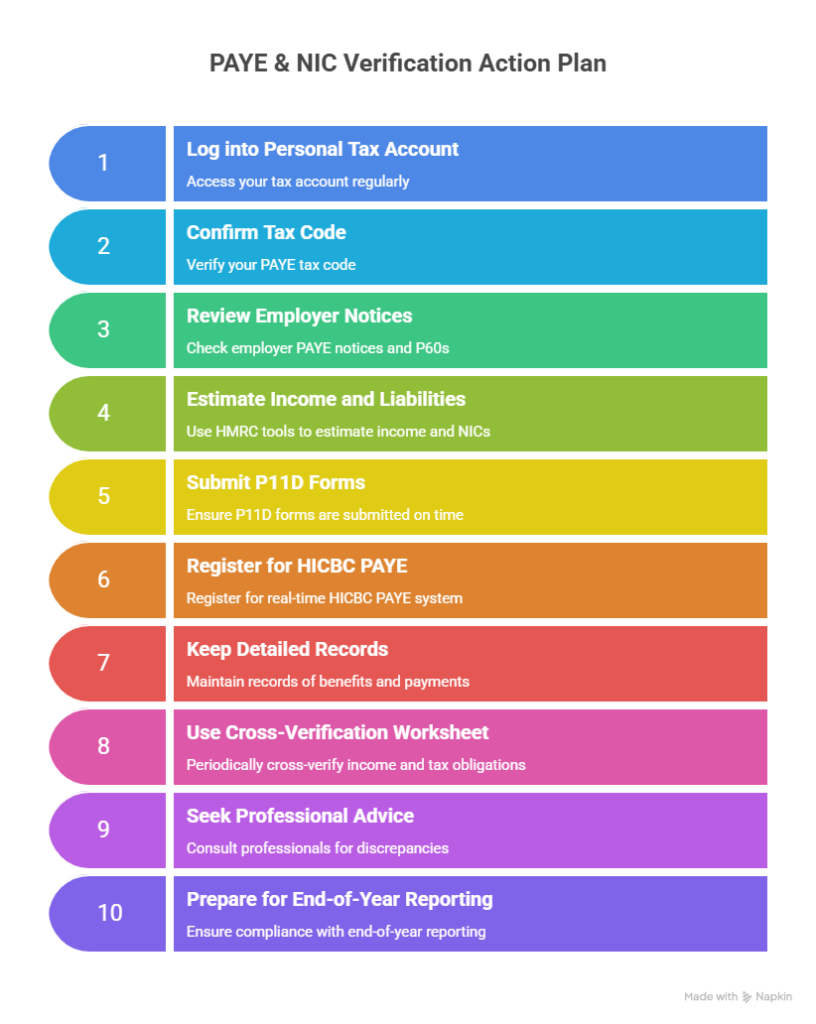
Final Checklist: Your PAYE & NIC Verification Action Plan
- Log into your personal tax account regularly during the year.
- Confirm your PAYE tax code and check for benefit adjustments.
- Review employer PAYE notices and P60s for accuracy.
- Use HMRC’s online tools to estimate total income and NIC liabilities.
- If providing benefits, ensure P11D forms are submitted on time.
- For high earners, register for real-time HICBC PAYE system before deadline.
- Keep detailed records of all benefits, benefits valuations, and payments.
- Use a comprehensive worksheet periodically to cross-verify your income and tax obligations.
- Seek professional advice if discrepancies or complex income streams are involved.
- Prepare for end-of-year reporting and PAYE scheme review to ensure compliance.
FAQs
Q1: Can Class 1A NIC be due on benefits that an employee repays the employer for?
A1: Well, it’s worth noting that if an employee fully reimburses the employer for the benefit, such as paying back the full cost of a company car’s private use, then Class 1A NIC is generally not due on that portion. However, if the reimbursement is partial or not at market value, Class 1A NIC will be due on the difference. In practice, I’ve seen these situations cause confusion, especially with car fuel benefits where employees sometimes forget to repay promptly. Always keep clear records of repayments to avoid unexpected NIC bills.
Q2: What happens if a business owner forgets to submit their P11D forms for benefits in kind?
A2: Forgetting to file P11Ds can lead to penalties and interest on late Class 1A NIC payments. HMRC can impose fixed penalties starting at £100 per 50 employees for late submission, plus daily penalties thereafter. In my years advising businesses, timely submission is a simple step that saves headaches later, so it’s crucial to mark your calendar for the 6th July deadline after the end of the tax year.
Q3: Are there regional variations in Class 1A NIC rates or rules within the UK?
A3: Interestingly, Class 1A NIC is uniformly set at 15% across the UK for the 2025/26 tax year, regardless of whether the employee is in Scotland, Wales, Northern Ireland, or England. This contrasts with income tax bands which vary regionally—so while your income tax might change, the employer’s NIC on benefits remains consistent. Clients with employees across borders find this uniform rate simplifies payroll but must maintain vigilance on region-specific income tax codes.
Q4: Can Class 1A NIC apply to termination payments or redundancy packages?
A4: Yes, it can. Class 1A NIC is payable on taxable termination payments exceeding £30,000. For example, if an employee receives a £40,000 redundancy payout, the Class 1A NIC applies only to the £10,000 above the tax-free threshold. In my experience, this trips up some employers who assume redundancy is entirely NIC-free—which it’s not beyond that limit. Accurate calculation and reporting avoid costly surprises.
Q5: How does Class 1A NIC affect sole traders or self-employed business owners who provide benefits to themselves through their company?
A5: If you’re a sole trader, Class 1A NIC doesn’t apply because you don’t have employees—though you pay Class 2 and Class 4 NICs personally. However, if you operate a limited company and provide yourself with benefits in kind as a director, your company must pay Class 1A NIC on those benefits. This is a common stumbling block for freelancers who switch from sole trader to limited company status, so it’s worth planning NIC costs into your budget from day one.
Q6: What if an employee has multiple jobs with different benefits—how do employers coordinate Class 1A NIC?
A6: Employers calculate Class 1A NIC only on the benefits they provide. There is no cross-employer consolidation of benefits for NIC purposes. So, if an employee has two jobs with separate benefits, each employer calculates Class 1A NIC solely on their respective benefits. I’ve seen employees miss this nuance, mistakenly thinking their total benefits supplier count together; it’s essential employers handle their specific liabilities independently.
Q7: Are expenses reimbursements ever subject to Class 1A NIC?
A7: Generally, if expenses are reimbursed purely for business purposes with correct evidence, Class 1A NIC does not apply. However, if the expenses relate to private use or non-business travel (like personal mileage claims), these may attract Class 1A NIC. In practice, meticulous documentation differentiating business from personal expenses avoids unexpected NIC charges and HMRC queries.
Q8: Can Class 1A NIC be deferred or spread over payments?
A8: Unfortunately, no. Class 1A NIC must be paid in one lump sum by the 22nd of July following the end of the tax year (or the 19th if paying by post). While this puts financial pressure on some employers, spreading payments isn’t an option. In rare cashflow crunches, businesses sometimes negotiate with HMRC for Time to Pay arrangements, but this is at HMRC’s discretion and requires early communication.
Q9: How can a business owner minimise Class 1A NIC liability without cutting employee benefits?
A9: One practical approach is payrolling benefits in kind. From April 2026, payrolling becomes mandatory, allowing employers to spread the NIC and tax on benefits through payroll each month, reducing the lump sum shock. Additionally, structuring benefits as non-taxable or tax-free perks—like pension contributions or certain allowable expenses—can help lower Class 1A NIC exposure without depriving employees.
Q10: Is Class 1A NIC included when calculating tax credits or Universal Credit?
A10: Since Class 1A NIC is an employer liability and not part of employee earnings, it does not directly impact tax credits or Universal Credit calculations. However, the value of taxable benefits on which Class 1A is based does count as income for those purposes, which can affect entitlement. Clients occasionally conflate these two, so it’s important to differentiate employer costs from employee income assessments.
Disclaimer
The information provided in this article is for general guidance only and is not intended to constitute professional advice, tax advice, financial advice, legal advice, or any other form of regulated guidance. Although every effort has been made to ensure accuracy at the time of publication, Fair View Accounting Services, including its director, employees, contractors, writers, and content-creation team, accepts no responsibility for any loss, damage, penalty, or consequence arising from reliance on the information contained herein.
UK tax legislation changes frequently, and HMRC interpretations, thresholds, and rules may vary depending on the individual circumstances of each taxpayer. Nothing in this article should be considered a substitute for obtaining formal, personalised advice from a qualified accountant or tax professional. Readers should not take action—or refrain from taking action—based solely on the content published on this website.
Fair View Accounting Services does not guarantee the completeness, accuracy, or ongoing validity of the information provided and assumes no liability for omissions or errors, whether typographical, factual, or technical. By using this content, the reader acknowledges that all responsibility for decisions remains solely with the user.