

Starting from April 2026, a single day’s delay in submitting your tax return now triggers an immediate £200 penalty, which is a sharp increase designed to enforce stricter compliance. It’s a stressful reality for many directors who find themselves caught between the daily demands of running a business and the complex web of corporation tax deadlines uk. You’re likely already feeling the pressure of distinguishing between payment dates and filing dates whilst trying to keep your records in order.
This guide provides the clarity you need to master these critical timelines and protect your limited company from HMRC’s updated penalty regime. We’ll outline the exact 2026 tax year schedule, explain the vital distinction between Companies House and HMRC obligations, and provide a structured checklist to keep your financial records organised year-round. By the end of this article, you’ll have a clear roadmap to navigate your tax obligations with total peace of mind.
Key Takeaways
- Learn the critical distinction between payment and filing dates to ensure you meet the 9-month and 1-day deadline for settling your tax bill.
- Discover how to implement a structured 12-month preparation cycle to manage your corporation tax deadlines uk with total confidence.
- Understand the updated 2026 penalty structure and the proactive steps you can take to avoid the immediate £200 fine for late submissions.
- Explore how cloud-based tools like Xero and QuickBooks can automate your record-keeping and provide a seamless link between your bookkeeping and tax compliance.
Understanding Corporation Tax Deadlines in the UK for 2026
For most company directors, the phrase tax deadline suggests a single date on a calendar. However, managing corporation tax deadlines uk is actually a dual-stage process. It involves calculating what you owe and paying it, followed by formally reporting those figures to HMRC through a Company Tax Return. This structure ensures that the government receives its revenue promptly, while giving businesses extra time to finalise their detailed accounts. Understanding this rhythm is the first step toward a stress-free compliance cycle in 2026.
Your legal obligation officially begins when HMRC issues a Notice to Deliver a Company Tax Return. This notice isn’t just a friendly reminder; it’s a statutory requirement that triggers your responsibility to file. Even if your business is currently dormant or you’ve experienced a trading loss, you usually still need to submit a return to confirm your status. Ignoring this notice because there’s no tax to pay is a common mistake that leads to unnecessary penalties. Aligning your internal bookkeeping with these 2026 expectations ensures that when the notice arrives, you’re prepared to respond accurately to all corporation tax deadlines uk.
The modern framework of the UK tax system has evolved significantly over decades. Reviewing the history of UK corporation tax reveals how the system has moved toward digital-first compliance and stricter enforcement. Today, this translates into a need for precise, real-time data rather than end-of-year guesswork. By maintaining digital records throughout the year, you transform a potentially stressful administrative task into a routine part of your business operations.
The Role of the Accounting Period
Your accounting period for Corporation Tax is usually 12 months long. In most cases, it aligns perfectly with your company’s financial year. However, exceptions do exist. If you’ve just started trading, your first period might be longer or shorter than a year. If it’s longer than 12 months, you’ll actually need to file two separate tax returns to cover the gap. Keeping these dates synchronised simplifies your administrative burden and prevents confusion during the filing window. We recommend checking your current accounting dates on the HMRC portal to ensure your internal records match their records exactly.
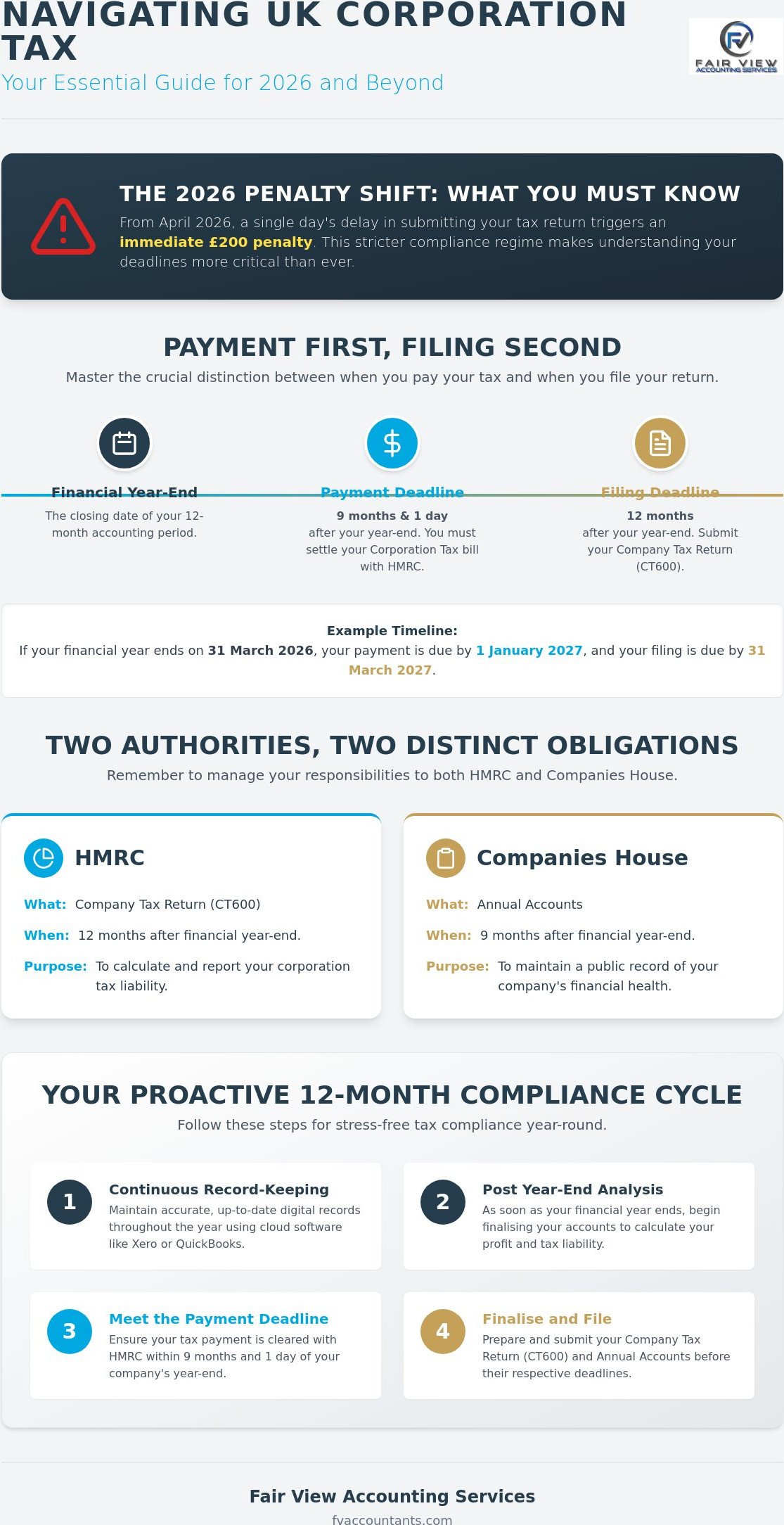
HMRC vs Companies House: Distinct Obligations
The Critical Distinction Between Payment and Filing Deadlines
Most directors naturally assume that their tax bill is due at the same time they submit their final accounts. This is a common misconception that can lead to significant financial strain. In the UK, the system follows a “Payment First, Filing Second” rule. This means you’re legally required to settle your debt with HMRC before you’re required to submit the formal CT600 return. It’s a sequence that catches many new business owners by surprise, but mastering it is essential for maintaining a healthy relationship with the tax office.
According to official government guidance, the payment deadline for most companies is 9 months and 1 day after the end of the accounting period. In contrast, the deadline for filing your return is 12 months after that same period ends. This three-month gap is a critical window. It requires you to have a precise understanding of your profits well before the final paperwork is due. Managing your corporation tax deadlines uk effectively means working backwards from these dates to ensure your bookkeeping is always current. If you need help staying ahead, our team can help you organise your tax affairs through modern digital tools.
Calculating Your 9 Months and 1 Day Deadline
Let’s look at a practical example to clarify this timeline. If your company’s financial year ends on 31st March, your payment is due by 1st January the following year. You must make this payment even if you haven’t yet filed your Company Tax Return. Waiting until the 12-month mark to look at your figures is a high-risk strategy. It often leads to cash flow shocks when a large, unexpected bill arrives. Estimating your tax liability throughout the year allows you to set aside funds incrementally. This proactive approach ensures you’re never caught off guard by a sudden demand for capital.
The 12-Month Filing Window
While you technically have 12 months to file your return, doing so earlier is always best practice. Filing early provides a clearer picture for your long-term Corporation Tax planning. It gives your accountant the necessary time to meticulously review your statutory accounts and identify any potential reliefs you might have missed. Early filing also simplifies your administrative life, as it allows you to tick off your compliance tasks well before the rush of the next financial year begins. Remember that your accountant needs a reasonable window to organise and review your records, so aim to provide your data as soon as your year-end passes.
A Comprehensive Corporation Tax Compliance Checklist
Knowing the specific dates for corporation tax deadlines uk is only the first step in a successful compliance strategy. The real challenge lies in the quality of your preparation. Without a structured approach to your data, you risk overpaying your tax or triggering an HMRC enquiry due to avoidable errors. We recommend treating your tax preparation as a continuous cycle rather than a once-a-year hurdle. This methodical approach ensures your records are always ready for review, providing you with a clear view of your company’s financial health at any given moment.
To ensure you meet all Corporation Tax return deadlines with ease, follow this essential preparation checklist:
- Gather all financial records: Collate every sales invoice, expense receipt, and bank statement for the period. Having these in one place prevents last-minute scrambles.
- Reconcile bank accounts: Use cloud software like Xero or QuickBooks to match every transaction. A reconciled bank account is the foundation of an accurate tax return.
- Review capital expenditure: Identify any equipment or machinery purchases that may qualify for Capital Allowances. These can significantly reduce your taxable profit.
- Adjust for non-deductible expenses: HMRC doesn’t allow deductions for everything. You must identify items like client entertainment and add them back to your profit figures.
- Verify your Notice to Deliver: Confirm you’ve received this from HMRC and check that the accounting dates listed match your internal records exactly.
Monthly Bookkeeping Habits
The most successful businesses don’t wait until the end of the year to organise their finances. We suggest using digital tools like Dext to capture receipts the moment they’re generated. This habit ensures no deductible expenses are missed. Monthly bank reconciliations are equally vital; they keep your ongoing tax estimate accurate and prevent cash flow surprises. Finally, always cross-reference your payroll and VAT records. Ensuring these figures align with your broader bookkeeping throughout the year makes the final corporation tax calculation much simpler and more reliable.
Year-End Review Steps
Before you commit to a submission, a final review of your Annual Accounts is essential. This is the time to ensure all director loans and dividends taken during the period are correctly documented. These figures have direct tax implications and must be handled with precision. You should also verify that your final CT600 return accurately reflects the profit or loss shown in your accounts. Taking these final steps provides the security of knowing your 2026 compliance is handled professionally and accurately.
Mitigating Risks: Penalties and Late Submission Consequences
Falling behind on corporation tax deadlines uk isn’t just a minor administrative slip. It’s an expensive mistake that can drain your company’s resources and damage your professional standing. HMRC has significantly tightened its enforcement for the 2026 tax year, making punctuality more critical than ever. Filing your return even one day late now triggers an automatic £200 penalty. This is a sharp increase from previous years, designed to ensure directors take their filing obligations seriously from the very first day.
The penalty structure escalates quickly if you don’t take corrective action. If your return is three months late, HMRC adds another £200 fine to your account. Once you reach the six-month mark, the consequences shift from flat fees to percentage-based charges. At this stage, HMRC will estimate your tax liability and add a penalty equal to 10% of the unpaid tax. If the delay reaches 12 months, you’ll be charged a further 10% on any tax that remains outstanding. These costs are entirely avoidable with the right systems in place. If you’re worried about these penalties, you can speak to our team today to secure your business’s future.
Financial penalties are only one part of the risk. HMRC also charges interest on late payments, currently set at the Bank of England base rate plus 4%. As of early 2026, this late payment interest rate stands at 7.75%. Beyond the direct costs, consistent lateness flags your company for increased scrutiny. It may lead to more frequent audits or detailed enquiries into your wider financial affairs, which can be both time-consuming and stressful for any business owner.
The Cost of Repeated Delays
HMRC is particularly strict with businesses that show a pattern of non-compliance. If you file late three times in a row, the initial £200 penalties jump to £1,000 each. You can attempt to appeal a penalty if you have a “Reasonable Excuse,” such as a serious illness or a death in the family. However, HMRC rarely grants these appeals for administrative errors, computer failures, or simply being too busy. Investing in professional accounting services acts as a reliable safeguard against these avoidable costs and provides the oversight needed to keep your record clean.
Managing Cash Flow for Tax Payments
The best way to handle your tax bill is to prepare for it every month. We recommend setting aside a fixed percentage of your revenue into a dedicated savings account. Modern cloud accounting software makes this simple by providing a real-time “Tax Pot” estimate based on your current bookkeeping. This proactive approach ensures that when the payment deadline arrives, the funds are already available. Effective tax planning throughout the year doesn’t just manage your cash flow; it allows you to identify legitimate ways to reduce the final amount you owe.
Streamlining Your Tax Affairs with Cloud-Based Accounting Services
Managing your corporation tax deadlines uk doesn’t have to be a manual, high-stakes race against the clock. At Fair View Accounting Services, we leverage the power of Xero and QuickBooks to transform your tax compliance from a source of anxiety into a streamlined, automated process. By integrating your daily transactions with these cloud-based platforms, we create a real-time financial environment where deadlines are tracked automatically. This modern approach eliminates the guesswork and ensures that you’re always looking at the most accurate version of your company’s financial health.
The transition from fragmented, messy spreadsheets to modern, MTD-compliant digital records is a vital step for any ambitious SME. Spreadsheets are prone to human error and often fail to provide the bird’s-eye view required for effective tax planning. Our remote, online support provides UK-wide business owners with a sophisticated accounting department without the need for an in-house team. We act as your methodical partner, receiving and handling the HMRC “Notice to Deliver” on your behalf. This ensures that your legal obligations are met with precision, leaving you free to focus on growth and operations.
Modern Efficiency for SMEs and Start-ups
Digital integration significantly reduces the time spent on manual data entry, which is often where the most costly errors occur. We provide a proactive service where we monitor your deadlines year-round, not just when the filing window opens. This constant oversight is particularly beneficial for e-commerce sellers and tradespeople who often deal with high volumes of transactions or complex project costs. A specialised cloud setup allows these businesses to categorise expenses instantly, ensuring that every legitimate deduction is captured well before your corporation tax deadlines uk approach.
Securing Your Compliance for 2026
The ultimate benefit of professional digital accounting is the peace of mind it provides. Knowing that your Corporation Tax is handled by experts who understand the latest 2026 regulations allows you to lead your company with confidence. If your current records are still paper-based or stored in outdated files, the best next step is to transition your data to a professional firm. Fair View Accounting Services guides you through this migration process, ensuring your historical data is clean and your future records are perfectly structured for HMRC compliance. Take the first step toward a more organised financial future today.
Ensure your business never misses a deadline with our expert accounting services.
Securing Your Business Compliance for the Year Ahead
Navigating the complexities of corporation tax deadlines uk requires more than just marking a date on your calendar. It demands a proactive approach to record-keeping and a clear understanding of the “Payment First, Filing Second” rule we discussed earlier. By implementing a structured monthly checklist and embracing digital tools, you can move away from year-end stress and toward a state of informed confidence. This methodical preparation ensures you’re never caught off guard by HMRC’s updated penalty regime or unexpected interest charges.
As Chartered Accountants with national UK coverage, Fair View Accounting Services specialises in helping SMEs, freelancers, and e-commerce sellers simplify their financial obligations. Our expertise in Xero, QuickBooks, and Dext integration allows us to act as your tech-savvy guardian, ensuring your accounts are always accurate and MTD-compliant. If you’re ready to transition to a more efficient way of working, we’re here to support your growth every step of the way.
Book a consultation with Fair View Accounting Services for seamless tax compliance and enjoy the peace of mind that comes from professional, expert oversight. Let’s make 2026 your most organised and successful financial year yet.
Frequently Asked Questions
What is the deadline for Corporation Tax 2026?
The deadline for filing your Company Tax Return (CT600) is 12 months after the end of your accounting period. However, you must pay any tax owed by the earlier deadline of 9 months and 1 day after your period ends. For a company with a financial year ending 31st March 2026, the payment is due by 1st January 2027, whilst the return must be filed by 31st March 2027.
How long do I have to pay my Corporation Tax bill?
You have exactly 9 months and 1 day from the end of your accounting period to settle your bill with HMRC. This timeline applies to most small and medium-sized companies that don’t pay in instalments. It’s vital to calculate your liability early to ensure you have sufficient liquid capital available to meet this corporation tax deadlines uk requirement without affecting your daily operations.
What happens if I miss the Corporation Tax filing deadline?
Missing the filing deadline by even one day results in an automatic £200 penalty under the 2026 regulations. If the return is three months late, a second £200 penalty is issued. For delays of six months or more, HMRC will estimate your tax bill and add a penalty of 10% of the unpaid tax, which increases to a further 10% if the delay reaches 12 months.
Do I have to file a tax return if my company made a loss?
Yes, you must usually file a return if you’ve received a Notice to Deliver from HMRC, even if you’ve made a loss. Filing a return is actually beneficial in this scenario, as it allows you to formally record the loss. You can then carry this loss forward to offset against future profits, potentially reducing your tax liability in subsequent years.
Can I change my company accounting period to delay the deadline?
You can change your accounting period by notifying Companies House, which will subsequently update HMRC. Whilst this may alter your specific corporation tax deadlines uk, you cannot extend an accounting period beyond 18 months, and you can’t do this more than once every five years without a specific reason. It’s a structural change that should be made for commercial reasons rather than purely to defer tax.
How do I pay my Corporation Tax to HMRC safely?
The safest way to pay is via online banking, CHAPS, or BACS using the 17-character payslip reference for the specific accounting period. You can find this reference on the Notice to Deliver or within your HMRC online account. Using the correct reference is essential to ensure HMRC allocates the payment to the right year and avoids unnecessary late payment interest charges.
Is the Corporation Tax deadline the same as the Companies House deadline?
No, these are separate obligations with different timelines. You must file your annual accounts with Companies House within 9 months of your year-end. For HMRC, the payment is due 9 months and 1 day after year-end, and the tax return is due 12 months after year-end. Managing these three distinct dates is a core part of maintaining your company’s legal compliance.
Can an accountant file my Corporation Tax return for me?
An accountant can certainly file your return once you’ve authorised them to act as your agent with HMRC. They will calculate your taxable profit, claim all eligible reliefs, and submit the CT600 on your behalf. This professional oversight provides the security of knowing your figures are accurate and that you’re meeting all regulatory requirements well before the final deadline.
Disclaimer
The information provided in this article is for general guidance only and is not intended to constitute professional advice, tax advice, financial advice, legal advice, or any other form of regulated guidance. Although every effort has been made to ensure accuracy at the time of publication, Fair View Accounting Services, including its director, employees, contractors, writers, and content-creation team, accepts no responsibility for any loss, damage, penalty, or consequence arising from reliance on the information contained herein.
UK tax legislation changes frequently, and HMRC interpretations, thresholds, and rules may vary depending on the individual circumstances of each taxpayer. Nothing in this article should be considered a substitute for obtaining formal, personalised advice from a qualified accountant or tax professional. Readers should not take action or refrain from taking action based solely on the content published on this website.
Fair View Accounting Services does not guarantee the completeness, accuracy, or ongoing validity of the information provided and assumes no liability for omissions or errors, whether typographical, factual, or technical. By using this content, the reader acknowledges that all responsibility for decisions remains solely with the user.