

You’re finalising a significant new contract when the client requests a copy of your VAT registration for their records. Suddenly, you realise your Government Gateway credentials are nowhere to be found, and the digital document hasn’t been seen since your business crossed the £90,000 threshold. It’s a moment of friction that many UK business owners face, turning a routine administrative request into a source of unnecessary anxiety.
We understand that managing tax documentation often feels secondary to running your daily operations, yet keeping your vat certificate accessible is vital for modern compliance. This guide will help you master your registration by showing you exactly how to retrieve your certificate, decode its specific details, and manage HMRC requirements whilst keeping your business records accurate. You’ll gain the confidence to navigate the Government Gateway, understand every code on your document, and implement a clear plan for updating your details to avoid the latest points-based penalty system. We’ll explore the recovery process for lost logins and explain why your certificate is the foundation of a successful, digitally-integrated business.
Key Takeaways
- Identify the official role of Form VAT66 as your formal proof of registration, allowing you to charge VAT and reclaim input tax legally.
- Follow a simple digital process to retrieve your vat certificate via the Government Gateway and keep your business records accessible.
- Decode essential document fields, such as the Effective Date of Registration, to ensure your Making Tax Digital (MTD) software remains fully compliant.
- Learn how to manage mandatory updates within the 30-day HMRC window to protect your business from the latest points-based penalty system.
- Understand the value of professional accounting support in managing your HMRC relationship and aligning VAT with your wider tax strategy.
Understanding the VAT Certificate: More Than Just a Registration Number
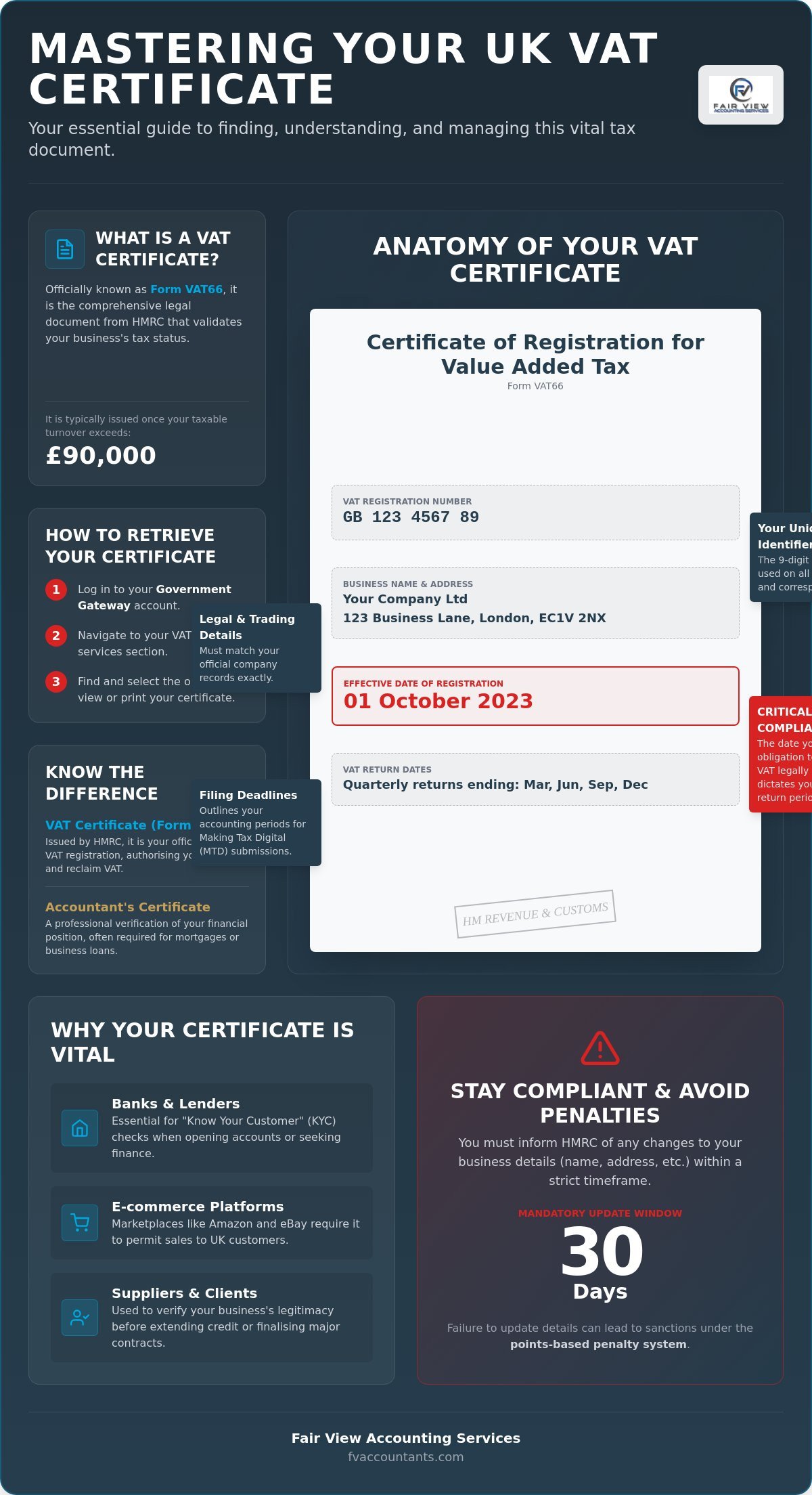
While many business owners focus solely on their nine-digit registration number, the vat certificate is the comprehensive legal document that validates your business’s tax status. Officially known as Form VAT66, it serves as the definitive proof that your company is registered with HMRC, typically after your taxable turnover exceeds the £90,000 threshold. Understanding What is Value-Added Tax (VAT)? and how it applies to your specific trade is the first step in maintaining a transparent relationship with the authorities. This document does more than sit in a digital folder; it empowers you to charge VAT on your taxable supplies and, crucially, allows you to reclaim the VAT you’ve paid on business expenses.
It’s easy to confuse your VAT number with the certificate itself. Your VAT number is a simple identifier, but the certificate provides a full snapshot of your registration details, including your effective date and accounting periods. Various stakeholders will require this full document to verify your legitimacy. High-street banks often demand it during the account opening process to satisfy “Know Your Customer” (KYC) requirements. If you trade on e-commerce platforms like Amazon or eBay, you’ll find that these marketplaces insist on a valid vat certificate before allowing you to sell to UK customers. Suppliers may also request it to ensure they are dealing with a compliant entity before extending credit terms.
Similarly, when managing high-value assets, property investment specialists like MaddisonV Properties require clear tax documentation to maintain transparency and compliance across their London portfolios.
The Legal Significance of Form VAT66
Form VAT66 is the primary legal instrument confirming your registration status to third parties. Whilst HMRC often issues your VAT number relatively quickly after an application, the certificate remains the final, authoritative evidence of your status. In a modern, digital-first business environment, keeping a high-quality digital copy is essential for transparency. It ensures you can respond to compliance checks or onboarding requests without delay. Relying on just the number is insufficient for formal audits or high-value contract negotiations where proof of standing is a prerequisite.
VAT Certificate vs. Accountant’s Certificate
It’s vital to distinguish between the document issued by HMRC and a professional Accountant’s Certificate. While the VAT66 confirms your tax registration, an Accountant’s Certificate is a professional verification of your financial position, often required for mortgages or business finance. Lenders frequently request both documents to build a complete picture of your business’s health and compliance. At Fair View Accounting, we provide these professional certifications to support your loan applications, ensuring your VAT records and broader financial standing are presented with the precision lenders expect.
Decoding Your VAT Certificate: Key Information and MTD Compliance
Once you have retrieved your vat certificate, the next step is ensuring every entry aligns with your actual business operations. This document acts as the digital blueprint for your tax identity, containing specific fields that dictate how you interact with HMRC. You will find your legal business name, any registered trading names, and your principal place of business clearly listed. It is vital that these details match your official records. Discrepancies here can cause significant friction when you attempt to open business bank accounts or integrate with online marketplaces. If you find errors in these fields, you must follow the official process for Changing your VAT registration details within the mandatory 30-day window to avoid potential penalties.
The “Effective Date of Registration” is perhaps the most critical field on the entire document. It dictates exactly when your legal obligation to charge VAT began. This date is not always the day you received the certificate; it often reflects the point your turnover crossed the £90,000 threshold or the date you chose for voluntary registration. This date determines the start of your first accounting period and your first return deadline. Misinterpreting this can lead to missed payments and the immediate accrual of penalty points under the current HMRC compliance framework. Your certificate also outlines your “VAT Return Dates,” which indicate whether you are on a standard quarterly cycle or a monthly filing schedule, allowing you to align your cash flow with these fixed liabilities.
Your Trade Classification, represented by a SIC code, is another essential component. This code tells HMRC what your business actually does. An incorrect classification can lead to unnecessary enquiries or complications with scheme eligibility. To fully understand how different rates and classifications affect your obligations, our comprehensive guide to VAT in the UK covering rates and compliance for 2026 explains the distinctions between zero-rated and exempt supplies in detail. If you are unsure whether your current SIC code is the most accurate for your trade, our e-commerce accountants can review your registration to ensure your business profile is correctly represented.
The Role of Making Tax Digital (MTD)
As of 2026, HMRC has fully transitioned away from issuing paper certificates by default. Your vat certificate now lives exclusively within your digital account, serving as the “master record” for your Making Tax Digital (MTD) software. You must ensure a secure digital link exists between this registration data and your accounting platform. This digital-first approach means that any changes you make online are reflected almost instantly in the systems HMRC uses to validate your returns, ensuring your filing remains seamless and modern.
Standard vs. Flat Rate Scheme Details
The certificate also specifies your chosen VAT accounting scheme. Whether you are on the Standard Rate or the Flat Rate Scheme, this status is clearly documented. Switching between schemes will trigger an update to your digital record. It is important to remember that your SIC code directly influences the percentage you pay whilst on the Flat Rate Scheme. A change in your business activity might not only require a certificate update but could also impact your tax liability, making regular reviews of your registration details a vital part of your financial strategy.
How to Find and Retrieve Your VAT Certificate Online
Locating your vat certificate is a straightforward digital process, provided you have your credentials ready. Most businesses obtain this document soon after they Register for VAT online. Accessing the document involves five clear steps within the Government Gateway. First, sign in using your 12-digit User ID and password. Second, navigate to the “Business Tax Account” dashboard and locate the VAT section. Third, select “View your VAT account” followed by “View VAT certificate”. Fourth, download the document as a PDF. Finally, organise this file within your cloud accounting software to ensure it is always available for audits or supplier requests.
Troubleshooting access issues is a common hurdle for busy directors. If you have forgotten your User ID or your password has expired, don’t panic. HMRC offers a recovery service that typically requires your registered email address or your National Insurance number for verification. If you’ve recently changed your phone number and can’t receive 2-factor authentication codes, you may need to reset your security preferences. This process can take a few days, so it’s best to keep your contact details updated before you need urgent access to your records.
Alternative Methods for Retrieval
If the digital portal remains inaccessible, you have other options. Check your original registration email if you applied through the online service, as a copy is often sent there. Alternatively, you can contact the HMRC VAT Helpline, though wait times can be significant. A more efficient route is to appoint an authorised agent. At Fair View Accounting, we can view your registration details and download your vat certificate on your behalf through our professional agent portal, ensuring you remain compliant without the technical stress.
Security and Access Management
Managing who sees this document is vital for business security. We strongly advise enabling 2-factor authentication on your Government Gateway account to prevent unauthorised access. You should also audit your account permissions regularly. Only trusted senior staff should have access to your tax account. If an employee or a previous accountant leaves your business, ensure you revoke their access permissions immediately within the “Manage Account” settings to maintain total control over your sensitive financial data.
Updating and Managing Your VAT Registration Details
Maintaining an accurate vat certificate is a legal requirement that demands proactive management. HMRC mandates a strict 30-day window for notifying them of any significant changes to your business circumstances. Failing to update your records within this timeframe can lead to administrative penalties and may disrupt your ability to reclaim input tax. You can manage most updates, such as changing your principal place of business or your trading name, directly through your Government Gateway account. This digital approach ensures your record remains a “single source of truth” for both HMRC and your commercial partners.
Structural changes to your business require more complex handling. If you are involved in a Transfer of a Going Concern (TOGC), where you buy or sell a business as a running entity, the treatment of the VAT registration is a critical part of the transaction. In some cases, the buyer can apply to keep the seller’s VAT number, which results in a new certificate being issued under the new ownership. Similarly, if you move from being a sole trader to a limited company (incorporation) or change your partnership structure, you must inform HMRC. These transitions often necessitate a fresh registration and a brand new vat certificate to reflect the new legal entity.
Correcting Errors on Your Certificate
Inaccuracies on your certificate are more than just clerical nuisances; they represent a compliance risk. If HMRC has misspelt your business name or assigned an incorrect SIC code, you must rectify this immediately. Using an incorrect certificate on your invoices can lead to your customers’ input tax claims being rejected by HMRC, which can damage your professional reputation. We recommend a thorough annual review of your registration details. Use this checklist to verify your status:
- Confirm the legal name matches your Companies House record exactly.
- Ensure the principal place of business is your current operating address.
- Verify the SIC code accurately reflects your primary source of income.
- Check that your bank details are correctly linked for repayments.
If you discover discrepancies during your review, our team of VAT returns specialists can help you navigate the correction process to ensure your documentation is flawless.
Cancelling or Suspending VAT Registration
There are instances where you may need to void your certificate entirely. If your taxable turnover falls below the deregistration threshold of £88,000, you can apply to cancel your registration. This process involves submitting a “final return” to account for any stock or assets held on the day of cancellation. Once HMRC approves the request, your certificate becomes legally void. However, your responsibility doesn’t end there. You must retain your old vat certificate and all associated records for at least six years. This ensures you remain protected amongst any future HMRC audits that look back at your period of registration.
Why Professional Accounting Support is Essential for VAT Compliance
Whilst automated software serves as an efficient tool for daily bookkeeping, it cannot replace the strategic oversight provided by a Chartered Accountant. We act as your professional intermediary with HMRC, ensuring that your vat certificate remains a correctly configured element of your tax profile rather than just a dormant document. A software package might flag a looming deadline, but it won’t identify if an outdated SIC code is causing you to overpay on the Flat Rate Scheme or if a shift in e-commerce regulations requires a fundamental change to your registration type. Partnering with a professional firm ensures that these nuances are managed proactively, protecting your business from the friction of administrative errors.
Fair View Accounting Services integrates VAT management into your broader tax strategy, aligning your returns with corporation tax and self-assessment planning. This holistic approach provides a level of security that standalone digital tools cannot replicate. We offer the peace of mind that comes from knowing every return is reviewed for accuracy before submission, which is vital under HMRC’s points-based penalty system. By ensuring your filings are precise and timely, we help you avoid the £200 penalties that accrue when thresholds are missed. Modern cloud technology allows us to maintain a secure, digital link to your records, ensuring your vat certificate and historical returns are always accessible for audits or financial applications.
Beyond the Certificate: Comprehensive VAT Services
Our commitment to your compliance extends far beyond the initial retrieval of your registration documents. We provide a full suite of services designed to navigate the complexities of MTD for VAT and the intricate rules surrounding international trade. For e-commerce businesses, centralising financial management is the most effective way to reduce administrative burden. We handle the technical details of quarterly submissions and scheme eligibility, allowing you to focus on growth. It is also important to remember the legal distinction we highlighted earlier; while HMRC issues your VAT66, lenders often require a professional Accountant’s Certificate to verify your financial standing for finance. We provide the expert verification needed to support your business’s long-term ambitions.
Partnering with Fair View Accounting Services
We invite you to book a consultation for a comprehensive compliance health check to ensure your registration details are accurate and your tax strategy is optimised. As your “tech-savvy guardian,” we take the stress out of regulatory changes and HMRC communications. We provide the stability and expertise required to navigate the UK’s evolving tax environment with total confidence. Ensure your business stays compliant with our professional VAT services and gain a partner dedicated to your financial precision and success.
Mastering Your VAT Compliance for Long-Term Growth
Your vat certificate is the cornerstone of your business’s tax identity, facilitating everything from supplier contracts to essential input tax reclaims. We have explored how to retrieve this document digitally and why maintaining its accuracy within HMRC’s mandatory 30-day reporting window is vital for avoiding penalty points. By mastering these administrative foundations, you transform a potentially stressful requirement into a streamlined part of your operational routine, allowing you to prioritise your health with specialists like Fit & Healthy Chiropractic.
Managing these complexities doesn’t have to be a solitary task. Our team of Chartered Accountants provides national UK coverage, specialising in cloud-based VAT management and MTD compliance. We offer proactive support tailored specifically for SMEs, e-commerce sellers, and tradespeople, ensuring your records are always precise and your submissions are timely. Get expert help with your VAT compliance today and experience the peace of mind that comes with professional financial guardianship.
With the right support and a clear digital strategy, you can navigate the UK’s tax regulations with absolute confidence. Focus on growing your business whilst we ensure your compliance remains flawless and secure.
Frequently Asked Questions
How long does it take to get a VAT certificate after registering?
It typically takes up to 30 days for HMRC to process your application and issue your certificate, though many businesses receive theirs much sooner through the online portal. Once approved, your digital record is updated almost immediately. You should check your Government Gateway account regularly after submitting your application to download the document as soon as it becomes available for your records.
Is a VAT certificate the same as a VAT registration number?
No, these are distinct but related items. Your VAT registration number is the nine-digit identifier used on invoices and returns, whereas the vat certificate (Form VAT66) is the official legal document that contains this number alongside your effective date, business address, and accounting periods. The certificate serves as the formal proof of your status that banks and marketplaces require for verification.
Do VAT certificates expire or need renewing?
VAT certificates do not have an expiry date and do not require periodic renewal. However, the information on the document must remain accurate to be legally valid. If your business name, structure, or principal place of business changes, you must notify HMRC within 30 days. They will then issue an updated digital certificate reflecting these new details to ensure your compliance remains current and transparent.
What should I do if I cannot find my VAT certificate online?
If the document is missing from your Business Tax Account on the Government Gateway, first verify that you are looking in the correct VAT section under “View your VAT account”. If it still isn’t visible, you may need to contact the HMRC VAT Helpline or check your original registration emails. Alternatively, an authorised agent can often retrieve these details for you through their professional portal.
Can I start charging VAT before I receive my physical certificate?
You must account for VAT on all taxable sales from your Effective Date of Registration, even if you haven’t received the document yet. However, you cannot issue a formal VAT invoice or show VAT as a separate line item until your registration number is confirmed. You should temporarily increase your prices to account for the tax and then re-issue invoices once your vat certificate is accessible.
What is a VAT exemption certificate and who needs one?
A VAT exemption certificate is a specific document used by eligible organisations, such as certain charities or medical research bodies, to purchase qualifying goods and services at the zero or reduced rate. This is different from a standard registration certificate. If your business sells to these organisations, you must obtain a copy of their exemption certificate to justify not charging the standard 20% rate on your return.
How do I change the address on my VAT certificate?
You can update your business address online through the “Manage Account” section of your HMRC Government Gateway portal. Most changes are processed digitally and will be reflected on your record within a few working days. If you prefer a manual route, you can submit Form VAT484 by post, though this typically takes longer to process than the streamlined digital update available through your account.
Does my VAT certificate show my bank details for repayments?
No, your bank details are not printed on the vat certificate itself. While HMRC holds your banking information for repayments and Direct Debit payments, this sensitive data is kept within the secure “Payments” or “Settings” area of your digital tax account. The certificate focuses on your legal entity name, trade classification, and registration dates rather than your private financial account numbers or payment history.
Disclaimer
The information provided in this article is for general guidance only and is not intended to constitute professional advice, tax advice, financial advice, legal advice, or any other form of regulated guidance. Although every effort has been made to ensure accuracy at the time of publication, Fair View Accounting Services, including its director, employees, contractors, writers, and content-creation team, accepts no responsibility for any loss, damage, penalty, or consequence arising from reliance on the information contained herein.
UK tax legislation changes frequently, and HMRC interpretations, thresholds, and rules may vary depending on the individual circumstances of each taxpayer. Nothing in this article should be considered a substitute for obtaining formal, personalised advice from a qualified accountant or tax professional. Readers should not take action or refrain from taking action based solely on the content published on this website.
Fair View Accounting Services does not guarantee the completeness, accuracy, or ongoing validity of the information provided and assumes no liability for omissions or errors, whether typographical, factual, or technical. By using this content, the reader acknowledges that all responsibility for decisions remains solely with the user.