
The most expensive accountant you’ll ever hire is often the one who seems the cheapest on paper. While a low headline rate might look attractive, it frequently masks a lack of proactive advice or leaves you vulnerable to surprise bills when HMRC compliance gets complex. We know that the pressure of managing your own books whilst trying to grow a brand is exhausting, and the anxiety surrounding the 2026 Making Tax Digital deadlines only adds to the weight.
This guide will demystify small business accountant fees uk for the current landscape, ensuring you know exactly what to expect for your investment. We’ll provide a clear breakdown of market rates and a checklist of essential services like corporation tax and payroll. By the end of this article, you’ll have the confidence to choose a tech-savvy partner who doesn’t just crunch numbers but provides the proactive tax optimisation and peace of mind your business deserves.
Key Takeaways
- Identify current market rates for 2026 to ensure you are receiving competitive pricing for both basic compliance and strategic advisory support.
- Gain a clear understanding of small business accountant fees uk across different structures, including sole traders, start-ups, and established limited companies.
- Discover the essential components of a high-value accounting package, ranging from VAT returns and payroll to annual accounts and proactive tax planning.
- Learn how to leverage digital integration and organised record-keeping to reduce your professional costs whilst maintaining total HMRC compliance.
- Understand the benefits of fixed-fee models in providing cash flow stability and protecting your business from the risk of surprise administrative bills.
Understanding the Landscape of Small Business Accountant Fees in the UK
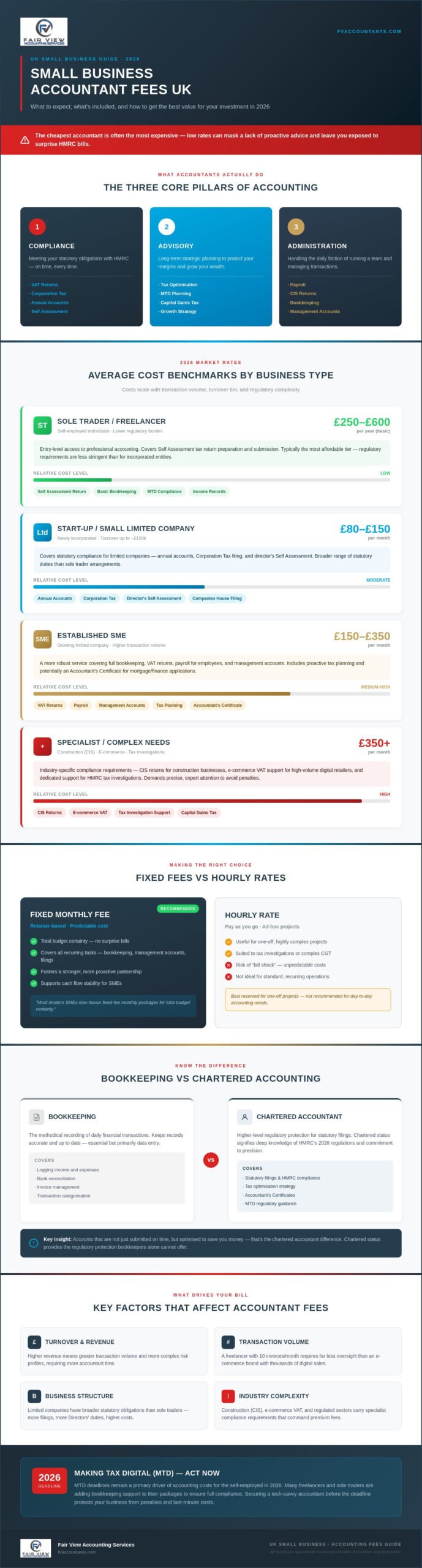
Professional accounting services provide far more than just a year-end tally of your profits. In 2026, the landscape of small business accountant fees uk is defined by three core pillars: compliance, advisory, and administrative support. Compliance ensures you meet statutory obligations like VAT returns and Corporation Tax. Advisory services focus on long-term tax planning to protect your margins. Administrative tasks, such as payroll and CIS tax, handle the daily friction of running a team.
Your specific costs depend on your business structure, turnover, and transaction volume. A freelancer with ten invoices a month requires less oversight than an e-commerce brand managing thousands of digital sales. Professional accounting fees in the UK are typically structured either as fixed monthly retainers or one-off annual charges, depending on the complexity of the business’s financial affairs.
Fixed Fees vs Hourly Rates: Which is Better?
Most modern SMEs now favour fixed-fee monthly packages because they provide total budget certainty. You pay a set amount each month, which covers recurring tasks like bookkeeping and management accounts. This model prevents the “bill shock” often associated with hourly rates. Hourly billing remains useful for one-off, highly complex projects, such as a tax investigation or a specific capital gains tax calculation. However, for standard operations, the retainer model fosters a stronger partnership between you and your accountant.
The Distinction Between Bookkeeping and Chartered Accounting
It’s vital to distinguish between daily data entry and strategic oversight. Bookkeeping involves the methodical recording of daily financial transactions to keep your records accurate and up to date. Whilst this is essential, a chartered accounting firm provides the higher-level regulatory protection you need for statutory filings. Chartered status signifies a commitment to precision and deep knowledge of HMRC’s shifting 2026 regulations. This expertise ensures your annual accounts are not just submitted on time but are optimised to save you money.
Average Cost Benchmarks for UK Small Businesses in 2026
Estimating small business accountant fees uk requires a clear understanding of your company’s scale and complexity. Most accounting firms categorise their services based on turnover tiers because higher revenue typically involves a greater volume of transactions and a more complex risk profile. When you follow official government guidance to establish your venture, you’ll find that your financial responsibilities scale alongside your growth. An accountant must dedicate more time to reconciling records and ensuring compliance as your business expands, which is reflected in the tiered pricing models common across the UK market.
Specialised requirements also influence the final cost. Businesses operating within the construction industry often face additional charges for CIS returns, whilst retailers managing high-volume digital sales may require e-commerce-specific VAT support. These services demand precise attention to detail to avoid HMRC penalties, making them a vital part of a comprehensive support package. If you are navigating these complexities for the first time, securing professional tax support ensures your records remain accurate and your liabilities are minimised.
Sole Trader and Freelancer Fee Expectations
Sole traders typically access the most affordable entry-point for professional accounting. These fees primarily cover the preparation and submission of a basic Self Assessment tax return. Because the regulatory requirements for individuals are less stringent than those for incorporated entities, the workload is significantly lower. Many freelancers choose to add simple bookkeeping support to their package to ensure they remain compliant with Making Tax Digital rules, which remain a primary driver of accounting costs for the self-employed in 2026.
Limited Company Statutory Requirements
Limited companies face a broader range of statutory duties that necessitate a more robust accounting service. A standard package for an SME usually includes the preparation of Annual Accounts, Corporation Tax filings, and the Director’s Self Assessment. Beyond these basics, many directors find they require a formal Accountant’s Certificate. This document is essential when applying for personal finance or mortgages, as it provides lenders with a verified statement of your earnings and business health. Including this in your annual service ensures you are always prepared for personal financial opportunities without needing to request ad-hoc, expensive reports later.
Evaluating Value: What Should Your Accounting Package Include?
When comparing small business accountant fees uk, it’s vital to look beyond the bottom line and assess the total value of the service package. A comprehensive SME offering should provide a complete safety net, encompassing VAT returns, payroll, year-end accounts, and strategic tax planning. Proactive tax planning is perhaps the most critical component; it identifies legitimate ways to reduce your tax liability, ensuring your accountant often saves you more than they cost in professional fees.
When you Find a qualified Chartered Accountant, ensure their package includes HMRC investigation insurance and continuous compliance monitoring. These features protect your business from the financial strain of an audit and ensure you never miss a shifting regulatory deadline. Many modern firms now offer “unlimited advice” models rather than pay-per-query systems. This approach encourages open communication, allowing you to seek guidance on financial decisions without the anxiety of receiving an unexpected bill for every phone call.
The Role of Cloud Accounting in Reducing Costs
Digital transformation has fundamentally changed how small business accountant fees uk are calculated. Platforms like Xero and QuickBooks allow for seamless data integration, which reduces manual entry and administrative overhead for the firm. This efficiency often translates into more competitive pricing for you. Real-time data access provides instant visibility into your finances, allowing your accountant to act as a “tech-savvy guardian” who spots potential cash flow issues or tax-saving opportunities the moment they arise.
Hidden Costs to Watch Out For
Transparency is essential when reviewing your engagement letter to avoid “scope creep.” Some firms exclude software subscriptions, confirmation statements, or the cost of registered office addresses from their headline price. Others may charge significant premiums for ad-hoc tax advice or management accounts that weren’t part of the original agreement. Always ensure your contract is inclusive of the core services your business needs to remain fully compliant with HMRC. For a transparent breakdown of services that scale with your growth, you can request a tailored quote from our expert team.
How to Minimise Your Accounting Spend Whilst Maximising Support
Managing small business accountant fees uk effectively doesn’t mean searching for the lowest headline quote. It involves optimising your internal processes so your accountant can focus on high-value advice rather than chasing paperwork. When you provide organised, digital records, you reduce the time required for basic compliance. This efficiency allows your professional partner to concentrate on tax planning and strategic growth. Whilst “cheap” DIY bookkeeping might seem like a saving, it often leads to costly errors and HMRC penalties that far outweigh the initial professional fee.
Digital Record Keeping and Dext Integration
Adopting digital tools is the most direct way to lower your professional costs. Using platforms like Dext for receipt scanning eliminates the need for manual data entry and the traditional “shoebox” accounting method. When you digitise your records in real-time, your accountant can access accurate information instantly. This streamlined workflow reduces billable hours and ensures your VAT returns and payroll are filed with precision. Digital organisation transforms your relationship with your accountant from a reactive year-end scramble into a proactive, seamless partnership.
Why a Chartered Firm is a Long-Term Saving
Investing in a chartered firm provides a level of expertise that pays for itself over the financial year. Professional tax planning often uncovers legitimate savings in Corporation Tax and Capital Gains Tax that a non-regulated provider might overlook. At Fair View Accounting Services, we act as your “tech-savvy guardian,” managing the regulatory burden so you can focus on your business. Our fixed-fee model ensures you receive expert support without the fear of hidden costs or surprise administrative bills.
Secure your business’s financial future with transparent, expert support that scales with your growth. Get a tailored quote today to discover how our cloud-based solutions and chartered expertise can save you time and money whilst ensuring total HMRC compliance.
Securing Your Financial Future in 2026
Professional accounting is a strategic investment in your company’s stability rather than a mere administrative cost. By understanding the current landscape of small business accountant fees uk, you can move away from the anxiety of hidden charges and towards a partnership that actively saves you money. We’ve explored how digital integration through platforms like Xero and the proactive oversight of a chartered firm create a foundation for long-term success.
Fair View Accounting Services provides the modern, reliable support your business needs to thrive. As Chartered Accountants offering UK-wide support, we specialise in fixed-fee models that eliminate surprises and maximise efficiency through QuickBooks and cloud-based tools. Our role as your tech-savvy guardian ensures your compliance is seamless whilst your tax position remains optimised. We’re committed to providing the clarity and stability you need to navigate HMRC regulations with total confidence.
Request a transparent fixed-fee quote from Fair View Accounting Services today. You deserve the peace of mind that comes from knowing your finances are in expert hands, allowing you to focus entirely on building your brand.
Frequently Asked Questions
How much does an accountant charge for a Self Assessment tax return in the UK?
A one-off Self Assessment tax return in the UK typically costs between £150 and £500, depending on the complexity of your income sources. This fee covers the preparation and submission of your return to HMRC, ensuring you utilise your £12,570 personal allowance correctly. For individuals with property income, capital gains, or multiple director roles, the cost may sit at the higher end of this industry range.
Is it worth paying for a monthly accounting package for a small business?
A monthly accounting package is highly beneficial for small businesses that value budget certainty and proactive financial oversight. These retainers often cover recurring tasks like bookkeeping and management accounts, preventing the “bill shock” of traditional annual charges. By spreading the small business accountant fees uk across the year, you gain continuous access to professional advice that helps optimise your tax position well before the year-end deadline.
Do accounting fees include the cost of software like Xero or QuickBooks?
Whether software costs are included depends entirely on the firm’s specific engagement terms, though many modern firms now bundle these subscriptions. Providing access to cloud platforms like Xero or QuickBooks as part of a package ensures your “tech-savvy guardian” has real-time visibility into your finances. Bundling these costs often provides better value than a standalone subscription and ensures your software is always configured correctly for HMRC compliance.
Can I change my accountant mid-year if their fees are too high?
You can change your accountant at any point during the financial year if you feel their service no longer aligns with your needs or budget. Your new accountant will handle the transition by requesting “professional clearance” and transferring your records securely from the previous provider. Switching mid-year is a straightforward process that allows your new partner to review your current books and ensure your 2026 tax obligations are managed efficiently.
What is the average cost of payroll services for a small UK team?
Payroll service costs are usually structured as a base monthly fee plus a small charge for each employee payslip processed. This service manages your PAYE submissions, pension auto-enrolment, and statutory filings, removing a significant administrative burden from your daily operations. For a small team, this investment ensures your staff are paid accurately and on time whilst protecting your business from the risk of expensive HMRC payroll penalties.
Disclaimer
The information provided in this article is for general guidance only and is not intended to constitute professional advice, tax advice, financial advice, legal advice, or any other form of regulated guidance. Although every effort has been made to ensure accuracy at the time of publication, Fair View Accounting Services, including its director, employees, contractors, writers, and content-creation team, accepts no responsibility for any loss, damage, penalty, or consequence arising from reliance on the information contained herein. UK tax legislation changes frequently, and HMRC interpretations, thresholds, and rules may vary depending on the individual circumstances of each taxpayer. Nothing in this article should be considered a substitute for obtaining formal, personalised advice from a qualified accountant or tax professional. Readers should not take action or refrain from taking action based solely on the content published on this website. Fair View Accounting Services does not guarantee the completeness, accuracy, or ongoing validity of the information provided and assumes no liability for omissions or errors, whether typographical, factual, or technical. By using this content, the reader acknowledges that all responsibility for decisions remains solely with the user.