
Why are you handing over nearly a third of your hard-earned pay to HMRC before you’ve even cleared your site? For many in the construction industry, the 30% deduction rate feels like an unfair penalty on the cash flow you need to keep your business moving. Completing your cis registration for subcontractors is the most effective way to stop this drain on your resources and ensure you aren’t paying more than your fair share from your very first invoice.
This guide is designed to help you master the registration process so you can protect your earnings and gain total clarity over your tax obligations. We’ll provide a clear, step-by-step path through the 2026 HMRC requirements, helping you move away from high emergency tax rates and toward a more efficient financial setup. You’ll learn how to navigate the latest compliance rules, understand the criteria for Gross Payment Status, and discover how to organise your records to make claiming back overpaid tax a seamless part of your year-end routine.
Key Takeaways
- Learn how completing your cis registration for subcontractors reduces your tax deduction rate from 30% to 20%, immediately improving your business’s monthly cash flow.
- Identify the essential details you need, including your UTR and National Insurance number, to navigate the HMRC registration process with confidence and precision.
- Understand the specific compliance and turnover tests required to achieve Gross Payment Status, which allows you to receive payments in full without deductions at source.
- Discover how to maintain accurate digital records and payment statements to ensure a seamless process when claiming back overpaid tax at the end of the year.
Understanding CIS Registration for Subcontractors
The Construction Industry Scheme (CIS) serves as a structured framework for HMRC to collect tax from the building trade at source. It’s designed to maintain transparency and ensure that tax is paid consistently throughout the year. Whilst the deductions might feel like a drain on your revenue, cis registration for subcontractors is actually a vital tool for protecting your profit margins. HMRC views these deductions as advance payments towards your annual Income Tax and National Insurance liabilities. Essentially, you’re paying your dues as you go, which prevents a massive, unmanageable bill from landing on your desk at the end of the financial year.
The scheme’s scope is broader than many realise. It doesn’t just apply to those laying bricks or pouring concrete. If your work involves site preparation, internal decorating, or general building repairs, you’re almost certainly within the scheme’s remit. If your project involves a final handover of a commercial space, you can check out Commercial Carpet Cleaners Stockport to ensure the interior is spotless for the client. Identifying this early is crucial because it dictates how much money you actually take home each month.
Who Must Register as a Subcontractor?
Whether you operate as a sole trader, a partner in a firm, or through a limited company, you must register if you perform construction work for a contractor. This broad definition of “construction work” includes civil engineering, site clearance, and even the installation of heating systems. You might also find yourself in a dual role where you hire other tradespeople whilst also working for a larger firm. In these scenarios, you’ll need to register as both a contractor and a subcontractor to stay fully compliant with HMRC’s 2026 standards.
The Financial Impact of Non-Registration
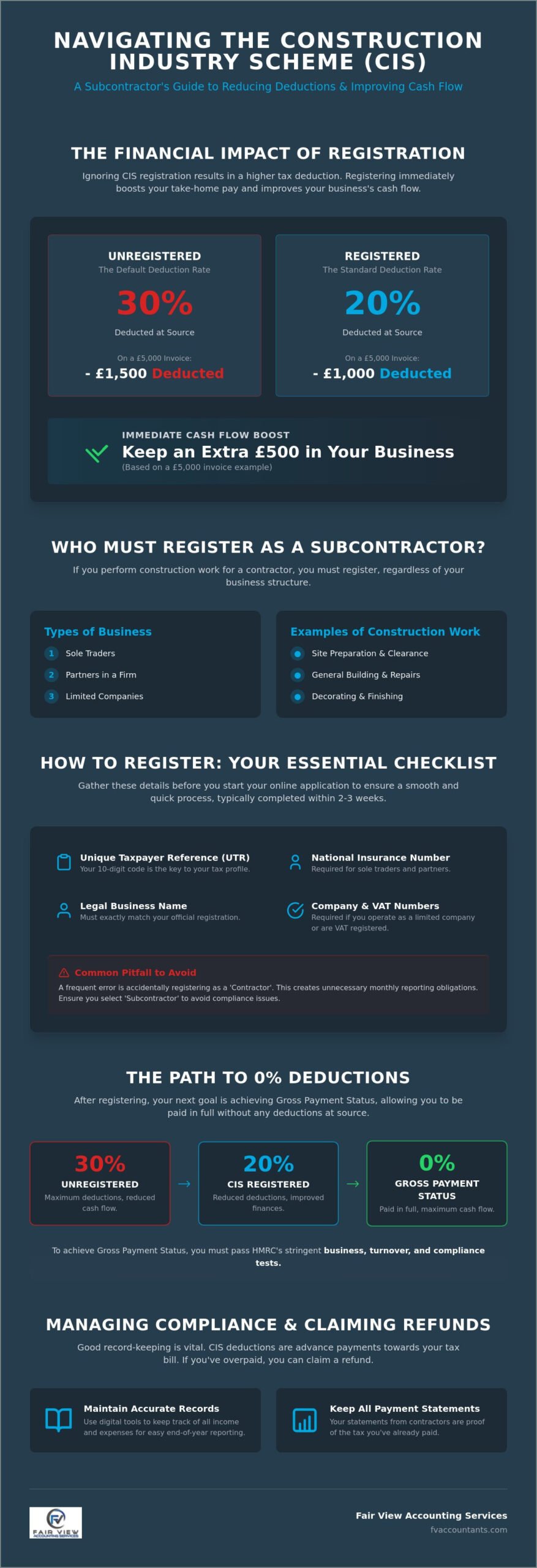
The cost of ignoring cis registration for subcontractors is immediate and steep. If you submit a £5,000 invoice for labour, an unregistered subcontractor will see £1,500 (30%) deducted by the contractor. By simply completing your registration, that deduction drops to £1,000 (20%), which keeps an extra £500 in your business account to cover materials, fuel, or wages. This immediate boost to your cash flow demonstrates why registration is a strategic financial move rather than just a box-ticking exercise.
How to Register for CIS: A Step-by-Step Guide
Registering for the scheme is a logical progression for any growing trade business. Whilst the paperwork might seem daunting, HMRC has streamlined the digital application process via the Government Gateway. If you’re launching a new venture, you can often register for Self Assessment and the scheme simultaneously, ensuring your tax profile is set up correctly before your first contract begins. Once you have your credentials, you can access the how to register for CIS portal to complete your subcontractor status.
In 2026, most online applications for cis registration for subcontractors are processed within two to three weeks. However, delays often occur if your details don’t match HMRC’s existing records. Precision is vital during the data entry stage to avoid your application being flagged for manual review.
Essential Documentation Checklist
Before you begin, gather these details to ensure a seamless application:
- Unique Taxpayer Reference (UTR): This 10-digit code is the golden key for your construction tax profile.
- National Insurance Number: Required for sole traders and partners.
- Legal Business Name: This must match your official registration with Companies House or HMRC.
- Company Registration Number (CRN): This is only required for limited companies.
- VAT Registration Details: Include these if your business is already VAT registered.
Common Registration Pitfalls to Avoid
A frequent error involves subcontractors accidentally registering as “Contractors”. This mistake triggers additional reporting requirements, such as monthly returns, which you don’t need if you aren’t hiring others. Providing inaccurate information can lead to HMRC investigations or financial penalties. Integrating cloud accounting software helps you organise your business details and financial history before you submit your application. If the process feels overwhelming, our team provides expert CIS tax services to ensure your registration is accurate and compliant from the start.
Advancing Your Status: Gross Payment Status and VAT
Once you’ve completed your initial cis registration for subcontractors, the next logical milestone is achieving Gross Payment Status (GPS). This status is the gold standard for established firms because it allows you to receive payments from contractors in full, with 0% deducted at source. It provides an immediate boost to your working capital, though you remain responsible for paying your tax and National Insurance at the end of the financial year. To transition to this status, you can Register for CIS as a subcontractor and apply for GPS through the Government Gateway portal.
HMRC grants this status based on three rigorous checks. The business test confirms you’re conducting construction work within the UK. The compliance test ensures you’ve submitted all tax returns and paid all dues on time over the previous 12 months. Finally, the turnover test measures your net construction income to ensure your business meets the minimum scale requirements. Maintaining a “clean” record is essential, as HMRC performs annual reviews to ensure you still meet these standards.
Meeting the Turnover Test for GPS
HMRC assesses your “net” turnover, which excludes VAT and the cost of materials used on site. For a sole trader, you must demonstrate a turnover of at least £30,000 in the preceding 12 months. For limited companies, the threshold is £30,000 per director or a total of £100,000 for the entire company. Precise digital record-keeping is vital here, and utilising professional construction bookkeeping services can help ensure your reported income is accurate, preventing rejected applications and delays in improving cash flow.
Navigating the VAT Domestic Reverse Charge
If you’re VAT registered and working for another VAT-registered contractor, the Domestic Reverse Charge (DRC) changes how you handle tax. Instead of you charging VAT, the contractor accounts for it themselves. This requires specific wording on your invoices to stay compliant. As of April 2026, HMRC has increased scrutiny on these filings, and they can immediately cancel Gross Payment Status for businesses involved in tax fraud. If you find these regulations complex, our expert CIS tax team can manage your compliance and status applications with absolute precision.
Managing Compliance and How to Claim a CIS Refund
Once you’ve finalised your cis registration for subcontractors, the focus shifts to maintaining rigorous compliance to protect your future refunds. Each month, your contractor must provide a Payment and Deduction Statement. These documents are vital. They serve as the only formal proof of the tax already paid to HMRC on your behalf. Without them, reconciling your total income against your tax liability becomes nearly impossible, potentially leading to lost revenue.
For many, the ultimate goal of cis registration for subcontractors is to ensure that any overpaid tax is returned promptly at the end of the financial year. In 2026, the process for triggering a repayment is tied directly to your annual Self Assessment or Corporation Tax return. If the total tax deducted by your contractors exceeds what you actually owe for the year, HMRC will process a repayment. However, this only happens if your figures are precise and your records are up to date.
The Step-by-Step CIS Refund Process
The journey to claim cis refund starts with a thorough calculation of your “advance payments.” You must tally every deduction listed on your monthly statements and compare this against your final tax and National Insurance bill. We recommend using cloud platforms like Xero to automate this tracking. These systems allow you to tag CIS offsets in real time, ensuring that when the tax year ends, you have a complete digital trail ready for submission. HMRC requires this evidence to verify that the 20% or 30% taken from your invoices matches their internal records.
Why Use a Chartered Accountant for Your CIS Tax?
Expert support is often the difference between a delayed repayment and a swift injection of cash into your business. Fair View Accounting Services acts as your tech-savvy guardian, identifying unclaimed business expenses that can significantly increase your final refund. We handle HMRC enquiries directly, removing the administrative burden from your shoulders. Beyond the tax return, we ensure your Accountant’s Certificate and annual accounts are fully compliant. This preparation is essential for subcontractors who need to prove their income for future mortgage or finance applications.
Take Control of Your Construction Tax Strategy
Completing your cis registration for subcontractors is more than a regulatory requirement; it’s a strategic move to protect your business’s liquidity. By moving from a 30% deduction rate to 20%, or even 0% through Gross Payment Status, you retain the capital needed to fuel growth and cover daily operational costs. Success in the construction industry requires this level of financial precision and a commitment to maintaining accurate, digital records throughout the year. When you treat your tax compliance as a pillar of your business strategy, you ensure that every pound you earn is accounted for and protected.
Managing these complexities doesn’t have to be a solo effort. As Chartered Accountants with deep CIS expertise, we provide the dedicated support tradespeople and construction firms need to thrive. We offer seamless cloud accounting integration with Xero and QuickBooks to ensure your compliance is effortless and your records are always audit-ready. Maximise your CIS refund and simplify your compliance with Fair View Accounting Services. With the right systems in place, you can focus on your trade whilst we ensure your tax works for you, not against you.
Frequently Asked Questions
How long does it take to get a CIS refund in 2026?
Most subcontractors receive their CIS refund within four to eight weeks after submitting their Self Assessment or Corporation Tax return. This timeline depends on the accuracy of your digital records and whether HMRC requires additional verification of your deductions. Using cloud accounting software helps speed up this process by ensuring your figures match HMRC’s internal records from the start.
Can I register for CIS if I am a foreign subcontractor working in the UK?
You can complete your cis registration for subcontractors even if your business is based outside the UK, provided you’re performing construction work within the country. You must register with HMRC as a “non-resident” subcontractor to ensure you’re taxed at the correct 20% rate. This prevents the 30% emergency deduction from being applied to your invoices whilst you operate across borders.
What happens if I lose my Payment and Deduction Statements?
You should contact your contractor to request duplicate copies if you lose your original statements. Contractors are legally required to keep these records for at least three years and must provide copies upon request. Having these documents is essential for reconciling your income and proving the tax already deducted. Moving to a digital system allows you to upload these statements as you receive them, which prevents future loss.
Is it possible to claim a CIS refund if I have outstanding tax debts?
HMRC will typically use any overpaid CIS credit to settle your outstanding tax debts before issuing a refund to your bank account. If your credit exceeds what you owe for Self Assessment, VAT, or Corporation Tax, the remaining balance will be paid out to you. This automatic offsetting helps keep your tax account in good standing without requiring separate manual payments for your arrears.
What is the difference between a contractor and a subcontractor under CIS?
A contractor is a business that pays others for construction work, whilst a subcontractor is the entity carrying out that work. Many businesses in the industry actually fall into both categories if they hire tradespeople whilst also working for larger firms. Correctly identifying your role during cis registration for subcontractors is vital because contractors have additional monthly reporting and filing obligations that sole subcontractors don’t have to manage.
Disclaimer
The information provided in this article is for general guidance only and is not intended to constitute professional advice, tax advice, financial advice, legal advice, or any other form of regulated guidance. Although every effort has been made to ensure accuracy at the time of publication, Fair View Accounting Services, including its director, employees, contractors, writers, and content-creation team, accepts no responsibility for any loss, damage, penalty, or consequence arising from reliance on the information contained herein. UK tax legislation changes frequently, and HMRC interpretations, thresholds, and rules may vary depending on the individual circumstances of each taxpayer. Nothing in this article should be considered a substitute for obtaining formal, personalised advice from a qualified accountant or tax professional. Readers should not take action or refrain from taking action based solely on the content published on this website. Fair View Accounting Services does not guarantee the completeness, accuracy, or ongoing validity of the information provided and assumes no liability for omissions or errors, whether typographical, factual, or technical. By using this content, the reader acknowledges that all responsibility for decisions remains solely with the user.