

Why treat your tax return as a stressful administrative chore when it’s actually the key to unlocking a refund of up to £3,000? For many tradespeople, filing a self assessment for cis contractors feels like a high-stakes balancing act where one simple mistake could lead to an HMRC penalty or a missed rebate. It’s completely understandable to feel overwhelmed by the pressure of reconciling “gross” versus “net” income, especially whilst trying to manage a busy site schedule and manual paperwork.
We believe that managing your finances should be as precise and sturdy as the projects you build. This guide provides a step-by-step framework to help you master your CIS tax return; it ensures you claim every legitimate business expense and secure the refund you’ve already earned. We’ll explore how to navigate the 2026 Making Tax Digital requirements, use cloud-based tools like QuickBooks to digitise your records, and maintain a seamless relationship with HMRC that keeps your business protected. By the end of this article, you’ll have a clear, professional strategy to turn your tax obligations into a streamlined digital process.
Key Takeaways
- Understand why filing a self assessment for cis contractors is a mandatory reconciliation exercise, even if tax has already been deducted at source.
- Learn how to accurately calculate your gross income and reconcile CIS statements to ensure you never pay more tax than necessary.
- Identify the specific business expenses you can claim to reduce your taxable profit and maximise the value of your HMRC tax refund.
- Discover how to use digital platforms like QuickBooks and Dext to streamline your record-keeping and remain compliant with upcoming Making Tax Digital regulations.
- Gain professional insights into avoiding common filing errors that lead to HMRC audits and late submission penalties.
Understanding the Link Between CIS and Self Assessment
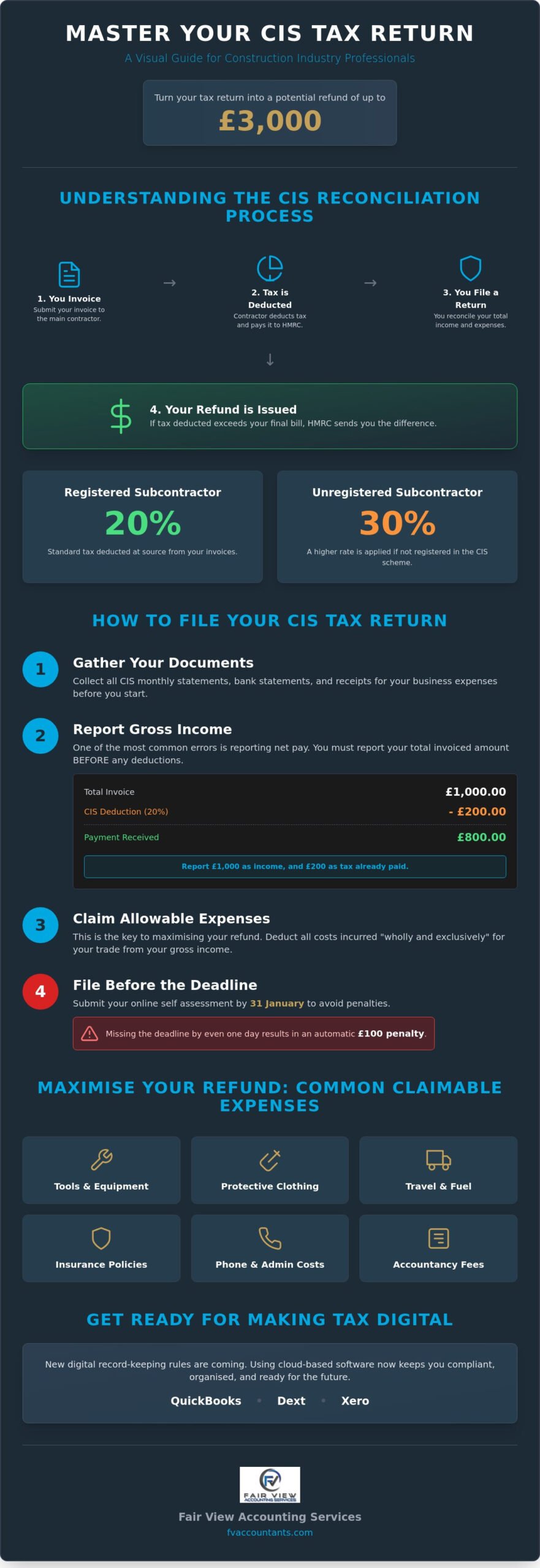
The Construction Industry Scheme (CIS) functions as a tax-deduction-at-source mechanism designed by HMRC to ensure consistent tax collection within the building trade. When you work as a subcontractor, your contractor deducts a portion of your pay and sends it directly to HMRC as an advance payment toward your tax and National Insurance. However, these deductions are merely estimates based on your gross pay. Completing a self assessment for cis contractors is mandatory because it serves as the official reconciliation of your financial year. It’s the only way to prove your actual business expenses and confirm whether you’ve overpaid.
HMRC applies different deduction rates depending on your registration status. Registered subcontractors typically see 20% withheld from their invoices, whilst those who are unregistered face a higher rate of 30%. This “Reconciliation Principle” is the foundation of the CIS system. By filing your return, you balance these advance payments against your final liability. If your deductions exceed the tax you actually owe, HMRC issues a refund to settle the difference. Filing accurately ensures you receive the maximum rebate whilst remaining fully compliant with current regulations.
Sole Trader vs Limited Company CIS Obligations
Your business structure dictates how you interact with the scheme. Sole traders must report their CIS income and deductions via the SA100 tax return. In contrast, limited companies usually manage these deductions through their payroll system using an Employer Payment Summary (EPS). Some contractors achieve Gross Payment Status if their net construction turnover exceeds £30,000. This status allows you to receive payments in full without any deductions, which significantly improves cash flow. However, you must still file your annual returns to maintain compliance and avoid losing this privileged status.
The Role of CIS Monthly Statements
To file an accurate return, you need precise records. Your contractor is legally required to provide a written CIS statement by the 19th of each month following the tax month. These documents are vital. They show exactly how much was paid and how much tax was withheld. If a statement is missing or contains an error, you should contact the contractor immediately to request a correction. Having digital copies stored in a platform like QuickBooks ensures you’re prepared when the filing deadline approaches, preventing the stress of chasing old paperwork at the last minute.
How to File Your CIS Tax Return: A Step-by-Step Guide
Filing a self assessment for cis contractors requires a methodical approach to ensure you don’t leave money on the table. You must gather all CIS monthly statements, bank statements, and receipts for business expenses before you begin. The deadline for online submission and paying any tax owed is 31 January. Missing this date by even one day results in an automatic £100 penalty. HMRC applies further daily charges if the delay reaches three months, so prompt action is essential for protecting your hard-earned profit.
Recording Income and Deductions Correctly
One of the most frequent errors involves confusing “net” pay with “gross” pay. For CIS purposes, Gross Income is the total amount invoiced before any CIS tax was deducted or materials were excluded. You must report this higher figure as your total income. You then enter the total amount of tax already withheld in the specific “CIS deductions” box on your tax return. This step is critical. It prevents you from being taxed twice on the same earnings and ensures your advance payments are credited correctly against your final liability.
Claiming Legitimate Construction Expenses
Reducing your taxable profit through allowable expenses is the most effective way to secure a significant refund. You can claim for costs that are incurred wholly and exclusively for your trade. These typically include:
- Tools, equipment repairs, and small consumables.
- Protective clothing and essential PPE.
- Travel costs to temporary sites, including fuel or public transport.
- Professional insurance, such as public liability.
Managing these records doesn’t have to be a manual burden. Using digital platforms like QuickBooks or Xero allows you to snap photos of receipts and categorise them instantly. This modern approach keeps you organised throughout the year and makes the final filing process seamless. If you find the technicalities of the HMRC portal daunting, our specialist CIS accountants can manage the entire reconciliation for you. For those handling the submission themselves, it’s helpful to review the official guidance on How to File CIS Monthly Returns to ensure every box is completed accurately.
Maximising Your Position: Refunds and Professional Support
The primary goal of a self assessment for cis contractors is often to trigger a tax rebate. Because contractors deduct tax at a flat rate of 20% or 30%, many subcontractors overpay throughout the year once their personal allowance and business expenses are factored in. When your total deductions exceed your actual tax and National Insurance liability, HMRC issues a refund to settle the balance. You can find more details on how these figures interact in this resource on CIS and Self Assessment Explained. Accuracy is paramount during this stage. HMRC audits CIS returns more frequently than standard filings to ensure that claimed expenses are legitimate and that gross income matches contractor reports.
Beyond immediate tax compliance, a well-managed CIS history is a significant financial asset. If you intend to apply for a mortgage or business finance, having your records verified by a professional allows you to secure an Accountant’s Certificate. This document provides lenders with the high-level assurance they require to approve applications for self-employed individuals. Partnering with a Chartered Accountant provides you with a “tech-savvy guardian” who protects your compliance whilst positioning your business for long-term growth.
When to Expect Your CIS Refund
HMRC typically processes refunds for online submissions within 2 to 4 weeks. Delays usually occur if there are discrepancies between your reported figures and the monthly returns filed by your contractors. Ensuring your bank account details are entered correctly on the return is the simplest way to avoid administrative hold-ups and receive your rebate promptly.
Why Professional Reconciliation Matters
A proactive review of your accounts identifies tax-saving opportunities that are easily overlooked when filing in a hurry. We specialise in organising your digital records through platforms like Xero and Dext, making every future filing effortless. This methodical approach transforms a stressful year-end task into a streamlined, reliable process that secures your financial stability and provides total peace of mind.
Securing Your Financial Future in Construction
Managing a self assessment for cis contractors doesn’t have to be a source of annual stress. By understanding the reconciliation process and maintaining precise digital records, you transform a complex regulatory requirement into a streamlined path toward your tax refund. We’ve explored how reporting gross income correctly and identifying every allowable expense protects your profit whilst ensuring full compliance. These steps are essential for any subcontractor looking to maintain a stable business profile.
If you prefer to focus on the build whilst experts handle the administrative burden, our team is here to support you. We are Chartered Accountants providing national UK coverage with deep expertise in construction industry tax compliance. Through seamless cloud accounting integration with platforms like Xero and QuickBooks, we ensure your filings are accurate and your rebates are maximised. Get expert help with your CIS Self Assessment from Fair View Accounting Services to gain the peace of mind that comes with professional oversight. Your hard work deserves a financial strategy that is as robust as the structures you create.
Frequently Asked Questions
Do I still need to file a tax return if my contractor already deducted CIS tax?
Yes, filing a self assessment for cis contractors is mandatory regardless of the deductions already made. The tax withheld by your contractor is an advance payment sent to HMRC on your behalf. You must file a return to calculate your true profit after deducting business expenses; this process determines if you owe any additional tax or if you are entitled to a refund.
What happens if I have lost my CIS monthly statements?
You should first contact your contractor to request duplicate copies of the missing statements. If they are unable to assist, you can access your deduction history through the HMRC Personal Tax Account portal. Maintaining digital backups in cloud software like QuickBooks throughout the year prevents these issues and ensures your final submission remains accurate and stress-free.
Can I claim for my own tools and van on my CIS tax return?
Yes, you can claim for business-related costs such as tools, equipment, and van expenses. For vehicles, you can either claim the actual running costs, including fuel and repairs, or use the simplified mileage rate of 45p per mile for the first 10,000 miles. These allowable expenses reduce your taxable profit, which often results in a higher tax rebate for the year.
How long does it take for HMRC to pay back a CIS refund?
HMRC typically processes CIS refunds within 2 to 4 weeks for returns submitted online. If you file a paper return, the process can take significantly longer due to manual handling. To avoid unnecessary delays, ensure your bank details are correct and that your reported income matches the figures provided to HMRC by your contractors during the tax year.
Is there a difference between a CIS return and a Self Assessment return?
Yes, these are two separate obligations within the construction industry. A CIS return is a monthly report filed by contractors to show payments made to subcontractors and the tax withheld. In contrast, the self assessment for cis contractors is an annual return filed by the subcontractor to report their total yearly income, claim expenses, and reconcile their final tax position.
What is the deadline for filing my CIS Self Assessment for the 2025/26 tax year?
The deadline for submitting your online return for the 2025/26 tax year is 31 January 2027. If you prefer to submit a paper return, the deadline is much earlier on 31 October 2026. Missing these dates results in an automatic £100 penalty, so it’s best to file as early as possible after the tax year ends on 5 April to secure your refund.
Disclaimer
The information provided in this article is for general guidance only and is not intended to constitute professional advice, tax advice, financial advice, legal advice, or any other form of regulated guidance. Although every effort has been made to ensure accuracy at the time of publication, Fair View Accounting Services, including its director, employees, contractors, writers, and content-creation team, accepts no responsibility for any loss, damage, penalty, or consequence arising from reliance on the information contained herein.UK tax legislation changes frequently, and HMRC interpretations, thresholds, and rules may vary depending on the individual circumstances of each taxpayer. Nothing in this article should be considered a substitute for obtaining formal, personalised advice from a qualified accountant or tax professional. Readers should not take action or refrain from taking action based solely on the content published on this website.Fair View Accounting Services does not guarantee the completeness, accuracy, or ongoing validity of the information provided and assumes no liability for omissions or errors, whether typographical, factual, or technical. By using this content, the reader acknowledges that all responsibility for decisions remains solely with the user.