

Could your business be unknowingly overpaying tax or risking an HMRC penalty simply because you’re confused by the difference between zero-rated and exempt supplies? Managing vat in uk is often the most significant administrative hurdle for any growing business. We understand that the fear of a surprise audit or a missed deadline can keep you awake at night, especially as digital requirements continue to evolve and change.
We’re here to provide the clarity you need to master your obligations with confidence and precision. This guide promises to simplify the complexities of Value Added Tax for 2026, from the current £90,000 registration threshold to the temporary 5% reduced rate for children’s activities running this summer. You’ll learn how to implement seamless digital record-keeping and identify every opportunity to maximise your VAT reclaims on business expenses.
We’ll walk through the current rate structures, the essential Making Tax Digital (MTD) rules, and the specific schemes designed to help small businesses maintain a healthy, stable cash flow.
Key Takeaways
- Identify which of the three VAT tiers applies to your specific goods or services to ensure accurate pricing and billing.
- Monitor your rolling 12-month turnover against the £90,000 threshold to manage your legal obligations for vat in uk effectively.
- Transition to Making Tax Digital (MTD) compliant software to create mandatory digital links between your accounting records and HMRC.
- Organise your business expenses to maximise VAT reclaims and protect your company’s cash flow from avoidable losses.
- Leverage chartered expertise to navigate complex HMRC communications and maintain precise digital compliance throughout the year.
Understanding VAT Rates and Registration Requirements in the UK
Value Added Tax is a consumption tax applied to most transactions involving goods and services. To manage Value-added tax (VAT) in the United Kingdom, you must first identify which rate applies to your sales. HMRC categorises items into three distinct tiers based on their necessity and social impact. Choosing the correct rate is essential for accurate bookkeeping and avoids the risk of underpaying your tax liabilities.
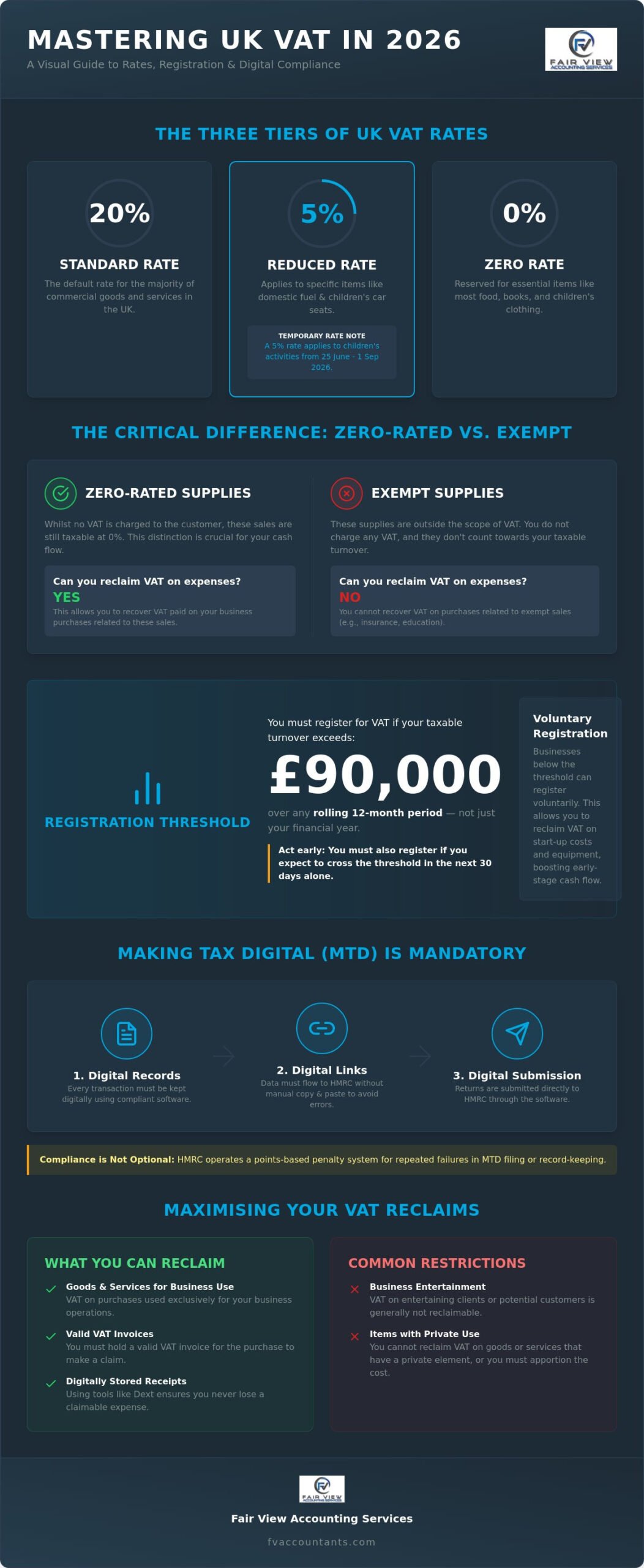
- Standard Rate (20%): The default rate for the majority of commercial goods and services.
- Reduced Rate (5%): Applies to specific items like domestic fuel and children’s car seats. Notably, a temporary 5% rate is active from 25 June 2026 to 1 September 2026 for children’s meals and attractions.
- Zero Rate (0%): Reserved for essentials like most food, books, and children’s clothing.
It’s vital to distinguish between zero-rated and exempt items. Whilst both result in no VAT charged to the customer, only zero-rated sales allow you to reclaim VAT on your business expenses. Exempt services, such as insurance, health services, or education, don’t provide this benefit. If your business only sells exempt goods, you cannot register for VAT or reclaim any tax on your purchases.
The VAT Registration Threshold: When Must You Act?
You must register for vat in uk if your taxable turnover exceeds £90,000 over any rolling 12-month period. This isn’t based on your fixed financial year; it’s a continuous look-back at your previous 12 months of trading. If you anticipate crossing this limit within the next 30 days, you also need to notify HMRC immediately to remain compliant.
Many smaller businesses choose to register voluntarily even if they’re below the £90,000 limit. This strategy allows you to reclaim VAT on significant start-up costs or equipment purchases, which can provide a welcome boost to your initial cash flow. It also simplifies your transition as you grow, ensuring your digital systems are ready for future expansion.
Your VAT Certificate: Proving Your Registration
Once your application is successful, HMRC issues a VAT registration certificate. This document serves as official proof of your status and contains your unique nine-digit VAT number and your effective date of registration. You’ll need this number to create valid VAT invoices and to set up trade accounts with many UK suppliers. Beyond administrative necessity, having a certificate enhances your professional credibility with larger corporate clients who expect to see a VAT-registered partner. For a deeper look at this document, see our guide on Understanding your VAT Certificate.
Managing VAT Compliance and Making Tax Digital (MTD)
Compliance for vat in uk has undergone a digital revolution. Making Tax Digital (MTD) is no longer an optional upgrade; it’s a mandatory requirement for all registered entities. HMRC requires “digital links” between your accounting records and their submission portals. This means your data must flow seamlessly from the point of entry to the final return without manual copying or pasting. This modern approach effectively eliminates the risk of transposition errors. It also provides you with a clear, real-time oversight of your tax liabilities, which is essential for accurate cash flow forecasting.
How MTD for VAT Works for Small Businesses
The transition to MTD has seen a significant shift from traditional spreadsheets to HMRC-recognised cloud software. You must now maintain a digital record for every single transaction, categorising them according to the current VAT rates to ensure your submissions are flawless. This digital-first strategy acts as a protective shield for your business, keeping your records organised and ready for any future HMRC enquiries. HMRC operates a points-based penalty system where repeated failures to comply with MTD filing or record-keeping rules result in financial charges.
Reclaiming VAT on Business Expenses
Maximising your VAT recovery is a vital part of maintaining a healthy balance sheet. You can typically reclaim the VAT paid on goods and services used exclusively for your business, but only if you possess a valid VAT invoice. Using digital tools like Dext allows you to scan and store these receipts instantly, ensuring you never lose a claimable expense. Be mindful of common restrictions; you generally cannot reclaim VAT on business entertainment for clients or travel that includes a private element. If you want to ensure you’re claiming every penny you’re entitled to, our VAT returns experts can provide the tailored oversight your business needs.
Streamlining Your VAT Returns with Fair View Accounting Services
Managing vat in uk shouldn’t be a source of constant administrative stress. At Fair View Accounting Services, we act as your tech-savvy guardian, bridging the gap between complex HMRC regulations and your daily operations. Our chartered accountants don’t just oversee your VAT; we provide a holistic service that integrates your payroll and corporation tax. This proactive approach ensures absolute compliance whilst identifying tax planning opportunities that protect your bottom line. We aim to move you from a state of concern regarding deadlines to a position of informed confidence.
Cloud-Based VAT Solutions: QuickBooks, Xero, and IRIS
We leverage modern platforms like QuickBooks, Xero, and IRIS to provide you with real-time data. This visibility allows you to predict future tax bills accurately and manage your cash flow with precision. We specialise in organising your digital links to meet the strict requirements of Making Tax Digital (MTD) without disrupting your workflow. This digital accuracy is also vital when we prepare your Accountant’s Certificate for mortgage or finance applications. It ensures your business’s financial stability is documented with the precision lenders require.
Avoiding HMRC Penalties and Pitfalls
Navigating the rules for vat in uk requires methodical attention to detail. Common errors, such as misidentifying exempt items as zero-rated, often lead to costly HMRC penalties. Our robust review process catches these categorisation mistakes before they reach the tax office. Having a dedicated team handle your statutory filings provides the peace of mind you need to focus on business growth. We ensure every submission is accurate, timely, and fully compliant with the latest regulatory changes. Enquire about our VAT return services today to secure your business’s financial health and simplify your digital record-keeping.
Secure Your Business’s Digital Future with Accurate VAT Management
Mastering your obligations for vat in uk is a foundational step towards long-term business stability. By accurately categorising your sales and maintaining precise digital links for MTD, you protect your company from avoidable HMRC penalties. It’s not just about compliance; it’s about using real-time financial data to make informed decisions for your future growth. We ensure your records remain accurate whilst you focus on expanding your operations.
As a chartered accounting firm with national UK coverage, Fair View Accounting Services provides the expert oversight you need to stay ahead of regulatory changes. We are specialists in cloud-based platforms like Xero and QuickBooks, ensuring your bookkeeping is seamless and your returns are always submitted with precision. Get expert VAT support from Fair View Accounting Services today and transition from tax-season stress to total financial clarity. You don’t have to navigate these complexities alone; we’re here to guide you every step of the way.
Frequently Asked Questions
What is the current VAT registration threshold in the UK for 2026?
The VAT registration threshold for vat in uk is £90,000 as of 2026. You must register if your taxable turnover over the last 12 months exceeds this limit or if you expect it to pass this mark in the next 30 days. It’s a rolling threshold, so you should check your cumulative turnover every month to stay compliant. Monitoring this through digital tools prevents any late registration penalties from HMRC.
Can I reclaim VAT on expenses incurred before my business was registered?
Yes, you can reclaim VAT on certain business expenses incurred before your registration effective date. You can generally claim for goods bought up to four years ago, provided you still have them, and services purchased in the last six months. This process requires you to have kept all original VAT invoices. It’s an excellent way to recoup some of your initial investment costs on your first digital return.
What happens if I miss a VAT return deadline or payment?
Missing a deadline triggers HMRC’s points-based penalty system. You’ll receive a penalty point for each late submission, and a financial penalty is applied once you hit a specific points threshold. Late payments also attract interest charges from the first day the tax is overdue. Staying organised with automated cloud accounting reduces the risk of these errors and protects your business’s cash flow from unexpected fines.
Do I need to register for VAT if my turnover is below the threshold?
You don’t have to register if your turnover is under £90,000, but many businesses choose to do so voluntarily. This allows you to reclaim the VAT you pay on your own business expenses, which can be a significant saving for your company. You should weigh this against the fact that you’ll have to charge VAT to your customers. If your clients are mostly VAT-registered themselves, they won’t mind the extra charge as they can reclaim it from HMRC.
Disclaimer
The information provided in this article is for general guidance only and is not intended to constitute professional advice, tax advice, financial advice, legal advice, or any other form of regulated guidance. Whilst every effort has been made to ensure accuracy at the time of publication, Fair View Accounting Services, including its director, employees, contractors, writers, and content creation team, accepts no responsibility for any loss, damage, penalty, or consequence arising from reliance on the information contained herein.UK tax legislation changes frequently, and HMRC interpretations, thresholds, and rules may vary depending on the individual circumstances of each taxpayer. Nothing in this article should be considered a substitute for obtaining formal, personalised advice from a qualified accountant or tax professional. Readers should not take action or refrain from taking action based solely on the content published on this website.Fair View Accounting Services does not guarantee the completeness, accuracy, or ongoing validity of the information provided and assumes no liability for omissions or errors, whether typographical, factual, or technical. By using this content, the reader acknowledges that all responsibility for decisions remains solely with the user.