

Imagine opening your inbox to find a surprise invoice for a simple five-minute query, or worse, a penalty notice from Companies House because a filing deadline was missed. These frustrations often signal a deeper misalignment between your business goals and your current financial support. If you feel like a small fish in an unresponsive pond, you are likely already noticing the clear signs you need a new accountant to protect your growth. Many directors hesitate to move because they fear the administrative upheaval, yet staying with a reactive firm can lead to late filing penalties reaching up to £1,500.
We agree that your focus should remain on running your company, not chasing your advisor for updates or worrying about Making Tax Digital compliance. This article promises to reveal the critical red flags you shouldn’t ignore whilst providing a methodical roadmap for a seamless transition. You will discover how a tech-forward partner uses cloud software to automate your bookkeeping and offers fixed-fee pricing for total peace of mind. We will preview the entire handover process, showing you how professional standards ensure a stable, organised transfer of your data with minimal effort on your part.
Key Takeaways
- Recognise the subtle signs you need a new accountant, from reactive communication to a lack of proactive advice on your Corporation Tax obligations.
- Navigate the transition with confidence by following a structured two-step process that begins with a formal Letter of Engagement.
- Utilise professional templates to notify your current firm, ensuring a respectful handover whilst maintaining full compliance with UK professional standards.
- Secure a modern partnership that prioritises cloud integration through tools like Xero and Dext for a paperless, efficient workflow.
- Shift to a transparent fixed-fee model to ensure predictable costs for your VAT returns, payroll, and statutory annual accounts.
Critical Signs You Need a New Accountant for Your UK Business
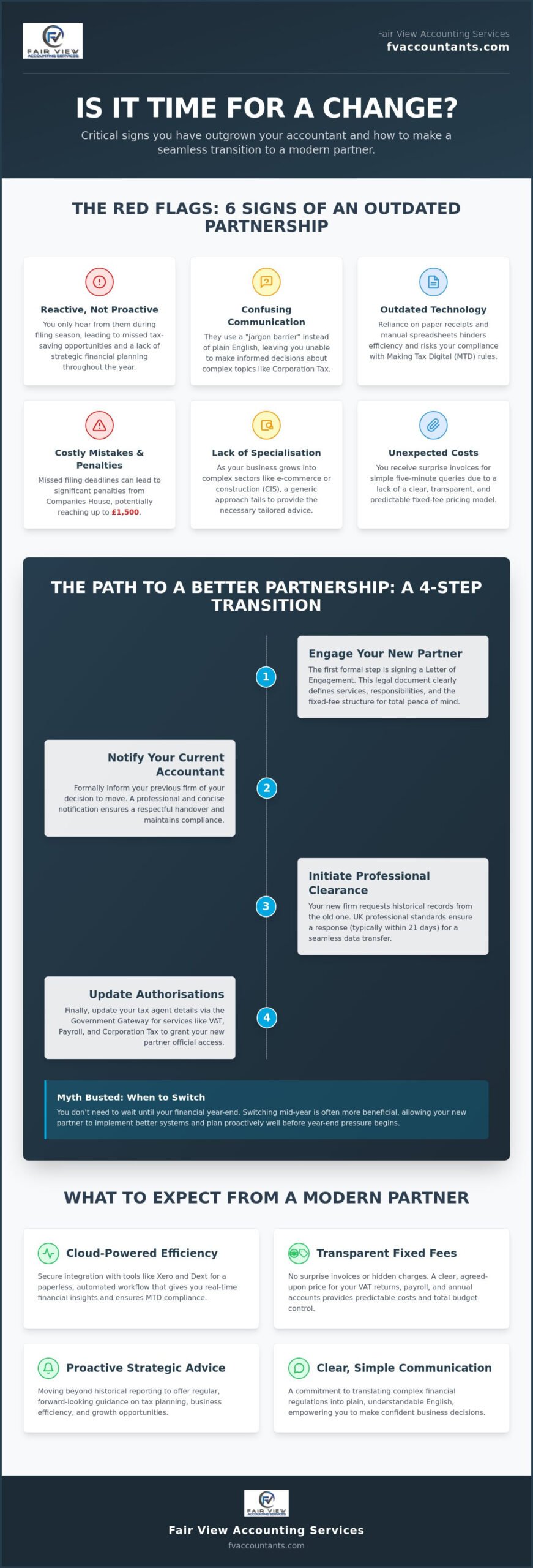
Your accountant should be a strategic partner, not just a once-a-year visitor who processes historical data. A reactive relationship often results in missed tax-saving opportunities, which is one of the most prominent signs you need a new accountant. If your current advisor only contacts you whilst filing your annual accounts, they aren’t helping you grow; they’re simply recording your past. A modern partner provides proactive advice, ensuring your records align with UK Generally Accepted Accounting Practice (UK GAAP) whilst identifying efficiencies in real-time.
Clarity is the foundation of a good partnership. If you encounter a “jargon barrier” when asking about Corporation Tax, your accountant is failing to empower you. Professional advisors translate complex regulations into plain English so you can make informed decisions. Stagnant technology is another red flag. If your firm still requests paper receipts or manual spreadsheets, they’re hindering your efficiency and risking your Making Tax Digital (MTD) compliance. From April 2026, MTD for Income Tax applies to sole traders with income over £50,000, and your firm must be ready to support this digital shift.
The Cost of “Quiet” Accounting
Silence from your accountant is often expensive. Without regular communication, you may miss critical windows for Capital Gains Tax planning before disposing of an asset. This lack of oversight also increases the risk of HMRC penalties if your advisor fails to flag upcoming VAT in the UK deadlines. A “quiet” accountant frequently leads to “loud” financial surprises, such as unexpected invoices for basic queries.
Outgrowing Your Current Firm
As your business scales, its complexity increases. You might have transitioned from a simple service business to a complex e-commerce operation or entered the construction sector under CIS. If your current firm lacks specialised knowledge in sectors like construction or online retail, they cannot provide the tailored support required to navigate 2026’s regulatory landscape. Specialised sector expertise is non-negotiable in 2026 because generic advice fails to account for the unique VAT and payroll nuances of high-growth industries.
The Step-by-Step Changing Accountants Process
Switching your financial representation is a structured procedure designed to protect your data and ensure continuity. Once you’ve recognised the signs you need a new accountant, the transition begins with choosing a partner who aligns with your modern business needs. The first formal step involves signing a Letter of Engagement. This document establishes the legal relationship and provides you with a clear breakdown of service expectations, responsibilities, and fixed-fee structures.
Following this, you must notify your current firm of your intent to move. We provide templates to ensure this communication remains professional and concise, reducing the potential for awkward conversations. Your new firm then initiates the “Professional Clearance” process. They will request your historical records, trial balances, and previous tax returns from the outgoing firm to ensure a seamless handover. Finally, you will need to follow official government guidance to update your tax agent details via the Government Gateway for VAT, Payroll, and Corporation Tax. If you’re ready for a more proactive partnership, our team can help you organise a stress-free transition today.
Understanding Professional Clearance
UK accountants operate under a strict ethical code that requires them to provide “clearance” to their successors. This process ensures there are no professional reasons why the new firm should not accept the appointment. If your previous advisor is slow to respond, most UK chartered bodies expect a reply within 21 days. This standardisation prevents administrative delays from impacting your filing deadlines or business operations, ensuring your records are transferred securely and promptly.
Timing Your Switch
Many directors believe they must wait until the end of the financial year to change advisors, but this is a common myth. Switching mid-year is often more beneficial. It allows your new partner to review your current bookkeeping and implement cloud-based systems well before the year-end pressure begins. Proactive planning ensures that your first set of annual accounts with a new firm is accurate, compliant, and delivered without the usual last-minute stress. Changing now gives your business the lead time required to optimise your tax position before the next deadline.
Selecting a Modern Partner: What to Look for in 2026
Identifying the signs you need a new accountant is only the first step; the next is ensuring your replacement firm is equipped for the future. You should prioritise cloud integration expertise. A modern firm must be proficient in Xero, QuickBooks, and Dext to ensure a seamless, paperless workflow. This digital approach eliminates manual errors and provides real-time visibility into your cash flow. Following guidance from the ICAEW, it’s vital to verify that your new advisor holds the necessary professional qualifications to manage your compliance effectively.
Look for fixed-fee transparency. Your partner should offer clear monthly packages that include Annual Accounts and tax compliance without hidden costs. Proactive tax planning is equally essential. Your firm should schedule regular reviews to discuss your CIS status or Accountant’s Certificate needs for mortgage applications. They must also demonstrate sector-specific knowledge, whether you’re a tradesperson, a landlord, or an e-commerce seller, as generic advice often misses industry-specific tax reliefs.
The Digital Handover: Moving Your Data Safely
Modern firms handle the transfer of cloud accounting subscriptions with precision, ensuring no data is lost during the migration. This involves a coordinated process where your new advisor takes over the subscription management seamlessly. It’s also a critical time to ensure a “clean break” with old software permissions. Removing previous users protects your business privacy and ensures that only your current, trusted partners have access to your sensitive financial records.
Why Fair View Accounting is the Logical Next Step
Fair View Accounting Services acts as a tech-savvy guardian for UK businesses. We provide national reach through our remote, online support model, managing the entire switching process on your behalf. Our chartered status ensures that every step of your transition meets the highest professional standards. We combine modern efficiency with grounded expertise, giving you the stability and clarity needed to focus on your business growth whilst we handle the administrative complexities.
Securing a Proactive Financial Future for Your Business
Recognising the signs you need a new accountant is the first step toward regaining control over your company’s financial health. We’ve explored how a reactive service can lead to missed tax opportunities and why a structured handover is far simpler than many directors anticipate. By moving to a modern firm, you replace administrative friction with streamlined cloud workflows and predictable monthly costs. This transition isn’t just about compliance; it’s about finding a partner who actively facilitates your growth whilst protecting you from HMRC penalties.
Fair View Accounting Services provides the stability of a chartered firm with the agility of a tech-forward guardian. We offer national UK support and specialise in seamless data migration across Xero and QuickBooks. Our fixed-fee pricing ensures you never face a surprise bill for seeking professional advice or clarifying your tax obligations. Don’t let a stagnant partnership hinder your company’s potential in 2026. You deserve an advisor who anticipates your needs and manages your compliance with precision. Switch to a proactive partner today—contact Fair View Accounting Services to begin your stress-free transition toward better financial management.
Frequently Asked Questions
Is it difficult to change accountants in the UK?
Changing your accountant is a structured and relatively simple process in the UK. Once you’ve spotted the signs you need a new accountant, your new firm manages the majority of the administrative burden by requesting professional clearance and historical data from your previous advisor. You simply need to sign a Letter of Engagement and notify your outgoing firm of the change, ensuring a smooth transition with minimal disruption to your daily operations.
Can I change my accountant if I have an outstanding bill with them?
You can certainly change advisors even if there is a payment dispute, but it may complicate the data transfer. Whilst your outgoing accountant cannot legally withhold records that belong to you, such as your own invoices or bank statements, they may exercise a “lien” over work they’ve produced until their fees are settled. It is usually best to resolve any outstanding balances to ensure the handover of all trial balances and tax computations happens without delay.
How much does the changing accountants process cost?
Most proactive accounting firms don’t charge a specific “switching fee” to bring you on board. The administrative tasks involved in professional clearance and data migration are typically included as part of your initial onboarding process. You should, however, check your current contract for any notice period requirements or final exit fees that your outgoing firm might apply for closing down your file or preparing final records for the transfer.
Do I need to notify HMRC myself when I switch accountants?
You don’t need to send a manual letter to HMRC, but you must authorise your new firm to act on your behalf. This is done digitally through your Government Gateway account for specific tax heads like VAT, Payroll, and Corporation Tax. Your new accountant will guide you through this process or send an online authorisation request, which you simply approve to ensure they can manage your filings and communicate with HMRC directly.
Disclaimer
The information provided in this article is for general guidance only and is not intended to constitute professional advice, tax advice, financial advice, legal advice, or any other form of regulated guidance. Although every effort has been made to ensure accuracy at the time of publication, Fair View Accounting Services, including its director, employees, contractors, writers, and content-creation team, accepts no responsibility for any loss, damage, penalty, or consequence arising from reliance on the information contained herein. UK tax legislation changes frequently, and HMRC interpretations, thresholds, and rules may vary depending on the individual circumstances of each taxpayer. Nothing in this article should be considered a substitute for obtaining formal, personalised advice from a qualified accountant or tax professional. Readers should not take action or refrain from taking action based solely on the content published on this website. Fair View Accounting Services does not guarantee the completeness, accuracy, or ongoing validity of the information provided and assumes no liability for omissions or errors, whether typographical, factual, or technical. By using this content, the reader acknowledges that all responsibility for decisions remains solely with the user.