

What if the biggest risk to your business isn’t a surprise HMRC enquiry, but a messy break-up with your current accountant? Ending a professional relationship often feels awkward, and it’s natural to worry that vital financial data will be lost or that you’ll miss a critical deadline during the move. With the 2026 MTD for ITSA requirements now active for those with income over £50,000, the stakes for a smooth transition have never been higher. Finding a reliable accountant disengagement letter template uk is the first step to ensuring your exit is handled with professional precision.
We believe that switching firms should be a catalyst for growth, not a source of stress. This guide will help you master the transition with professional guidance and a comprehensive handover checklist to ensure no record is left behind. You’ll learn how to navigate the new AML supervision rules whilst securing a seamless data transfer to a more modern, cloud-based partner. We’re here to provide the clarity you need for a clean break, giving you total peace of mind that your compliance remains perfectly intact during the journey ahead.
Key Takeaways
- Understand why a formal record is essential to define exactly when your previous firm’s responsibilities for VAT or Payroll end.
- Access a professional accountant disengagement letter template uk to ensure your departure is handled with legal clarity and professional courtesy.
- Learn the essential 5-step process for switching firms, including how to navigate notice periods without disrupting your business operations.
- Discover how to leverage your transition as an opportunity to modernise your finance function through cloud-based platforms like Xero and QuickBooks.
- See how a “tech-savvy guardian” can manage the professional clearance process on your behalf, reducing the administrative burden of your move.
What is an Accountant Disengagement Letter and Why is it Necessary?
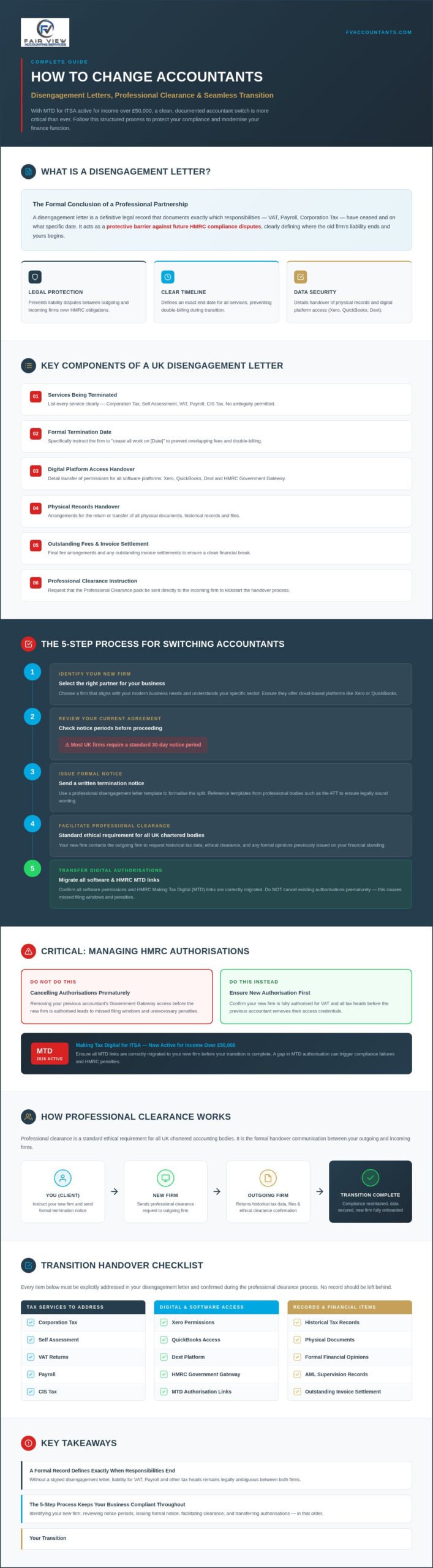
An accountant disengagement letter serves as the formal conclusion to your professional partnership. It acts as a definitive legal record, documenting exactly which responsibilities, such as VAT or Payroll, have ceased and on what specific date. Whilst the outgoing firm typically issues this document, using a professional accountant disengagement letter template uk to initiate the process ensures you remain in control of the timeline. Think of this letter as a protective barrier against future HMRC compliance disputes; it clearly defines where the old firm’s liability ends and yours begins.
The Role of Professional Clearance in the UK
When you decide to move your accounts, your new firm must request “professional clearance” from your previous provider. This communication is a standard ethical requirement amongst UK chartered bodies. It allows the incoming firm to ask if there are any professional reasons why they shouldn’t accept the appointment. This step is vital for a seamless transition, as it facilitates the accurate transfer of historical tax data and any formal opinion previously issued on your financial standing. At Fair View, we manage this request on your behalf to reduce the administrative burden on your business.
Key Components of a Standard UK Disengagement Letter
A well-structured disengagement letter leaves no room for ambiguity. It should clearly list every service being terminated, whether that includes Corporation Tax, Self Assessment, or CIS Tax. A standard accountant disengagement letter template uk should also detail the specific arrangements for the handover of physical records and the transfer of digital software access. This includes permissions for platforms like Xero, QuickBooks, or Dext. Finally, the letter outlines any outstanding invoice settlements and final fee arrangements. Ensuring these details are documented protects your business from unexpected costs and ensures your financial data remains secure during the migration.
How to Change Accountants: A 5-Step Guide for UK Businesses
Switching your financial partner is a strategic move that requires a logical, structured approach. By following these five steps, you’ll ensure your business remains compliant whilst moving toward a more efficient service model.
- Step 1: Identify your new firm. Select a partner that aligns with your modern business needs and understands your specific sector.
- Step 2: Review your current agreement. Check your existing engagement letter for notice periods; most UK firms require a standard 30-day notice.
- Step 3: Issue formal notice. Send a written termination notice using a professional accountant disengagement letter template uk to formalise the split.
- Step 4: Facilitate professional clearance. Your new firm will contact the outgoing firm to request the necessary files and ethical clearance.
- Step 5: Transfer digital authorisations. Confirm that all software permissions and HMRC “Making Tax Digital” (MTD) links are correctly migrated.
Accountant Disengagement Letter Template Structure
A professional termination notice should be clear and direct to prevent any overlap in fees. Your letter must include the formal date of termination and the name of your new firm. Specifically instruct your current provider to “cease all work on [Date]” to avoid being double-billed during the transition period. It’s also helpful to reference accountant disengagement letter templates provided by professional bodies like the ATT to ensure your wording is legally sound. Finally, explicitly request that the “Professional Clearance” pack be sent directly to Fair View Accounting to kickstart the handover.
Managing HMRC Authorisations
Handling your Government Gateway credentials with care is vital during a move. You’ll need to ensure your new firm is fully authorised for VAT in the UK and other tax heads before your previous accountant removes their access. Don’t cancel existing authorisations prematurely; doing so can lead to missed filing windows and unnecessary penalties. If you’re feeling overwhelmed by the paperwork, you can speak with our team about how we manage these technical handovers on your behalf.
Ensuring a Seamless Transition to a Modern Accounting Firm
Moving firms is more than just a paperwork exercise; it’s the ideal moment to modernise your finance function. While you might use an accountant disengagement letter template uk to start the formal exit, the real value lies in the onboarding. We act as your “tech-savvy guardian,” ensuring your data isn’t just moved, but optimised for the future. Whether you need a clean set of accounts for a future mortgage application or an Accountant’s Certificate, we ensure your records are accurate from day one.
Many business owners delay switching because they dread the “break-up” conversation. We eliminate this friction by managing the majority of the communication with your previous accountant. This professional approach keeps the transition polite and efficient, allowing you to focus on your business while we handle the technical migration and professional clearance requests.
The Digital Handover: Xero, QuickBooks, and Dext
A successful switch requires a clean digital handover. You’ll need to transfer ownership of your cloud subscriptions for platforms like Xero or QuickBooks to your new firm. UK law requires you to keep financial records for at least six years; we ensure these historical archives remain fully accessible within your new digital ecosystem. Our remote, online support provides national coverage, making it easy for UK businesses to stay compliant whilst benefiting from streamlined, paperless workflows via tools like Dext.
Why Fairness and Transparency Matter During a Switch
Professionalism works both ways. Settling your final fees ensures your previous firm cannot legally exercise a “lien” over your books, which would otherwise delay the transfer of your vital records. We recommend using a structured accountant disengagement letter template uk to confirm that all final invoices are identified and paid. At Fair View, we provide clear, upfront fee structures for all our services, from Corporation Tax to Payroll, so you never face similar disengagement issues in the future.
We look forward to helping you build a more stable and streamlined financial future.
Frequently Asked Questions
Do I have to give a reason for leaving my accountant in the disengagement letter?
You aren’t legally required to provide a specific reason for terminating your contract in your accountant disengagement letter template uk. It’s perfectly acceptable to state that you’re moving your business to a firm that better suits your current requirements or that you’re seeking a more modern, cloud-based approach. Keeping the notice polite and professional ensures a smoother handover process between the outgoing firm and your new partner.
Can my old accountant refuse to hand over my records if I owe them money?
Accountants can legally exercise a “lien” over your books and records if there are outstanding fees for the work they’ve completed. This means they may withhold certain documents until their final invoice is settled. However, they cannot withhold information required for you to meet your statutory tax obligations or files that belong to you rather than work they’ve produced. Settling your account promptly is the best way to avoid these delays.
How long does the professional clearance process usually take in the UK?
The professional clearance process typically takes between 14 and 21 days from the moment your new firm sends the initial request. This timeline allows your previous accountant enough time to review their files and respond to ethical enquiries. Whilst most firms respond within this window, delays can occur if there are complex historical issues or outstanding fees. We proactively monitor this timeline to ensure your transition stays on schedule.
What happens to my Making Tax Digital (MTD) settings when I change accountants?
Your Making Tax Digital (MTD) authorisations don’t automatically transfer between firms. You’ll need to grant your new accountant fresh permission through your Government Gateway account to file VAT returns or MTD for ITSA updates on your behalf. It’s vital that you don’t cancel the existing authorisation until the new firm is ready to take over. This overlap prevents any disruption to your digital record-keeping and ensures you don’t miss critical HMRC deadlines.
Disclaimer
The information provided in this article is for general guidance only and is not intended to constitute professional advice, tax advice, financial advice, legal advice, or any other form of regulated guidance. Although every effort has been made to ensure accuracy at the time of publication, Fair View Accounting Services, including its director, employees, contractors, writers, and content-creation team, accepts no responsibility for any loss, damage, penalty, or consequence arising from reliance on the information contained herein.UK tax legislation changes frequently, and HMRC interpretations, thresholds, and rules may vary depending on the individual circumstances of each taxpayer. Nothing in this article should be considered a substitute for obtaining formal, personalised advice from a qualified accountant or tax professional. Readers should not take action or refrain from taking action based solely on the content published on this website.Fair View Accounting Services does not guarantee the completeness, accuracy, or ongoing validity of the information provided and assumes no liability for omissions or errors, whether typographical, factual, or technical. By using this content, the reader acknowledges that all responsibility for decisions remains solely with the user.