

What if your accounting didn’t feel like a monthly chore but a strategic advantage that updates in real time? Many UK business owners still worry that an online accountant lacks the professional rigour of a high-street firm, yet the reality in 2026 is exactly the opposite. You’ve likely felt the frustration of opaque billing or waiting days for a response whilst HMRC deadlines loom. With Making Tax Digital (MTD) for Income Tax Self Assessment now mandatory for those earning over £50,000, the risk of penalties from slow communication has never been higher.
It’s understandable to feel overwhelmed by shifting regulations like the new FRS 102 revenue recognition rules or the recent increase in HMRC late payment interest. You deserve a partner who acts as a tech-savvy guardian, ensuring your compliance is seamless and your financial data is secure. This guide shows how a professional online accountant provides the perfect balance of cloud efficiency and Chartered expertise to protect and grow your UK business.
We’ll explore how modern firms use platforms like Xero and QuickBooks to provide real-time visibility of your tax liabilities. You’ll discover how to secure fixed, predictable monthly costs and professional peace of mind without being limited by your geographic location.
Key Takeaways
- Understand how the “Tech-Savvy Guardian” model combines automated data entry with Chartered tax strategy to secure your business against HMRC penalties.
- Identify the essential software stack, including Xero and QuickBooks, required for real-time financial oversight and seamless data flow in 2026.
- Learn why a professional online accountant offering fixed, all-inclusive monthly fees provides better financial predictability than traditional hourly billing models.
- Discover the stress-free professional clearance process that allows you to switch accounting partners without having to manage the handover yourself.
- Prepare for the latest Making Tax Digital (MTD) requirements and FRS 102 changes with a digital-first integration plan tailored for UK compliance.
What is an Online Accountant and How Do They Protect Your Business?
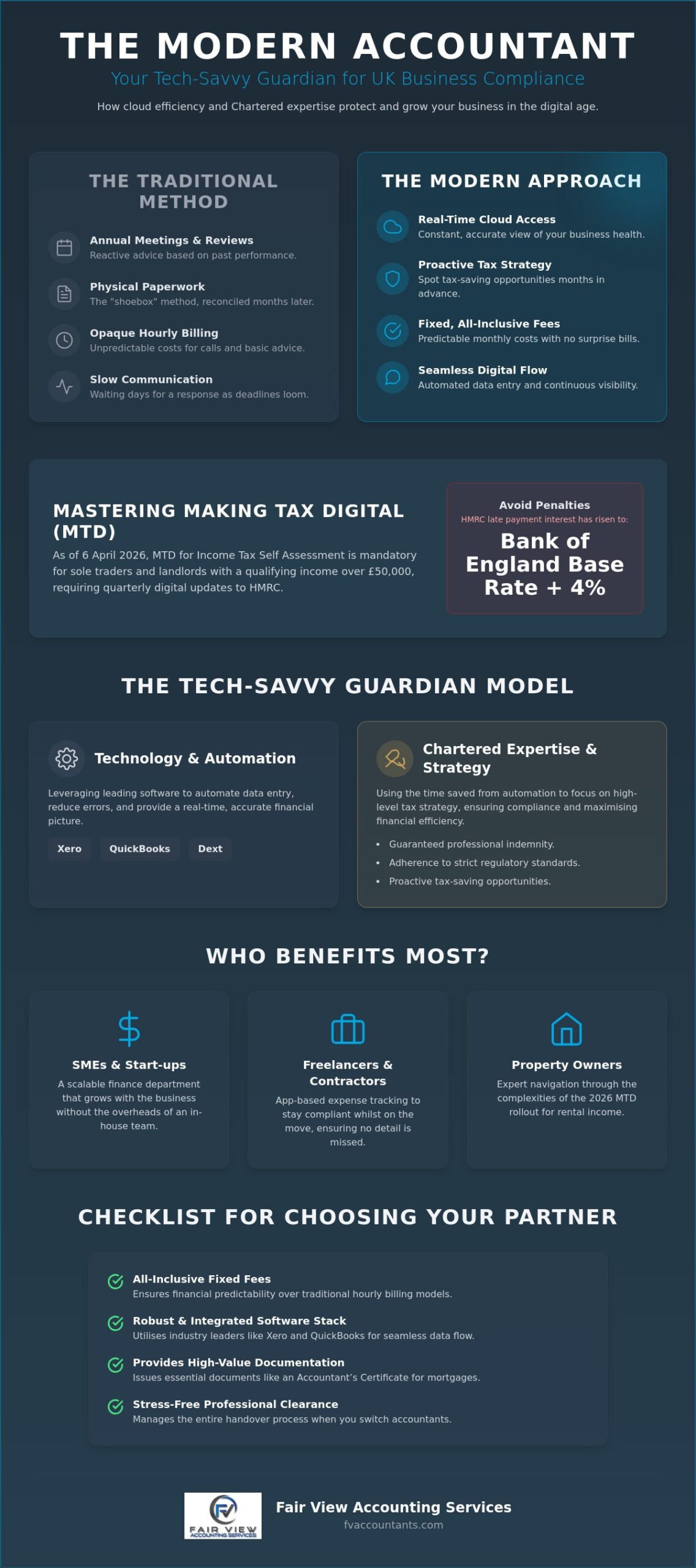
An online accountant is a professional service provider that uses digital platforms to manage your financial records and compliance requirements. Unlike the traditional model, which often relies on annual meetings and physical paperwork, this modern approach leverages E-accounting principles to provide real-time oversight. This shift means you don’t have to wait until the end of the financial year to understand your tax position; you can see it today. By moving your records to the cloud, you gain a constant, accurate view of your business health.
We view this role as a “tech-savvy guardian.” By using automation for repetitive data entry tasks, your online accountant can spend more time on high-level tax strategy. This moves your business away from the old “shoebox” method, where records were reconciled months after the fact, toward a model of continuous visibility. This proactive stance is essential in 2026, especially as HMRC late payment interest has risen to the Bank of England base rate plus 4%. Staying ahead of your liabilities isn’t just good practice; it’s a vital financial safeguard.
Compliance is the primary shield provided by a modern firm. As of April 6, 2026, Making Tax Digital (MTD) for Income Tax Self Assessment is mandatory for sole traders and landlords with a qualifying income over £50,000. We ensure your software is configured to submit quarterly updates correctly, protecting you from the increased penalty risks associated with the new digital regime. This structured approach ensures that no deadline is missed and no detail is overlooked.
The Chartered Difference in an Online World
Choosing a Chartered firm provides a level of security that software-only services can’t match. Our status guarantees professional indemnity and adherence to strict regulatory standards. By integrating cloud accounting into our workflow, we can spot tax-saving opportunities months in advance rather than reacting to a completed tax year. This proactive oversight ensures you never pay more than necessary whilst maintaining total transparency with HMRC.
Who Benefits Most from Remote Accounting Support?
Remote support is particularly valuable for those who value efficiency and scalability. We find the following groups benefit most from this digital-first approach:
- SMEs and start-ups: These businesses need a scalable finance department that grows with them without the overhead of an in-house team.
- Freelancers and contractors: Individuals who require app-based expense tracking to stay compliant whilst on the move.
- Property owners: Landlords navigating the complexities of the 2026 MTD rollout for their rental income.
Comparing Online Accountancy Services: Key Criteria for UK Businesses
Selecting an online accountant shouldn’t be a race to the bottom on price. Whilst some firms offer low entry rates, they often lack the depth of service required for complex business structures. Look for a partner that utilises a robust software stack, including industry leaders like Xero, QuickBooks, and Dext. This ensures a seamless flow of data, allowing your financial records to remain accurate and accessible at all times. A well-integrated system reduces manual errors and provides the clarity you need to make informed decisions.
Transparency is vital for long-term planning. You should seek all-inclusive fixed fees to avoid unexpected charges for phone calls or basic tax advice. A generalist firm may struggle with the specific nuances of VAT in the UK, particularly for businesses involved in international trade or the Construction Industry Scheme (CIS). Professional firms should also provide high-value documentation, such as an Accountant’s Certificate, which is essential for mortgage applications and securing business finance.
Modern firms align their services with HMRC’s digital direction. The government has recently expanded online interactive help for compliance checks, which highlights the importance of having a professional who can navigate these digital tools. If you need clarity on your specific obligations, you can consult with our Chartered team to ensure your records are fully compliant and optimised for growth.
Specialist Support for E-commerce and Construction
E-commerce businesses facing the complexities of Amazon FBA or eBay must manage international VAT and marketplace fees with precision. Similarly, tradespeople require accurate CIS returns to ensure timely HMRC refunds. A specialist online accountant understands these sector-specific pressures and automates the reporting process to reduce errors. For construction firms in particular, managing payroll for construction companies UK requires a precise balance between standard PAYE and strict CIS deductions to avoid heavy penalties. This ensures that you remain compliant whilst focusing on your core operations.
The Myth of the “Missing” Personal Touch
Many worry that remote services feel impersonal. In reality, video calls and real-time screen sharing often provide more focused “face time” than a hurried annual meeting in a physical office. You gain a dedicated partner who understands your specific business goals and is available to provide strategic advice whenever you need it. This combination of digital efficiency and human expertise creates a more responsive relationship than traditional models allow.
Transitioning to a Modern Partner: The Fair View Approach
Switching to an online accountant should be a seamless transition that removes administrative burdens rather than adding to them. Our methodical approach ensures your business remains protected whilst we take over the management of your financial obligations. We follow a structured three-step process to move you from a state of potential concern to one of informed confidence.
- Step 1: Professional Clearance. We liaise directly with your previous firm to request all necessary records and tax history. This removes the social and administrative friction of the handover, meaning you don’t have to manage awkward conversations or chase paperwork yourself.
- Step 2: Digital Integration. Our team sets up or optimises your Xero or QuickBooks environment to ensure it’s fully ready for 2026 requirements. This includes configuring your software for the mandatory Making Tax Digital (MTD) updates and ensuring your data flow is secure.
- Step 3: Ongoing Vigilance. We maintain a rigorous monthly cycle of bookkeeping, payroll, and proactive tax planning. This constant oversight provides the peace of mind that your statutory accounts and corporation tax are always under control.
Avoiding Common Pitfalls When Switching
Switching partners requires careful timing to ensure no VAT or payroll deadlines are missed during the handover. We prioritise a “clean data” migration, where we verify your opening balances before proceeding. This prevents historic bookkeeping errors from affecting your future returns or triggering unnecessary compliance checks. By auditing your existing records during the transition, we ensure your digital foundation is accurate from day one.
Scaling Your Business with Management Accounts
Professional accounting goes beyond simple compliance. We help you use your financial data to drive profitability through monthly management accounts. In this capacity, your online accountant acts as a virtual CFO, providing deep insights into your cash flow and profit margins. This strategic oversight is essential for growing SMEs that require high-level financial leadership to scale effectively without the overhead of a full-time executive.
Securing Your Financial Future in a Digital-First UK
Modern UK business demands more than just annual compliance; it requires constant, strategic oversight. By partnering with a professional online accountant, you move away from reactive accounting and toward a model of continuous financial clarity. This approach ensures you remain fully compliant with the latest Making Tax Digital requirements whilst gaining the real-time data needed to drive profitability.
Our team of Chartered Certified Accountants provides the stability you need to manage complex statutory accounts and corporation tax. As specialists in Accountant’s Certificates and experts in Xero and QuickBooks, we ensure your digital integration is seamless and your financial records are always audit-ready. You don’t have to navigate shifting regulations alone; you can rely on a dedicated guardian to protect your interests.
Take the next step toward a more organised and predictable financial future. We are ready to help you navigate the complexities of 2026 regulations with confidence and precision.
Frequently Asked Questions
How much does an online accountant cost in the UK?
The cost of a professional online accountant depends on your business complexity and the volume of transactions you process. Most modern firms move away from unpredictable hourly billing in favour of fixed monthly fees. This structure typically covers core requirements like annual accounts and VAT returns. Factors such as the number of employees on your payroll or the need for specialised tax planning will influence your specific fee structure.
Is an online accountant as safe as a traditional one?
A professional online accountant is just as safe as a high-street firm, provided they hold Chartered status and use secure, encrypted platforms. Chartered firms must adhere to strict regulatory standards and maintain professional indemnity insurance to protect their clients. By using cloud platforms with bank-level security and two-factor authentication, your financial data is often more secure than physical records stored in a traditional office environment.
Can an online accountant help with my mortgage application?
Yes, a Chartered online accountant can provide the Accountant’s Certificate required for mortgage applications and other business finance. Lenders require this document to verify the income of company directors, sole traders, and contractors. Because your records are managed digitally and updated in real time, we can produce accurate evidence of your earnings quickly. This ensures your application proceeds without the delays often associated with manual record-keeping.
What software do online accountants typically use?
Modern online accountants utilise a integrated tech stack led by industry-standard platforms like Xero and QuickBooks. These cloud-based systems are often supplemented by tools like Dext for automated receipt capture and IRIS for compliant tax filings. This software integration allows for a seamless flow of data, ensuring your bookkeeping is accurate and your tax liabilities are visible in real time. It removes the need for manual data entry and reduces the risk of human error.
Disclaimer
The information provided in this article is for general guidance only and is not intended to constitute professional advice, tax advice, financial advice, legal advice, or any other form of regulated guidance. Although every effort has been made to ensure accuracy at the time of publication, Fair View Accounting Services, including its director, employees, contractors, writers, and content-creation team, accepts no responsibility for any loss, damage, penalty, or consequence arising from reliance on the information contained herein.UK tax legislation changes frequently, and HMRC interpretations, thresholds, and rules may vary depending on the individual circumstances of each taxpayer. Nothing in this article should be considered a substitute for obtaining formal, personalised advice from a qualified accountant or tax professional. Readers should not take action or refrain from taking action based solely on the content published on this website.Fair View Accounting Services does not guarantee the completeness, accuracy, or ongoing validity of the information provided and assumes no liability for omissions or errors, whether typographical, factual, or technical. By using this content, the reader acknowledges that all responsibility for decisions remains solely with the user.