

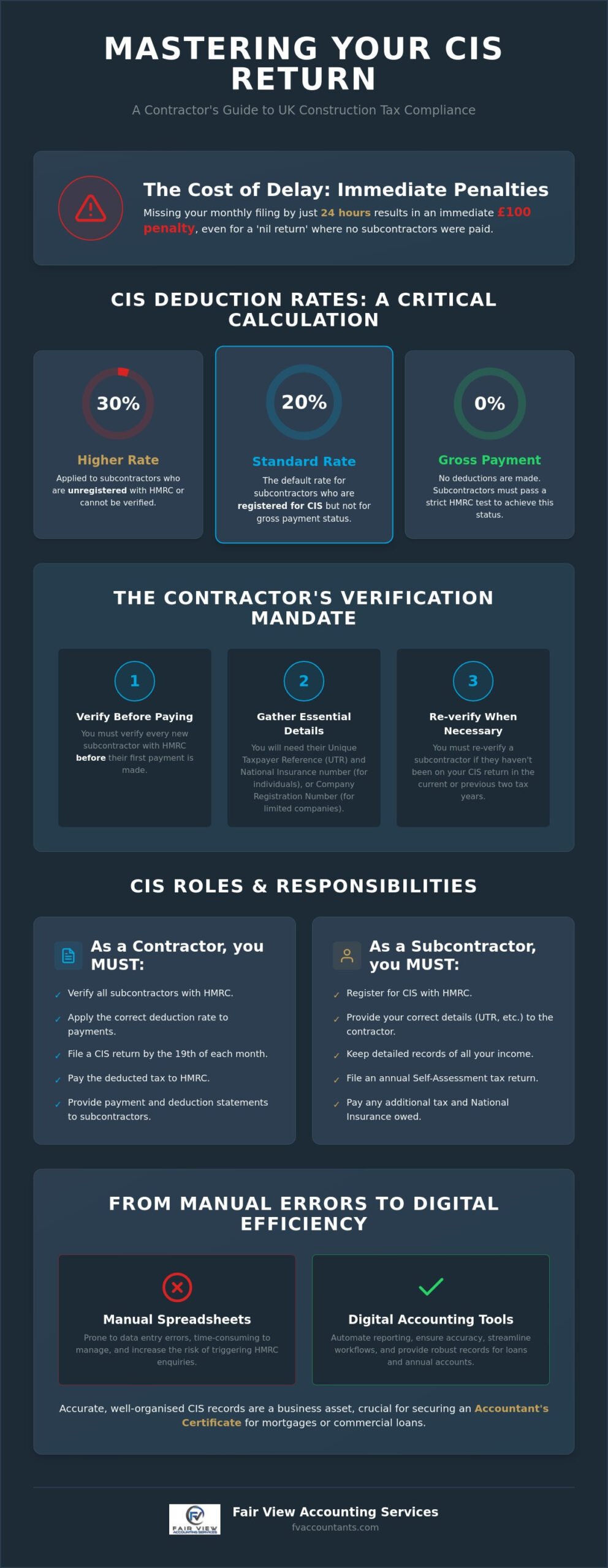
Did you know that missing your monthly filing by just twenty-four hours results in an immediate £100 penalty, even if you didn’t pay a single subcontractor that month? Following the reinstatement of mandatory nil returns in April 2026, the margin for error has narrowed significantly for contractors across the UK. We understand that the pressure of the 19th-of-the-month deadline can feel like a constant weight on your shoulders, especially when manual spreadsheets and data entry errors threaten your hard-earned profits.
Managing your monthly cis return shouldn’t be a source of anxiety. You deserve a clear, stable process that protects your business from heavy HMRC fines and ensures your subcontractors are paid accurately every time. This guide provides the clarity you need to handle complex tax regulations with ease, moving you from a state of administrative worry to one of informed confidence.
We’ll walk you through the essential steps for total compliance, from verifying deduction rates to utilising digital tools that automate your workflow. By the end of this article, you’ll have a professional roadmap for maximising tax efficiency and ensuring your construction firm stays ahead of regulatory changes.
Key Takeaways
- Learn how to file your monthly cis return accurately to avoid immediate HMRC penalties and protect your business cash flow.
- Identify the three critical deduction rates for subcontractors to ensure your tax withholdings are precise and compliant.
- Understand your legal obligation to verify subcontractors before payment to prevent costly administrative errors and status disputes.
- Discover how integrating digital accounting tools can automate your reporting and replace time-consuming manual spreadsheets.
- Clarify the specific tax responsibilities for both contractors and subcontractors to maintain a transparent and professional working relationship.
Understanding the CIS Return: A Compliance Essential for UK Construction
The Construction Industry Scheme (CIS) serves as a dedicated tax collection mechanism designed specifically for the building sector. Under this framework, contractors deduct money from a subcontractor’s payments and pass it directly to HM Revenue and Customs (HMRC). These deductions count as advance payments towards the subcontractor’s tax and National Insurance contributions. Within the broader UK Tax System, this scheme ensures that tax is collected efficiently at the source, reducing the likelihood of revenue loss in a fast-moving industry.
Your monthly cis return is the primary reporting tool used to inform HMRC about these transactions. It’s more than just a monthly administrative task; it’s a formal declaration of your compliance. For professional contractors, including specialists like I R. Wilson Roofing, filing an accurate return confirms that you’ve verified your subcontractors, applied the correct deduction rates, and handled public funds with precision. Maintaining a flawless reporting history builds a profile of reliability with the authorities, which acts as a safeguard for your business reputation.
Why HMRC Prioritises the Construction Industry
HMRC has historically identified the construction sector as an area with high risks regarding tax evasion. The prevalence of temporary contracts and mobile workforces once made it difficult to track income accurately. This led to the creation of the CIS to enforce transparency. Today, the shift towards digital reporting and “Making Tax Digital” principles means that HMRC’s systems are more sophisticated than ever. They use your monthly cis return to cross-reference data instantly. If the figures you report don’t match the subcontractor’s self-assessment, it triggers an immediate red flag in their system.
The Commercial Value of Accurate CIS Records
Precision in your tax reporting provides benefits that extend far beyond avoiding penalties. Clean, well-organised CIS records are essential when you seek to grow your business or secure personal financing. For instance, lenders often require an Accountant’s Certificate to verify your earnings and stability before approving a mortgage or commercial loan. If your records are fragmented, this process becomes significantly more difficult.
Furthermore, accurate CIS data ensures that your Annual Accounts are robust and reflect the true financial position of your company. Professional oversight of your monthly filings ensures that every deduction is accounted for correctly, which simplifies your year-end processes. By treating compliance as a strategic asset, you reduce the risk of a disruptive HMRC enquiry and position your business as a stable, trustworthy entity in the eyes of both the government and financial institutions.
The Mechanics of Monthly Reporting: Verification and Deductions
Contractors carry a significant legal burden under the CIS framework. Before you issue a single payment to a new subcontractor, you’re required to verify their tax status directly with HMRC. This step isn’t optional. It dictates exactly how much money you must withhold for your monthly cis return. Failing to verify correctly often leads to under-deductions, which HMRC expects the contractor to cover from their own pocket. Precision at this stage prevents future financial liabilities and ensures your reporting remains beyond reproach.
The Verification Process Explained
Verification is a straightforward digital process performed via the HMRC online service. You’ll need specific details from the subcontractor to proceed. For individuals, ensure you have their Unique Taxpayer Reference (UTR) and National Insurance number. If you’re hiring a limited company, you’ll need the UTR and the company registration number. It’s vital to remember that verification isn’t a one-time event for every worker. If you haven’t included a subcontractor on a cis return during the current or previous two tax years, you must re-verify them to ensure their tax status hasn’t changed.
Calculating Deductions Correctly
Once verified, HMRC will confirm which of the three deduction rates applies to that specific subcontractor. These rates are non-negotiable and must be applied to the labour portion of every payment:
- 30% Deduction: Applied to unregistered subcontractors who cannot be verified by HMRC.
- 20% Deduction: The standard rate for subcontractors who are correctly registered with the scheme.
- 0% Deduction: Reserved for those who have applied for and been granted gross payment status.
Gross Payment Status represents the highest tier of CIS reliability for a subcontractor, allowing them to receive full payment without deductions.
When calculating the actual amount to withhold, you only apply the percentage to the labour element of the invoice. You must exclude the cost of materials, plant hire, fuel, and any VAT charged. This “supply and fix” distinction requires careful bookkeeping to ensure you don’t over-deduct or under-deduct tax. Providing a clear “Statement of Payment and Deductions” to your subcontractors within 14 days of the tax month end is a legal requirement. This document helps them manage their own tax affairs, as outlined in this guide on CIS Explained for Subcontractors.
Maintaining accurate records is non-negotiable. You’re legally required to keep all CIS-related documents, including verification numbers and payment statements, for at least three years after the end of the tax year they relate to. If you find the manual tracking of these variables overwhelming, our team at Fair View Accounting Services can help you implement automated systems that handle these calculations with precision. Consistent record-keeping protects you during HMRC audits and ensures your business remains in good standing.
Contractor vs Subcontractor: Navigating Your Specific Obligations
Understanding the distinction between a contractor and a subcontractor is fundamental to avoiding administrative friction. In this relationship, the contractor acts as an unpaid tax collector for HMRC. They carry the responsibility of deducting the correct tax amount from payments and reporting these figures through the monthly cis return. Subcontractors, whilst receiving net pay, must ensure they collect their payment statements and maintain meticulous records for their own end of year filings. This interaction requires constant communication to ensure that the tax withheld matches the tax reported.
It’s a common misconception that only building companies fall under these rules. A business is legally considered a “deemed contractor” if its expenditure on construction operations exceeds £3 million within a rolling 12-month period. This rule often catches out large retailers, property investors, or local authorities who commission significant works. Once you cross this threshold, you must register for the scheme and fulfill all reporting duties to remain compliant with HMRC regulations. Failing to recognise this status can lead to years of backdated penalties and interest charges.
The “Nil Return” Trap: A Common Compliance Pitfall
Many businesses mistakenly believe that if they haven’t used subcontractors in a specific month, they can simply skip the filing. This is a costly assumption that often leads to unexpected fines. As of April 6, 2026, contractors are legally required to submit a cis return every month, even if no payments were made. This is known as a “nil return”. If you don’t expect to pay any subcontractors for up to six months, you can file an “inactivity request” with HMRC to pause these requirements. Proactively managing these periods of inactivity prevents the automated £100 penalty that triggers the moment a deadline is missed.
Subcontractor Tax Reconciliation
For subcontractors, the monthly statements provided by contractors are the foundation of a successful Self Assessment. These documents serve as proof that tax has already been paid at the source, preventing you from being taxed twice on the same income. If the contractor’s reports don’t match your own records, it can significantly delay a CIS repayment claim or trigger a manual review of your accounts. Ensuring that your records are reconciled monthly makes the final tax submission a seamless process rather than a stressful administrative hurdle. This methodical approach protects your cash flow and ensures you receive any overpaid tax as quickly as possible.
Deadlines, Penalties, and the Path to Error-Free Filing
The 19th of every month is the most critical date in the construction calendar. This is the hard deadline for submitting your cis return for the previous tax month, which runs from the 6th of one month to the 5th of the next. HMRC operates a strict, automated penalty system that triggers the moment this window closes. Unlike other tax obligations where there might be a grace period, the CIS framework is designed to enforce immediate compliance through financial deterrents.
The penalty structure is progressive and can quickly erode your project’s profit margins. Missing the deadline by just one day results in an immediate £100 fine. If the return remains outstanding after two months, an additional £200 penalty is applied. At the six-month mark, the fine increases to £300 or 5% of the CIS deductions on the return, whichever is higher. For delays reaching 12 months, you face another £300 or 5% penalty, and in serious cases, HMRC may apply an additional penalty of up to £3,000 or 100% of the tax due.
Beyond the immediate financial cost, late filings threaten your Gross Payment Status (GPS). HMRC regularly reviews your compliance history; consistently missing deadlines or filing incorrect returns can lead to the revocation of your GPS. Losing this status means your own income will be subject to a 20% deduction at the source, which can devastate your business cash flow. Whilst you can appeal a penalty if you have a “reasonable excuse”, HMRC defines this narrowly as an unforeseeable or unavoidable event, such as a serious illness or a system failure at their end. Forgetting the date or being too busy is never accepted as a valid reason.
A Step-by-Step Monthly CIS Routine
Establishing a methodical rhythm is the only way to guarantee error-free filing. We recommend the following schedule to ensure you never face a late penalty:
- By the 5th: Collate all subcontractor invoices and ensure any new starters are verified.
- By the 10th: Calculate all deductions, ensuring you’ve correctly excluded VAT and materials.
- By the 14th: Submit your cis return via cloud software to provide a five-day buffer for any technical issues.
- By the 19th: Confirm that your payment has reached HMRC to clear the balance.
Correcting Mistakes on Past Returns
If you discover a calculation error after submission, you must act quickly to amend the entry. You can typically correct a return by notifying HMRC through your digital filing system or by telephone. If the error resulted in an underpayment, paying the difference immediately can help mitigate potential interest charges. Utilising professional bookkeeping services ensures that these discrepancies are caught during the reconciliation process rather than during an HMRC audit. If you’re looking for a reliable partner to manage your monthly filings and protect your GPS, explore our professional CIS return services.
Streamlining Your Construction Tax with Fair View Accounting
At Fair View Accounting Services, we act as your tech-savvy guardian, ensuring that your monthly compliance never falters. We move beyond basic data entry by integrating advanced cloud platforms directly into your construction workflow. By utilising industry-leading tools like Xero, QuickBooks, or IRIS, we transform the way you handle your cis return. These systems allow for a seamless flow of information, which significantly reduces the risk of manual errors that often lead to disruptive HMRC enquiries.
Our approach isn’t isolated to a single task. We synchronise your CIS data with your broader Corporation Tax obligations and VAT Returns. This joined-up strategy ensures that your tax position is optimised across all fronts, providing a clear and stable picture of your business health. We take the weight of administrative complexity off your shoulders, allowing you to focus on project delivery whilst we maintain the precision of your financial records.
Digital Integration: The Future of Construction Accounting
We leverage modern tools like Dext to automate invoice capture, meaning you don’t have to spend your evenings sorting through paper receipts. Data moves instantly from your payroll records to your monthly cis return filings. This automation provides real-time visibility of your tax liabilities, allowing for much more accurate cash flow management. You’ll always know exactly what’s owed to HMRC well before the deadline arrives, ensuring you never face the stress of an unexpected bill.
Why Choose Fair View Accounting Services for Your Construction Business?
As Chartered Accountants, we provide professional, national support across the UK, tailored specifically to the builders and contractors we serve. We understand that your time is best spent on-site, managing projects and driving growth. Our methodical approach handles the administrative burden of subcontractor verification and reporting on your behalf. We provide the stability and clarity you need to scale your operations without the fear of compliance failures or heavy penalties. Our team is dedicated to your success, acting as a proactive partner in your business journey.
If you’re ready to move away from stressful spreadsheets and embrace a more efficient, digital-first approach to tax, we’re here to help. Our tailored solutions ensure that your business remains compliant and your tax efficiency is maximised at every stage. Get a professional quote for your CIS return management from Fair View Accounting Services today and experience the peace of mind that comes with expert oversight.
Secure Your Construction Business with Professional Compliance
Managing your monthly cis return shouldn’t be a source of administrative stress. We’ve explored how transitioning from manual spreadsheets to digital cloud integration protects your business from the progressive penalty system and the risk of losing Gross Payment Status. By implementing a methodical verification routine and understanding the “nil return” requirement, you ensure your construction firm remains both compliant and commercially attractive to lenders. Professional oversight transforms these regulatory obligations from a monthly hurdle into a strategic asset for business growth.
While digital systems and professional accountants can handle the paperwork, managing the personal pressure of business ownership is equally important. For those feeling the strain of high-stakes deadlines and administrative burdens, Citizen Coaching and Counselling provides specialised support to help you manage stress and maintain a healthy focus on your business goals.
As a Chartered Accounting firm with national UK coverage, Fair View Accounting Services provides the precision and technological expertise required to manage your tax obligations seamlessly. We integrate your CIS reporting with your broader financial strategy, including VAT and Corporation Tax, to optimise efficiency across the board. Our team is dedicated to providing the stability and clarity your business needs to thrive in a digital-first regulatory environment.
Let Fair View Accounting Services manage your CIS returns and protect your business compliance. We’re ready to act as your tech-savvy guardian so you can focus on delivering high-quality builds without the weight of HMRC enquiries. We look forward to supporting your continued success and ensuring your financial future remains under control.
Frequently Asked Questions
What is the deadline for filing a CIS return?
The deadline for filing your monthly cis return is the 19th of every month following the end of the tax month. This covers payments made between the 6th of one month and the 5th of the next. Missing this date by even twenty-four hours triggers an automatic £100 fine. We recommend submitting your data by the 14th to allow a buffer for technical issues or bank delays.
Can I file a CIS return myself or do I need an accountant?
You can legally file your own returns via the HMRC online service or compatible software. However, many construction firms partner with an accountant to eliminate the risk of manual data entry errors. Professional oversight ensures that deduction rates are applied correctly and that your records are robust enough to withstand a potential HMRC enquiry. This partnership allows you to focus on your builds whilst we handle the complex administration.
What happens if I forget to file a Nil Return?
Failing to file a Nil Return results in an immediate £100 penalty, even if no subcontractors were paid during that period. Since April 6, 2026, a monthly cis return is a mandatory requirement unless you have formally notified HMRC of a period of inactivity. Proactively managing these zero-payment months is essential for protecting your compliance record and avoiding automated fines that can quickly accumulate over several months.
How much are the penalties for a late CIS return?
Penalties for late filing start at £100 for being one day late. If the return is still outstanding after two months, a further £200 fine is issued. At six and twelve months, additional penalties of £300 or 5% of the tax due are applied, whichever is greater. In extreme cases of prolonged non-compliance reaching the twelve-month mark, HMRC may issue additional fines of up to £3,000 to reflect the severity of the oversight.
Do I need to verify every subcontractor every month?
You don’t need to verify every subcontractor every month, but you must check their status if you haven’t included them on a return in the current or previous two tax years. HMRC’s systems may update a worker’s tax status at any time, so it’s a professional best practice to re-verify if you have any doubts. Keeping your verification numbers up to date ensures you always apply the correct 20% or 30% deduction rate.
What expenses can be deducted before calculating CIS tax?
You can deduct the cost of materials, plant hire, fuel, and equipment used specifically for the job before calculating the tax. VAT is also excluded from the deduction calculation. It’s vital to ensure these costs are clearly itemised on the subcontractor’s invoice. Only the labour element of the payment is subject to tax withholding, so precise bookkeeping is necessary to prevent over-deducting tax and impacting the subcontractor’s cash flow.
Can I get my Gross Payment Status back if HMRC cancels it?
You can regain Gross Payment Status if HMRC cancels it, but the process usually involves a formal appeal or a waiting period. You must demonstrate that you’ve rectified the compliance failures that led to the cancellation, such as late filings or unpaid tax. HMRC will review your history over the following twelve months to ensure total compliance before restoring the status. Maintaining a flawless record is always easier than attempting a recovery.
How do I change from a 30% deduction rate to 20% for a subcontractor?
To change a subcontractor from a 30% rate to 20%, the subcontractor must first register for the scheme with HMRC. Once they’ve successfully registered and received their Unique Taxpayer Reference, you must re-verify them through your accounting software or the HMRC portal. The system will then provide a new verification number and confirm the lower deduction rate. You cannot manually lower the rate without this formal confirmation from HMRC systems.
Disclaimer
The information provided in this article is for general guidance only and is not intended to constitute professional advice, tax advice, financial advice, legal advice, or any other form of regulated guidance. Although every effort has been made to ensure accuracy at the time of publication, Fair View Accounting Services, including its director, employees, contractors, writers, and content-creation team, accepts no responsibility for any loss, damage, penalty, or consequence arising from reliance on the information contained herein.
UK tax legislation changes frequently, and HMRC interpretations, thresholds, and rules may vary depending on the individual circumstances of each taxpayer. Nothing in this article should be considered a substitute for obtaining formal, personalised advice from a qualified accountant or tax professional. Readers should not take action or refrain from taking action based solely on the content published on this website.
Fair View Accounting Services does not guarantee the completeness, accuracy, or ongoing validity of the information provided and assumes no liability for omissions or errors, whether typographical, factual, or technical. By using this content, the reader acknowledges that all responsibility for decisions remains solely with the user.