

What if the “free” selling era on eBay is actually costing your business more in missed tax deductions and reconciliation errors? Many UK entrepreneurs feel a sense of dread when attempting to match monthly ebay seller fees with their actual bank deposits. You likely find it difficult to account for the 0.35% regulatory operating fee or the 20% VAT applied to your business charges, especially whilst trying to maintain accurate bookkeeping for HMRC. It is often the small details, such as the £0.30 per-order fee on lower-value items, that create the biggest headaches during your Self Assessment.
By mastering the 2026 fee structure, you can transform this confusion into a streamlined financial process that supports your growth. This guide provides a clear breakdown of final value fees and per-order charges, ensuring you have total clarity over your margins. We will explore how to categorise these expenses correctly and manage international surcharges with professional precision, giving you the peace of mind that your e-commerce tax obligations are fully under control.
Key Takeaways
- Understand the critical distinction between private and business account models to ensure you are utilising the correct fee structure for your sales volume.
- Master the calculation of ebay seller fees for 2026, including specific final value percentages and the mandatory regulatory operating fees that impact your bottom line.
- Evaluate the true cost of optional listing upgrades and Promoted Listings to ensure your pricing strategy accounts for every deduction before the sale.
- Clarify your tax position by applying the HMRC ‘Badges of Trade’ to your selling behaviour, ensuring you remain compliant whilst scaling your enterprise.
- Discover how to reconcile complex eBay reports with your digital bookkeeping software to maintain accurate records for VAT and Self Assessment.
Understanding the eBay Fee Structure: Private vs Business Sellers
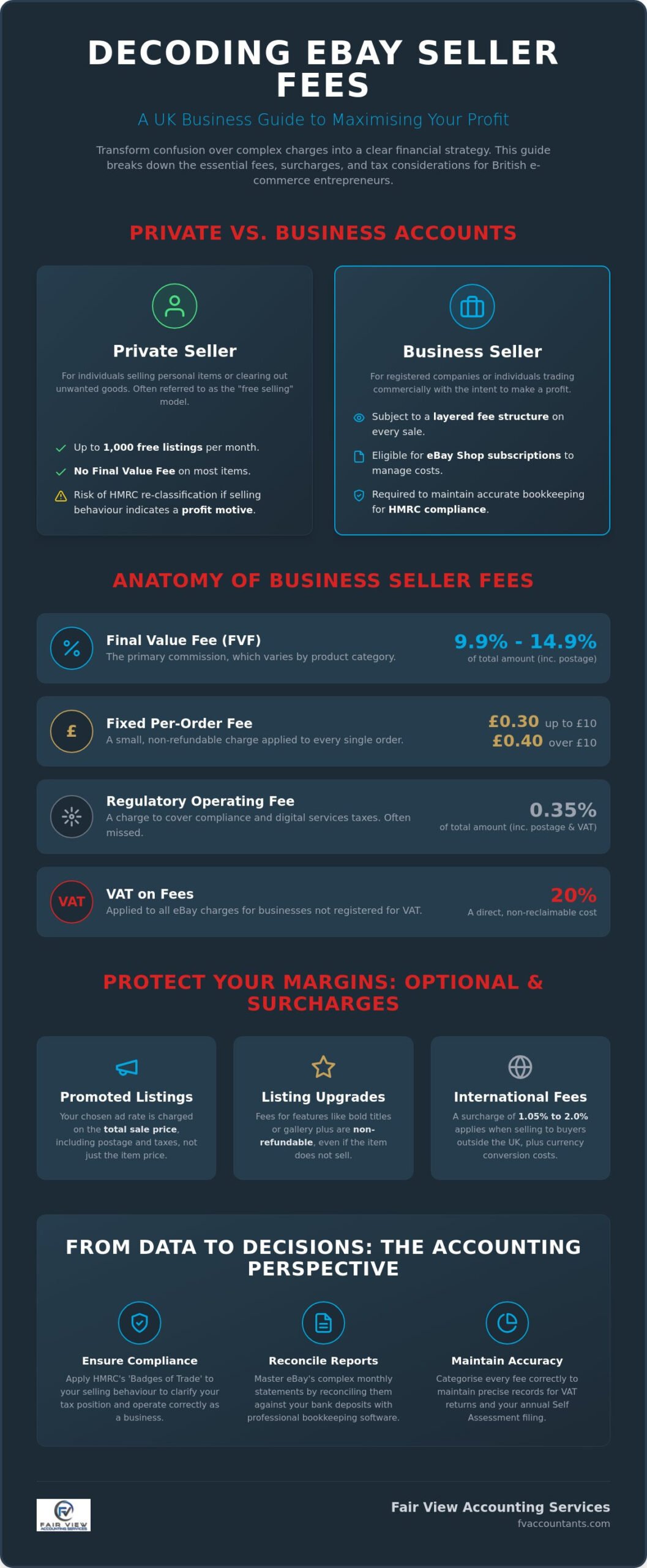
The landscape for ebay seller fees underwent a significant transformation in recent years, creating a distinct divide between casual and commercial activity. eBay now operates a “free selling” model for private individuals across most categories, which simplifies the entry point for those clearing out personal items. However, for established UK companies, the structure remains a sophisticated system of commissions and fixed charges designed to support eBay’s business model as a global marketplace. This transition highlights the need for sellers to accurately categorise their accounts to avoid unexpected compliance issues.
Business sellers typically encounter a Final Value Fee (FVF) that fluctuates based on the product category, usually falling between 9.9% and 14.9%. Specialist retailers, such as First4Frames Gallery, must account for these variations when selling bespoke frames or fine art prints. This percentage is accompanied by a fixed per-order fee of £0.30 for transactions up to £10.00, or £0.40 for those exceeding £10.00. To manage these costs, many businesses opt for an eBay Shop subscription. A Basic Shop, for instance, provides 250 fixed-price listings for a monthly fee. This often proves more cost-effective than paying the standard 30p insertion fee for every individual item listed once your inventory reaches a certain scale.
A frequently overlooked cost is the Regulatory Operating Fee. Fixed at 0.35% of the total sale amount, this charge covers the increasing costs of global compliance and digital services taxes. For those operating on a larger scale, you can discover International Associates Limited to see how independent certification supports your commitment to international standards. Whilst it seems small, it applies to the entire transaction value, including postage and VAT. This creates a layered fee structure that requires methodical bookkeeping to ensure your true margins remain protected.
The Private Seller Exemption
Private sellers currently enjoy a generous allowance of 1,000 free listings per month. This exemption removes the final value fee for most everyday items, although high-value categories like Motors still carry specific charges for all users. It’s vital to distinguish between a hobbyist and a business; HMRC monitors these “free” accounts closely. If your selling behaviour suggests a profit motive, you may lose this exemption and face backdated tax obligations and penalties.
Business Account Fundamentals
eBay calculates your ebay seller fees based on the total amount the buyer pays. This includes the item price, any postage charges, and taxes. For businesses not registered for VAT, the 20% VAT applied to eBay’s own fees represents a direct cost that cannot be reclaimed. This “tax on fees” often causes confusion when reconciling monthly statements with bank deposits. Partnering with a professional firm helps you track these deductions accurately, ensuring your accounts reflect your actual take-home profit.
Calculating Your True Margin: Optional Upgrades and Surcharges
Success on eBay requires more than just knowing the headline commission rates. To protect your profitability, you must account for the secondary layer of ebay seller fees that often go unnoticed until the monthly statement arrives. These optional upgrades and performance-based surcharges can quickly erode thin margins if they aren’t factored into your initial pricing strategy. Professional bookkeeping for e-commerce ensures these varied costs are tracked as distinct business expenses, providing a clearer picture of your net income.
Promoted Listings represent a significant portion of modern ad spend. Whether you choose the Standard or Advanced model, eBay calculates your “ad rate” fee based on the total sale price, which includes postage and any applicable taxes. If you set an ad rate of 10%, you aren’t just paying 10% of the item price; you’re paying a percentage of the entire amount the buyer hands over. Similarly, optional listing upgrades like bold titles or gallery plus features are non-refundable. You pay these fees even if the item fails to sell, making them a fixed risk to your cash flow.
International expansion offers growth, but it introduces specific financial complexities. When selling to buyers outside the UK, eBay applies an international fee ranging from 1.05% to 2.0%, depending on the buyer’s registered address. You must also account for currency conversion charges if you receive payments in a different currency. For those navigating these rules, the UK government tax guidance for online sellers provides essential context on how to treat these transactions for HMRC reporting.
Promoted Listings Strategy
Balancing visibility with your profit margin is a delicate task. A lower ad rate of 5% might result in fewer clicks than a 10% rate, yet it often yields a higher net profit per sale. We recommend categorising these costs as a marketing expense rather than a direct cost of sale. This approach allows you to measure the return on ad spend more effectively whilst keeping your core product margins transparent.
The Hidden Cost of International Trade
Beyond the standard international surcharges, currency conversion margins silently impact your bottom line. eBay applies a margin on top of the wholesale exchange rate when converting funds into Sterling. Additionally, if a buyer initiates a payment dispute that you cannot successfully defend, you may face a dispute fee of approximately £16.80. Managing these risks involves precise accounting and a proactive approach to customer service to avoid unnecessary financial penalties.
The Accounting Perspective: Tax Compliance and Professional Support
The line between a casual hobby and a commercial enterprise is often thinner than sellers realise. Whilst many rely on the £1,000 Trading Allowance, this relief is not a universal solution if your activity meets the HMRC “Badges of Trade” criteria. If you are purchasing stock specifically to resell for profit, you are legally a business from your first transaction. This distinction is vital because although eBay scraps fees for private sellers in many categories, business accounts must still account for ebay seller fees as deductible expenses to reduce their tax liability. For those just launching their online retail venture, working with a startup accountant UK specialists trust ensures your business structure is tax-efficient from day one, preventing costly compliance errors before they arise.
One of the most significant challenges for growing brands is reconciling eBay Managed Payments. Your bank account receives a “net” deposit, which represents your sale price minus fees and refunds. However, your annual accounts must record the “gross” sale and the specific ebay seller fees separately for accurate reporting. This is where E-commerce Accountants provide essential value. They implement systems that bridge the gap between platform reports and your financial statements, ensuring no deductible cost is overlooked during your tax preparation. This level of oversight can help owners achieve more than just compliance; for instance, The Bucket List Accountant specialises in tax minimisation strategies designed to help small business owners fund their personal bucket lists.
VAT and eBay Sales
Monitoring your turnover is a continuous requirement for any scaling shop. Once your rolling 12-month taxable turnover exceeds £90,000, VAT registration becomes mandatory. We help clients navigate this transition by managing their VAT Returns, ensuring they choose the most efficient scheme for their specific margins. Whether you utilise the Flat Rate Scheme or the Standard Scheme, accurate fee tracking is non-negotiable for maintaining compliance and protecting your cash flow.
Cloud Accounting Integration
Modern efficiency relies on seamless digital integration. Tools like Xero and QuickBooks automate the flow of transaction data, but they require expert configuration to handle eBay’s complex fee breakdowns correctly. As Making Tax Digital is now the standard for VAT-registered businesses, having a tech-savvy guardian to oversee your digital records ensures you remain compliant whilst focusing on scaling your inventory and reaching new customers.
Securing Your E-commerce Growth Through Financial Precision
Managing a successful online business requires a shift from viewing marketplace costs as simple expenses to seeing them as strategic data points. You now understand how the distinction between private and business accounts dictates your fee structure and how optional upgrades can silently impact your bottom line. Mastering the intricacies of ebay seller fees is just the first step toward long-term profitability; the real value lies in how you reconcile this data for HMRC compliance and tax efficiency.
Accurate bookkeeping ensures that every deduction is claimed and every margin is protected. As Chartered Accountants with dedicated e-commerce expertise, Fair View Accounting Services acts as your tech-savvy guardian. We are cloud accounting specialists, helping retailers across the UK integrate Xero and QuickBooks to automate their financial reporting with absolute precision. Get a Professional E-commerce Tax Review from Fair View Accounting to ensure your enterprise is structured for sustainable success. With the right professional support, you can stop worrying about complex spreadsheets whilst you focus on scaling your inventory with confidence.
Frequently Asked Questions
Do I have to pay eBay fees if I sell as a private individual in 2026?
Private sellers generally pay no final value fees for most categories, provided they’re selling personal items they no longer require. You’re granted 1,000 free listings each month, though a 35p insertion fee applies once this limit is exceeded. High-value categories like Motors are excluded from this “free” model and carry their own specific ebay seller fees that you must factor into your asking price.
What is the difference between a private and a business seller on eBay for tax purposes?
The distinction rests on your “intent to trade” rather than just your sales volume. HMRC uses the “Badges of Trade” to determine if you’re a hobbyist or a business; buying stock with the sole purpose of reselling it for profit usually classifies you as a trader. Once you’re recognised as a business, you’re required to register for Self Assessment and potentially VAT, regardless of the account type you use on the platform.
How do I download a VAT invoice for my eBay seller fees?
To download your VAT invoices, log into the Seller Hub, click on the “Payments” tab, and select “Reports.” You’ll find a section for “Tax invoices” where you can generate monthly statements as PDF files. These documents provide the necessary breakdown of VAT charged on your fees, which is crucial for your quarterly returns and maintaining accurate digital records in your bookkeeping software.
Is the eBay final value fee calculated before or after postage costs?
eBay calculates the final value fee based on the total amount the buyer pays, which includes the item price, postage charges, and any applicable taxes. This total also attracts the 0.35% regulatory operating fee for business accounts. Understanding this total-sum calculation helps you price your inventory accurately whilst protecting your net profit from these combined ebay seller fees.
Can I claim my eBay seller fees as a business expense on my tax return?
You can absolutely claim your eBay fees as a legitimate business expense on your tax return to reduce your overall liability. When preparing your annual accounts, you should report your gross turnover and then deduct the fees as a cost of sale. This methodical approach ensures your taxable profit is accurate and prevents you from overpaying on your Corporation Tax or Self Assessment bill.
For entrepreneurs with diversified investments or those operating across borders, seeking advice from international specialists such as Tax Partners can help identify further savings, such as understanding how to deduct mortgage interest on your taxes, which is a valuable strategy for those with property interests in Canada.
What happens if I don’t report my eBay income to HMRC?
HMRC receives automated data from digital platforms under modern reporting rules, so failing to declare your income can result in a formal investigation and heavy financial penalties. If you’ve missed previous deadlines, it’s best to make a voluntary disclosure to settle your tax position and pay any outstanding interest. Our team can support you through this process to ensure your enterprise remains compliant and secure.
Disclaimer
The information provided in this article is for general guidance only and is not intended to constitute professional advice, tax advice, financial advice, legal advice, or any other form of regulated guidance. Although every effort has been made to ensure accuracy at the time of publication, Fair View Accounting Services, including its director, employees, contractors, writers, and content-creation team, accepts no responsibility for any loss, damage, penalty, or consequence arising from reliance on the information contained herein.UK tax legislation changes frequently, and HMRC interpretations, thresholds, and rules may vary depending on the individual circumstances of each taxpayer. Nothing in this article should be considered a substitute for obtaining formal, personalised advice from a qualified accountant or tax professional. Readers should not take action or refrain from taking action based solely on the content published on this website.Fair View Accounting Services does not guarantee the completeness, accuracy, or ongoing validity of the information provided and assumes no liability for omissions or errors, whether typographical, factual, or technical. By using this content, the reader acknowledges that all responsibility for decisions remains solely with the user.