

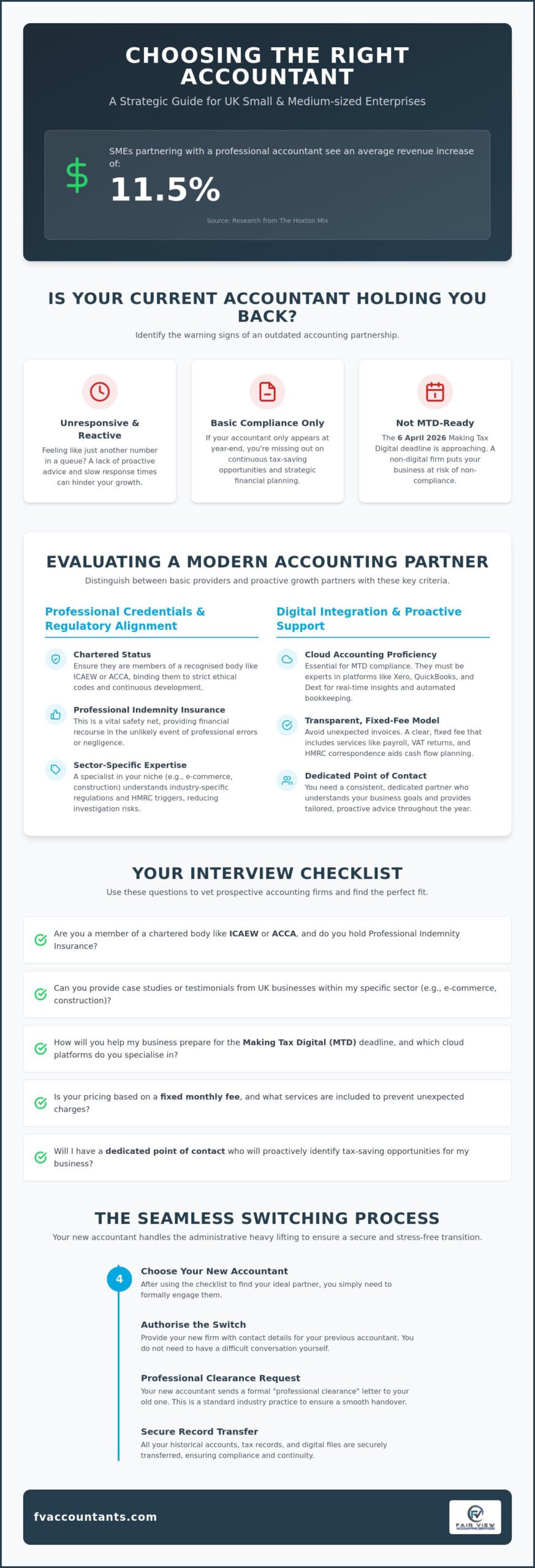
SMEs that partner with a professional accountant see an average revenue increase of 11.5 per cent, according to research from The Hoxton Mix. Despite this potential for growth, many business owners feel stuck with unresponsive firms that offer little more than basic compliance and reactive advice. If you’re concerned about the 6 April 2026 Making Tax Digital (MTD) deadline or feel like your current provider treats you as just another number, it’s time to consider a more modern partnership. Knowing the right questions to ask a new accountant uk is the first step toward regaining control over your financial obligations and securing your peace of mind.
You deserve a tech-savvy guardian who automates your bookkeeping whilst proactively identifying tax-saving opportunities. We’ve created this guide to help you master the transition to a better financial partner. You’ll find a definitive list of interview questions designed to test a firm’s expertise in digital integration and sector-specific regulations. We also provide a step-by-step switching guide that details how a new firm handles the professional clearance process on your behalf; this ensures your move is entirely seamless, secure, and stress-free.
Key Takeaways
- Verify professional standing by confirming membership in bodies like ICAEW or ACCA and assessing sector-specific expertise in niche areas such as e-commerce or construction.
- Prepare for the 2026 Making Tax Digital (MTD) milestones by partnering with a firm that utilises cloud-based platforms to provide real-time financial insights.
- Utilise our comprehensive list of questions to ask a new accountant uk to distinguish between basic compliance providers and proactive growth partners.
- Understand the “Professional Clearance” process, where your new accountant handles the administrative heavy lifting to ensure a seamless transfer of records.
- Master the transition with our step-by-step guide, designed to eliminate the anxiety of switching whilst ensuring your digital records remain fully compliant.
Evaluating Professional Credentials and Regulatory Alignment
Before you commit to a new partnership, you must verify that your prospective advisor possesses the necessary regulatory standing. One of the most critical questions to ask a new accountant uk involves their professional membership and accreditation. This isn’t just about verifying a degree; it ensures your accountant is bound by strict ethical codes and continuous professional development requirements. You need an expert who doesn’t just record the past but actively protects your future.
The Importance of Chartered Status and Indemnity
A “qualified” accountant might have completed a basic course, but a “chartered” partner has met the rigorous standards set by organisations like the Institute of Chartered Accountants in England and Wales (ICAEW) or the ACCA. This distinction matters because it guarantees a level of oversight that protects your business interests. You should also confirm they hold Professional Indemnity Insurance. This insurance acts as a vital safety net. It ensures you have financial recourse in the unlikely event of professional negligence or errors in your tax filings.
Sector-Specific Expertise and HMRC Compliance
A “one size fits all” approach often fails for niche sectors. For instance, an Amazon FBA seller needs an expert who understands e-commerce VAT and international shipping complexities, whilst a construction worker requires deep knowledge of the Construction Industry Scheme (CIS). Ask for case studies or testimonials from similar UK businesses to prove their competence. A specialist accountant understands the specific HMRC triggers in your industry, which reduces the risk of stressful tax investigations.
Beyond daily bookkeeping, your accountant should facilitate your long term financial goals. If you plan to buy a home or secure business funding, ask if they can provide an Accountant’s Certificate. Many lenders require this specific document to verify your income accurately. Finally, ensure they have a methodical system for monitoring HMRC tax changes and UK budget announcements. A proactive partner alerts you to changes before they impact your cash flow, ensuring you stay compliant without the last minute panic.
Assessing Digital Integration and Proactive Support
Modern accounting is no longer a once-a-year exercise. When considering questions to ask a new accountant uk, you must focus on how they integrate technology to provide real-time clarity. A proactive partner uses cloud-based tools to offer a continuous view of your cash flow; this helps you make informed decisions today rather than reacting to figures that are months out of date. The HMRC guidance on choosing a tax agent highlights the need for a representative who can handle digital requirements effectively whilst protecting your data.
Cloud Infrastructure and Making Tax Digital (MTD)
Making Tax Digital is a mandatory digital bridge between business records and HMRC. From 6 April 2026, self-employed individuals and landlords with qualifying income over £50,000 must comply with MTD for Income Tax. Your accountant should be proficient with platforms like Xero, QuickBooks, and Dext to automate your bookkeeping and ensure seamless quarterly submissions. Proficiency in these tools ensures your digital records are accurate and that you meet the first quarterly update deadline on 7 August 2026 without stress.
Service Levels and Fee Transparency
Predictable cash flow is essential for SMEs, which is why fixed-fee models are generally superior to hourly billing. You should ask whether their quote includes payroll, VAT returns, and HMRC correspondence to avoid unexpected invoices later in the year. A dedicated point of contact is also vital. You don’t want to feel like a number in a helpdesk queue; you need a partner who identifies tax-saving opportunities throughout the year rather than just at year-end. If you’re looking for a firm that prioritises this level of proactive support, ensure they can demonstrate a clear communication philosophy. This ensures you receive tailored advice that aligns with your specific business goals and growth trajectory.
How to Switch Accountants in the UK: A Seamless Transition
Many business owners hesitate to change firms because they perceive the move as a complex administrative burden. In reality, your new partner manages the majority of the transition on your behalf. Once you’ve finalised your questions to ask a new accountant uk and selected a firm, the actual handover is straightforward and methodical. A professional transition involves four key stages:
- Step 1: Notice of change. You inform your current accountant of your intention to move; we can provide a template to make this communication professional and neutral.
- Step 2: Professional Clearance. Your new accountant sends a formal request to your previous firm to obtain your historical records and confirm there are no ethical reasons for the transfer.
- Step 3: HMRC Authorisation. You’ll approve a 64-8 agent authorisation, which allows your new partner to deal directly with HMRC regarding your Corporation Tax, VAT, or Self Assessment.
- Step 4: Digital Onboarding. Your new firm migrates your data into a modern cloud dashboard, giving you immediate visibility into your real-time financial health.
The Professional Clearance Process Explained
Accountants in the UK have a professional duty to cooperate during a handover. When you choose a “tech-savvy guardian,” they handle the bulk of this administrative heavy lifting. Your new firm will request a “trial balance,” your most recent tax returns, and any outstanding correspondence with HMRC. This structured exchange ensures that no data is lost and your compliance history remains intact without you needing to act as a middleman.
Timing Your Move for Minimum Disruption
Whilst you can switch at any time, moving at the start of a new financial year or VAT quarter is often the cleanest approach. It provides a natural “cut-off” point for your records and simplifies the opening balances in your new software. If you must switch closer to the 31 January Self Assessment deadline, your new accountant will prioritise the transfer of your most urgent digital records. This proactive management mitigates the risk of late filing penalties and ensures your transition doesn’t interfere with your mandatory HMRC obligations.
Secure Your Financial Future with a Modern Partnership
Choosing the right advisor requires more than a casual conversation. By using our definitive list of questions to ask a new accountant uk, you can move beyond basic bookkeeping and secure a partner who proactively identifies tax-saving opportunities. A modern accountant should act as your tech-savvy guardian, navigating complex HMRC regulations and MTD milestones so you don’t have to. The transition itself is a methodical process; your new firm manages the professional clearance and digital migration to ensure your data remains secure and accessible throughout the move.
Fair View Accounting Services provides Chartered Accountants with national UK coverage, specialising in MTD compliance and cloud-based growth for SMEs. Our dedicated onboarding team manages the entire handover process for you, providing a stress-free start to your new partnership. Switch to a proactive partner—book your free consultation with Fair View Accounting today. Regain your peace of mind and ensure your business is positioned for success in 2026 and beyond.
Frequently Asked Questions
How much does a new accountant cost in the UK?
Fees for a new accountant depend on your business complexity and the volume of transactions. SMEs should generally expect fixed-fee packages starting from £100 to £250 per month for comprehensive support that includes VAT returns and payroll. It’s vital to request a clear breakdown of what’s included in your quote. This ensures you don’t face surprise bills for routine phone calls or standard HMRC correspondence.
Can I switch accountants at any time of the year?
You can switch accountants at any time during the year; you don’t have to wait for your year-end. Whilst many business owners prefer to move at the start of a new financial year, a proactive partner can manage a mid-year transition seamlessly. They’ll synchronise your cloud accounting data and ensure no critical HMRC deadlines are missed during the handover. This is one of the most common questions to ask a new accountant uk when you’re concerned about maintaining continuity.
Do I need to tell HMRC that I have changed accountants?
You don’t need to contact HMRC directly to inform them of your change in representation. Your new firm will ask you to sign a 64-8 authorisation form, which is typically handled through a secure digital signature. Once this is submitted, HMRC updates its records to recognise your new firm as your official agent. This allows them to manage your tax affairs and communicate with HMRC on your behalf without you needing to act as a middleman.
What is professional clearance in accounting?
Professional clearance is a standard procedure where your new accountant writes to your previous advisor to request your historical records. This process confirms there are no ethical or professional reasons why the new firm shouldn’t represent you. It’s a key part of the questions to ask a new accountant uk to ensure they handle this administrative task efficiently. The clearance request ensures a complete transfer of your tax history and previous filings, allowing your new partner to take over your accounts with full visibility.
Disclaimer
The information provided in this article is for general guidance only and is not intended to constitute professional advice, tax advice, financial advice, legal advice, or any other form of regulated guidance. Although every effort has been made to ensure accuracy at the time of publication, Fair View Accounting Services, including its director, employees, contractors, writers, and content-creation team, accepts no responsibility for any loss, damage, penalty, or consequence arising from reliance on the information contained herein. UK tax legislation changes frequently, and HMRC interpretations, thresholds, and rules may vary depending on the individual circumstances of each taxpayer. Nothing in this article should be considered a substitute for obtaining formal, personalised advice from a qualified accountant or tax professional. Readers should not take action or refrain from taking action based solely on the content published on this website. Fair View Accounting Services does not guarantee the completeness, accuracy, or ongoing validity of the information provided and assumes no liability for omissions or errors, whether typographical, factual, or technical. By using this content, the reader acknowledges that all responsibility for decisions remains solely with the user.