

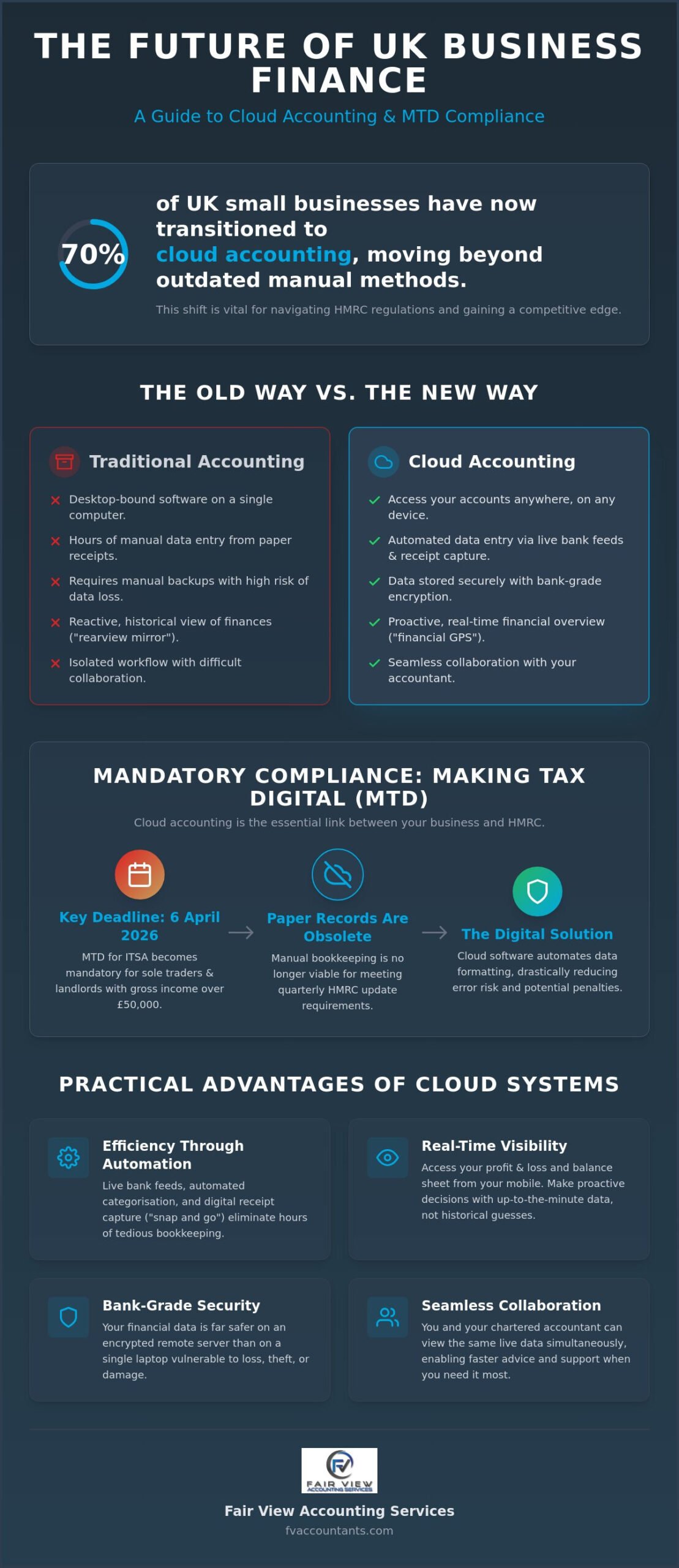
Over 70% of UK small businesses have now transitioned to cloud accounting, moving away from the outdated era of manual spreadsheets and paper receipts. For most, this shift wasn’t merely about following a digital trend; it was a vital step to stay ahead of evolving HMRC regulations and maintain a competitive edge. If you still feel that managing your books is a second job that eats into your evenings, you are certainly not alone.
We understand that you started your business to pursue a specific vision, not to spend hours on repetitive data entry or stress over the risk of Making Tax Digital (MTD) errors. It’s exhausting to work through the day only to face a mountain of admin at night, especially when you lack a clear, real-time view of your cash flow. This guide will show you how to transform these financial chores into a genuine strategic advantage for your company.
You’ll discover how to automate your daily tasks, ensure total compliance with the latest 2026 tax thresholds, and gain the ability to check your profit and loss directly from your mobile phone. We provide a clear roadmap to help you move from administrative uncertainty toward a state of informed, confident growth.
Key Takeaways
- Understand the core differences between traditional desktop software and secure, remote-server platforms that eliminate the need for manual backups and hardware dependency.
- Learn how cloud accounting automates your bookkeeping through live bank feeds and digital receipt capture to reclaim your time and improve accuracy.
- Identify the essential steps for a seamless migration, ensuring your opening balances and historical data are accurately transferred by a professional chartered partner.
- Discover how to leverage a modern app ecosystem to maintain 100% compliance with HMRC regulations whilst gaining real-time visibility into your business cash flow.
What is Cloud Accounting and Why is it Essential in 2026?
At its core, cloud accounting is a digital platform where your financial data is stored securely on remote servers rather than on a single office computer. You access your accounts through an internet connection, which transforms your financial records into a living, breathing asset. This modern approach to Cloud accounting software has replaced the rigid, hardware-dependent systems of the past. It removes the need for manual backups and eliminates the confusion of “version control” issues often found with multiple CSV files.
In 2026, this technology is no longer a luxury for the few. It serves as a vital bridge between your daily operations and HMRC. As your tech-savvy guardian, we use these digital tools to oversee your compliance in real-time, ensuring that complex regulations feel manageable rather than overwhelming. This integration allows for a closer partnership, where we can provide support based on what is happening in your business right now, not what happened six months ago.
Cloud vs Traditional Accounting: The Key Differences
Traditional accounting often relies on reactive data. You gather receipts at the end of the month, enter them manually, and look at your performance in the rearview mirror. Cloud systems provide real-time synchronisation. Every transaction flows into the system as it happens, allowing for proactive planning. Instead of wondering how your business performed last quarter, you can see your current profit and loss at a glance. It’s the difference between looking at a map of where you’ve been and using a GPS to see where you’re going.
The Role of Making Tax Digital (MTD)
The UK regulatory landscape reached a major milestone on 6 April 2026. Making Tax Digital for Income Tax Self Assessment (MTD for ITSA) is now mandatory for sole traders and landlords with a total gross income over £50,000. Paper-based records are no longer viable for meeting these quarterly update requirements. Cloud software acts as the essential link to HMRC, automatically formatting your data to meet digital standards and drastically reducing the risk of manual errors that lead to penalties. Working with a professional online accountant ensures your MTD submissions are handled with precision and that you remain fully compliant as regulations continue to evolve.
The Practical Advantages of a Cloud-Based Financial System
Adopting cloud accounting provides more than just a digital checkbox for HMRC. It builds a resilient foundation for your business. Live bank feeds allow transactions to flow automatically into your ledger, removing the tedious task of typing up statements. According to the Open Banking Impact Report, this integration significantly improves financial visibility for SMEs. You might worry about security, but these platforms use bank-grade encryption. Your data is far safer on a secure remote server than it is on a single laptop that could be lost, stolen, or damaged.
Efficiency Through Automation
The days of the year-end shoe-box filled with faded paper receipts are over. We encourage a snap and go culture using tools like Dext. You simply take a photo of a receipt on your phone, and the software talks to your accounts, extracting the data instantly. Automated bank matching then suggests the correct expense categories. This process saves hours of manual bookkeeping. It ensures your records are accurate and up-to-date without you lifting a pen.
Collaborative Financial Management
Cloud systems allow for multi-user access. This means you and your accountant can view the same live screen simultaneously, regardless of where you are in the UK. This level of transparency is invaluable when you need quick advice or a formal Accountant’s Certificate for a mortgage application. You can even check your balance sheet whilst on the train via a mobile app. If you’re ready to streamline your workflow, you can explore our bookkeeping services to find the right fit for your business.
Implementing Cloud Accounting: Working with a Chartered Partner
Selecting the right software is the first step toward digital freedom. Whilst platforms like Xero, QuickBooks, and IRIS all offer robust features, their suitability depends on your specific industry and tax structure. We help you navigate these choices, ensuring you don’t overspend on unnecessary features or complex tiers you’ll never use. It’s helpful to review government guidance on managing cloud spending to understand how shifting from capital to operational expenditure affects your monthly budget.
The migration process often causes the most anxiety for small business owners. You shouldn’t fear the switch. We manage the entire data transfer, including the complex alignment of your “opening balances,” so your financial history remains intact and accurate. Once established, cloud accounting allows us to move beyond basic bookkeeping into high-level VAT compliance and strategic tax planning. Many UK business owners are also discovering that partnering with a dedicated online accountant provides the same professional rigour as a traditional high-street firm, with the added benefit of real-time collaboration and transparent, predictable fees.
How to Organise Your Transition to the Cloud
- Step 1: Audit your current manual processes. Identify exactly where bottlenecks occur, such as delayed invoicing or lost paper receipts that cause stress at the end of the month.
- Step 2: Consult with a chartered accountant. We ensure your software choice aligns with your specific tax structure and future growth plans. For businesses in the construction sector, this includes integrating your cloud platform with compliant payroll for construction companies UK requirements, including CIS deductions and PAYE obligations.
The Long-term Value of Proactive Advice
Clean, real-time data is a powerful asset. It allows us to spot tax-saving opportunities months before your year-end arrives, rather than reacting after the window has closed. This proactive approach is the hallmark of the Fair View method. We act as your tech-savvy guardian, monitoring the numbers whilst you focus on running your business. You’ll gain the peace of mind that comes from knowing your compliance is handled with precision. Cloud accounting isn’t just a box-ticking exercise; it’s a tool that empowers you to make informed decisions every single day.
Securing Your Financial Future with Modern Accounting
Transitioning to a digital-first approach is the most effective way to protect your business from the risks of manual error and regulatory non-compliance. By adopting cloud accounting, you reclaim your evenings through automation and gain the clarity needed to make informed, real-time decisions. Whether you’re navigating the 2026 MTD for ITSA requirements or seeking a clearer view of your cash flow, the right technology provides a foundation of total stability.
As Chartered Accountants, we offer the professional oversight required to keep your business moving forward. Our expertise in Xero, QuickBooks, and Dext ensures that your financial systems are integrated seamlessly, whilst our dedicated support for Making Tax Digital provides the peace of mind you deserve. We act as your tech-savvy guardian, monitoring the details so you can focus on your vision. For those operating in specialist sectors, such as managing payroll for construction companies UK, our cloud-integrated approach ensures your CIS and PAYE obligations are handled with the same precision and care.
Ready to move away from administrative stress? Simplify your business finances today with Fair View Accounting Services. Taking control of your numbers now ensures a more profitable and predictable tomorrow for your company.
Frequently Asked Questions
Is cloud accounting safe for my business data?
Cloud-based systems are far more secure than local storage because they utilise bank-grade encryption and automatic off-site backups. Your financial information is protected by multi-factor authentication, which creates a robust barrier against unauthorised access. Unlike a physical office computer, these remote servers are maintained in high-security data centres that are resilient to hardware failure, theft, or fire damage. This setup provides a level of protection that most small businesses cannot achieve on their own.
Do I need to be a tech expert to use cloud accounting software?
You do not need any advanced technical skills to use cloud accounting software effectively. Modern platforms are built with user-friendly interfaces that simplify complex tasks into intuitive, visual workflows. We take care of the initial setup and provide tailored training to ensure you can navigate the dashboard with ease. Our role as your chartered partner is to manage the technical complexities whilst you focus on the day-to-day running of your business.
How much does it cost to switch to a cloud-based system?
Most cloud systems operate on a monthly subscription basis, which replaces the need for expensive upfront software purchases. This operational expense model allows you to choose a plan that fits your current turnover and scale up as your business expands. Whilst there is an initial investment of time for migration and training, the automation of repetitive tasks often results in significant long-term savings. We help you select the most cost-effective platform to avoid paying for redundant features.
Can I still use my existing spreadsheets alongside cloud accounting?
You can still use spreadsheets for specific internal analysis, but they should no longer serve as your primary bookkeeping method. HMRC regulations for Making Tax Digital require a “digital link” between your records and their systems, which manual spreadsheets cannot always provide without complex bridging software. Transitioning your core records to the cloud reduces the risk of manual data entry errors and ensures that your financial data remains fully compliant with current UK tax laws.
Disclaimer
The information provided in this article is for general guidance only and is not intended to constitute professional advice, tax advice, financial advice, legal advice, or any other form of regulated guidance. Although every effort has been made to ensure accuracy at the time of publication, Fair View Accounting Services, including its director, employees, contractors, writers, and content-creation team, accepts no responsibility for any loss, damage, penalty, or consequence arising from reliance on the information contained herein.UK tax legislation changes frequently, and HMRC interpretations, thresholds, and rules may vary depending on the individual circumstances of each taxpayer. Nothing in this article should be considered a substitute for obtaining formal, personalised advice from a qualified accountant or tax professional. Readers should not take action or refrain from taking action based solely on the content published on this website.Fair View Accounting Services does not guarantee the completeness, accuracy, or ongoing validity of the information provided and assumes no liability for omissions or errors, whether typographical, factual, or technical. By using this content, the reader acknowledges that all responsibility for decisions remains solely with the user.