

Is saving a few hundred pounds on professional fees worth the risk of an immediate HMRC penalty or the late-night stress of balancing your own books? Most entrepreneurs start with the same question: can I do my own business accounts to keep overheads low? It’s a natural instinct to want total control over your finances, especially whilst you are building your reputation and growing your client base. You likely feel that if you can manage the day-to-day operations, you can surely handle the tax returns too.
This guide provides the certainty you need to decide whether to continue with DIY filing or transition to professional support. We will break down the 2026 Making Tax Digital (MTD) requirements and the recent UK GAAP changes to help you understand your legal obligations. You will discover a clear framework for deciding when to outsource your accounts. This ensures you maintain tax efficiency and gain the peace of mind that comes from expert compliance and modern, cloud-based record-keeping.
Key Takeaways
- Understand the legal distinction between basic Self Assessment and complex statutory filings to see if the answer to can I do my own business accounts is right for your current scale.
- Identify the hidden costs of DIY accounting, including the risk of overpaying tax through miscategorised expenses and the significant opportunity cost of your professional time.
- Learn how the 2026 Making Tax Digital (MTD) rules for Income Tax affect your record-keeping obligations and why modern, cloud-based software is now essential for compliance.
- Recognise the specific business milestones, such as reaching the £90,000 VAT threshold or hiring your first employee, that signal it is time to transition to professional support.
- Discover why an Accountant’s Certificate is often a non-negotiable requirement for proving your income when applying for a personal mortgage or business lending.
The Legal Reality of Preparing Your Own Business Accounts
The legal framework in the UK is surprisingly flexible. There is no law stating that you must hire a professional to manage your finances. Consequently, the answer to can I do my own business accounts is a definitive yes, but this freedom comes with significant responsibility. You are the one legally liable for any errors, regardless of whether you prepared the figures yourself. True compliance means your records must adhere to standard methods of bookkeeping and meet the latest UK GAAP standards. These standards saw major updates in January 2026, particularly regarding how businesses must now recognise revenue and long-term leases on their balance sheets.
Most business owners face a dual filing obligation. You must report to HMRC to settle your tax liabilities, and if you run a limited company, you must also file accounts with Companies House. These two bodies have different deadlines and distinct requirements. HMRC focuses on taxable profits, whilst Companies House requires accounts that provide transparency for the public record. Managing both sets of data accurately requires a methodical approach and a deep understanding of current regulatory expectations.
Sole Traders vs Limited Companies: Different Rules Apply
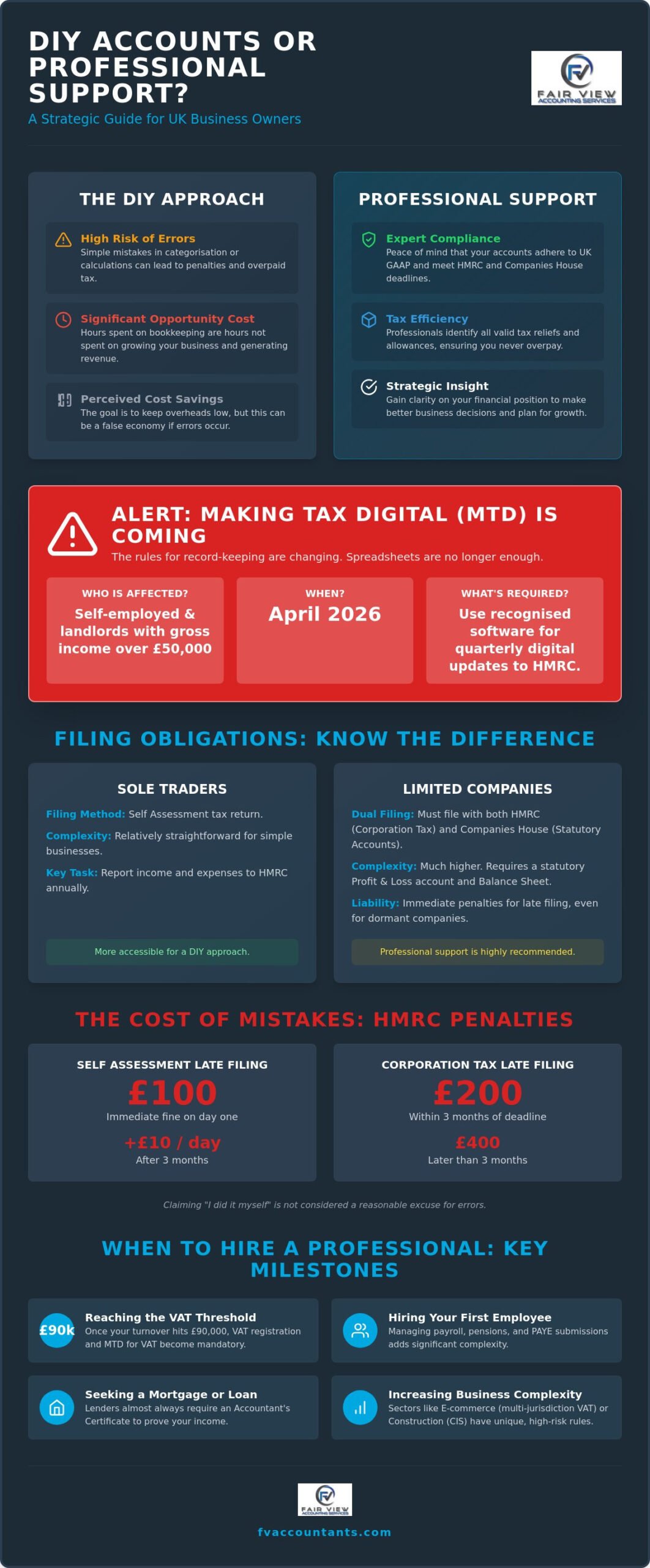
Sole traders typically find the DIY route more accessible. They report income and expenses through a Self Assessment tax return, which is relatively straightforward for simple business models. Limited companies face a much steeper challenge. They are legally required to produce a Balance Sheet and a Profit and Loss account. These documents must follow rigid statutory formats. Even for a dormant company, failing to submit these documents on time results in immediate financial penalties.
The Role of Making Tax Digital (MTD)
The digital shift has fundamentally changed how you manage your own records. As of April 2026, self-employed individuals and landlords with a gross income over £50,000 must follow MTD for Income Tax rules. This means you can no longer rely on simple spreadsheets or paper ledgers. You must use HMRC-recognised software to provide quarterly updates. Doing it yourself now requires digital proficiency and a commitment to real-time data entry rather than a once-a-year rush. It’s a modern requirement that demands precision and the right technical tools.
The Hidden Risks of the DIY Accounting Approach
Managing your own finances might seem like a cost-effective strategy, but it often creates a “tax gap” through simple human error. Misinterpreting Companies House guidance on accountants can lead to filing mistakes that trigger an HMRC enquiry. Small errors in categorising expenses or failing to claim valid tax reliefs, such as Capital Gains Tax allowances, often result in business owners overpaying their tax liabilities. This financial leakage usually costs more than the professional fees you intended to save.
The concept of “compliance debt” is another significant danger. Messy records today lead to expensive “clean-up” fees from a professional later, especially when you need accurate data for a mortgage or business loan. Beyond the money, there is a substantial opportunity cost. If you spend ten hours a month on bookkeeping, those are ten hours not spent on revenue-generating activities. This trade-off often stunts business growth. You can protect your future growth by ensuring your Annual Accounts are handled with precision from the start.
HMRC Penalties and Interest Charges
HMRC maintains a strict penalty regime, and claiming “I did it myself” rarely qualifies as a reasonable excuse for errors. From April 1, 2026, corporation tax late filing penalties have increased to £200 for returns filed within three months of the deadline and £400 for those later than three months. For self-assessment, an immediate £100 fine applies, followed by £10 daily penalties after three months. These costs escalate quickly, eroding your hard-earned profits and causing unnecessary stress.
The Complexity of Construction and E-commerce
Certain sectors face unique hurdles that make the question of can I do my own business accounts particularly risky.
- Construction: Tradespeople under the CIS scheme must manage monthly returns and contractor deductions accurately to avoid heavy fines.
- E-commerce: Amazon FBA or Shopify sellers must navigate complex VAT rules across different jurisdictions and manage high transaction volumes.
Precision in these areas is vital for maintaining a healthy cash flow and avoiding regulatory scrutiny. Digital integration through cloud platforms helps manage these complexities, but the oversight of a professional ensures that no detail is overlooked.
When to Transition: Recognising the Trigger Points for Professional Support
Whilst you technically can I do my own business accounts during the early stages of your venture, certain growth milestones make professional oversight a strategic necessity. The transition usually begins when your turnover approaches the £90,000 VAT registration threshold. Managing VAT returns alongside your daily operations adds a layer of complexity that often leads to burnout. Similarly, hiring your first employee introduces payroll and pension obligations that require absolute precision. These triggers represent the moment your business evolves from a solo project into a scalable entity that needs a robust financial foundation.
The risks of DIY accounting become more significant as your business grows. Beyond the daily admin, you must consider your long-term financial credibility. Fair View Accounting Services acts as a tech-savvy guardian during this transition, ensuring your records are not just compliant, but also optimised for future opportunities. Moving to professional support allows you to reclaim your time and focus on the revenue-generating activities that drive your success.
The Value of an Accountant’s Certificate
A major trigger for many business owners is the need for personal lending. If you are applying for a mortgage, most UK lenders won’t accept your self-prepared figures as proof of income. They require a formal Accountant’s Certificate signed by a chartered professional. This document provides the third-party verification lenders need to assess your borrowing capacity. It bridges the gap between your business profits and your personal financial goals, such as buying a home or investing in property.
From DIY to Digital Partnership
Transitioning to professional support doesn’t mean losing control of your data. Modern cloud accounting allows for a collaborative “hybrid” approach. By using platforms like Xero or QuickBooks integrated with tools like Dext and IRIS, we can provide real-time oversight whilst you maintain your daily record-keeping.
- Real-time Accuracy: We monitor your data to catch errors before they become costly HMRC enquiries.
- Seamless Integration: Digital tools automate the collection of receipts and invoices, reducing your manual workload.
- Strategic Insight: Professional oversight turns your raw data into management accounts that help you make informed decisions.
This partnership transforms your accounting from a stressful administrative task into a protective shield for your business.
Securing Your Business Growth and Compliance
Choosing the right path for your financial management is a defining step for any entrepreneur. Whilst the legal answer to can I do my own business accounts is yes, the practical decision depends on your long-term ambitions. Professional oversight protects you from the rising HMRC penalties and ensures you are fully prepared for the 2026 MTD for Income Tax rollout. By moving away from manual record-keeping, you eliminate the hidden “tax gap” and reclaim valuable time for revenue-generating activities.
As Chartered Accountants with national UK coverage, we specialise in modern cloud platforms like Xero and QuickBooks. We provide the expert support you need for complex areas like CIS, VAT, and Payroll, acting as your tech-savvy guardian in an increasingly digital landscape. Our goal is to provide the stability and precision required to turn your financial data into a strategic asset.
You have worked hard to build your reputation and your client base. Don’t let administrative burdens or compliance risks slow your momentum. Expert support provides the clarity and peace of mind you need to lead your business toward a successful future.
Frequently Asked Questions
Do I legally need an accountant to file limited company accounts?
No legal requirement exists in the UK for most SMEs to hire a professional to file their accounts. However, as a company director, you are personally liable for the accuracy of every submission to Companies House and HMRC. Whilst you can manage the process yourself, the complexity of statutory annual accounts often necessitates expert oversight to ensure full compliance with the latest UK GAAP standards and to avoid technical filing errors.
What is the penalty for filing my business accounts late in 2026?
From April 1, 2026, the initial penalty for filing a corporation tax return up to three months late is £200. If the delay exceeds three months, the fine increases to £400. For businesses that miss the deadline for a third consecutive year, these penalties rise significantly to £1,000 and £2,000 respectively. HMRC also applies daily interest to any unpaid tax liabilities from the original due date, which can quickly erode your business capital.
Can I use Excel for my business accounts under Making Tax Digital?
You can only use spreadsheets if they are connected to HMRC via “bridging software” to meet the digital link requirements of MTD. For those asking can I do my own business accounts using Excel, it is important to realise that manual data entry often leads to broken links and compliance risks. Most modern businesses now prefer cloud platforms like Xero or QuickBooks to ensure seamless, real-time record-keeping and to satisfy the quarterly update rules effortlessly.
How much does a chartered accountant typically cost for a small UK business?
Fees for professional accounting services vary based on the complexity of your operations and the specific level of support your business requires. Many firms now provide fixed-fee monthly packages that bundle essential tasks like bookkeeping, VAT returns, and annual accounts. This structured approach provides you with predictable costs and continuous access to professional expertise. You should request a tailored quote to ensure the service level matches your turnover and specific industry obligations.
Disclaimer
The information provided in this article is for general guidance only and is not intended to constitute professional advice, tax advice, financial advice, legal advice, or any other form of regulated guidance. Although every effort has been made to ensure accuracy at the time of publication, Fair View Accounting Services, including its director, employees, contractors, writers, and content-creation team, accepts no responsibility for any loss, damage, penalty, or consequence arising from reliance on the information contained herein.UK tax legislation changes frequently, and HMRC interpretations, thresholds, and rules may vary depending on the individual circumstances of each taxpayer. Nothing in this article should be considered a substitute for obtaining formal, personalised advice from a qualified accountant or tax professional. Readers should not take action or refrain from taking action based solely on the content published on this website.Fair View Accounting Services does not guarantee the completeness, accuracy, or ongoing validity of the information provided and assumes no liability for omissions or errors, whether typographical, factual, or technical. By using this content, the reader acknowledges that all responsibility for decisions remains solely with the user.