

Would your construction firm survive an unannounced HMRC inspection into your CIS records tomorrow morning? For many site managers, the thought of a surprise audit is enough to cause genuine anxiety, especially whilst juggling the physical demands of a live project. Managing payroll for construction companies uk has become a high-stakes exercise in risk management as we enter the 2026/27 tax year. It requires a precise balance between standard PAYE for your staff and strict CIS deductions for your subcontractors to avoid the heavy penalties that accompany non-compliance.
We understand that you’d rather be focused on project delivery than stuck in a site office reconciling manual timesheets and worrying about HMRC letters. This complete guide provides the clarity you need to handle your financial obligations with total confidence. You’ll discover how to automate your CIS returns, adapt to the new mandatory payrolling of benefits, and implement digital solutions that protect your business from errors. From the latest National Living Wage of £12.71 per hour to the nuances of gross payment status, we have outlined the essential steps to keep your workforce paid and your records spotless.
Key Takeaways
- Understand why payroll for construction companies uk requires a specialist dual-system approach to manage both traditional PAYE and the Construction Industry Scheme (CIS) effectively.
- Identify the non-negotiable compliance features your provider must offer, including automated subcontractor verification and monthly CIS statement generation.
- Discover how integrating your payroll with modern online accounting platforms provides the real-time data needed for accurate project costing and HMRC reporting.
- Learn how professional oversight provides peace of mind by protecting your business from the risks of HMRC status investigations and compliance penalties.
- Shift your focus from time-consuming manual reporting to project growth by adopting a streamlined, digital-first approach to your firm’s payroll.
Why Payroll for Construction Companies in the UK Requires a Specialist Approach
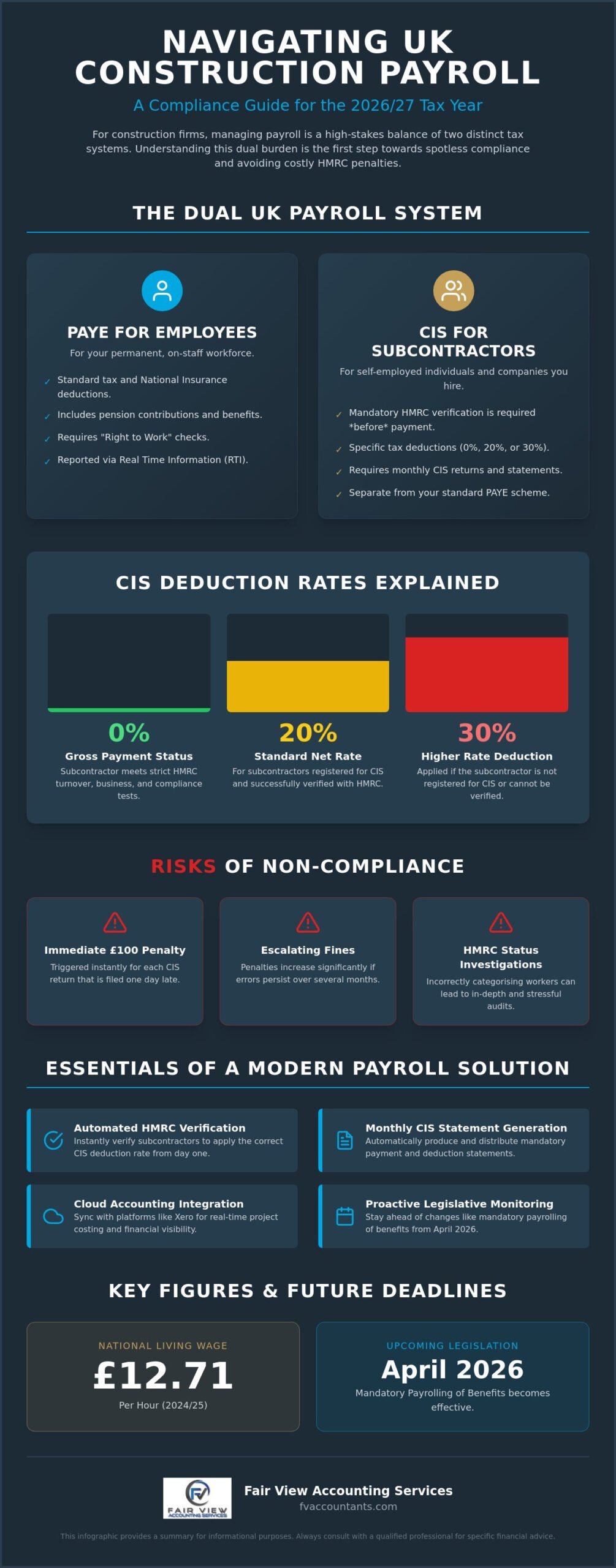
The UK construction industry operates on a unique financial model that sets it apart from almost any other sector. Unlike a standard retail or office business, construction firms must navigate a complex dual-tax system. This means processing standard PAYE for permanent staff whilst simultaneously managing the Construction Industry Scheme (CIS) for subcontractors. Effective payroll for construction companies uk isn’t just about paying people on time; it’s about protecting your business from the severe financial fallout of incorrect tax treatment.
Generalist payroll services often struggle with the nuances of site-based work. They frequently overlook the necessity of subcontractor verification or fail to account for the fluctuating pay rates common in trades. Moving away from manual spreadsheets toward an automated, compliant system is no longer optional for modern firms. It is the only way to ensure that your records remain spotless and your workers remain satisfied.
The Dual Burden: Managing PAYE and CIS Simultaneously
Contractors face a significant administrative load when verifying subcontractors with HMRC. You must determine if a worker should be paid gross or have 20% or 30% deducted before they ever set foot on site. Missing a deadline for CIS returns triggers an immediate £100 penalty from HMRC, which can escalate quickly if errors persist. A specialist approach ensures these deductions are calculated with precision, providing you with the peace of mind that your monthly reporting is handled correctly.
Navigating Variable Pay and Mixed Workforces
Construction teams are rarely static, and managing payroll for construction companies uk requires a deep understanding of site-based variables. You’re often balancing a diverse team with different pay grades, overtime structures, and site-specific bonuses. Professional oversight ensures that every worker is correctly categorised, which is vital for preventing HMRC disputes regarding employment status. Our role as a tech-savvy guardian involves tracking these complexities through digital integration, ensuring that:
- “Right to Work” checks are completed for every new hire.
- Employment status is verified to avoid IR35 or status investigations.
- Fluctuating hours amongst temporary workers are recorded accurately.
By automating these administrative hurdles, you can move from a state of constant concern to one of informed confidence, knowing your compliance is managed by experts.
Key Criteria When Selecting Payroll Services for the Construction Sector
Choosing the right partner for payroll for construction companies uk involves more than finding the lowest price. You need a provider that acts as a tech-savvy guardian, ensuring every deduction is accurate and every deadline is met. Non-negotiable features include automated HMRC verification, the generation of monthly CIS statements, and seamless RTI submissions. Since the government is moving toward mandatory payrolling of benefits from April 2026, your provider must be proactive in monitoring these legislative shifts to keep your business ahead of the curve.
Transparency and a dedicated point of contact are essential for SMEs. You can’t afford to wait days for an answer when a subcontractor is questioning their pay or when site-based rates fluctuate. Reliability is the foundation of a successful partnership, and having a specialist who understands the Construction Industry Scheme (CIS) ensures that your administrative burden remains light.
Integration with Cloud Accounting Software
Modern construction firms require real-time visibility to stay profitable. By selecting a provider that offers integrated online accounting support, you can track payroll costs directly against project budgets. Platforms like Xero and QuickBooks are central to this process. At Fair View Accounting Services, we utilise cloud accounting to create a seamless link between your daily bookkeeping and your payroll cycle. This integration ensures that your financial data is always current, allowing for better decision-making whilst you’re on site.
HMRC Verification and Compliance Assurance
Compliance begins before a single penny is paid to a subcontractor. You must verify every new hire through HMRC to determine if they require a 20% or 30% deduction, or if they hold gross payment status. A professional payroll service handles this verification automatically, protecting you from the risk of under-deducting tax and facing subsequent penalties. An Accountant’s Certificate serves as a formal mark of professional verification that can significantly assist your business when applying for future financing. If you’re looking to streamline your operations, you might consider how our specialist payroll services can provide the stability your business needs.
Streamlining Your Construction Business with Professional Payroll Support
Outsourcing payroll for construction companies uk is a strategic decision that empowers directors to reclaim their time. Instead of losing weekends to administrative tasks, you can focus on securing high-value contracts and overseeing project delivery. Managing all your financial obligations, from VAT to payroll, under one chartered roof provides a level of consistency that fragmented services simply cannot match. This unified approach eliminates data silos and ensures that your business remains a lean, efficient operation.
The migration process is designed to be seamless and stress-free. A modern firm handles the transfer of worker data and historical records whilst ensuring there is no disruption to your weekly or monthly pay cycles. This transition replaces manual, error-prone spreadsheets with a secure digital framework, providing the stability needed for long-term growth. By centralising your financial management, you gain a clearer picture of your company’s health without the burden of daily data entry.
Mitigating HMRC Risk and Avoiding Penalties
Common compliance failures, such as late CIS returns or incorrect status categorisation, can lead to costly investigations. A chartered firm acts as a professional buffer between your business and HMRC, managing enquiries with the authority that only qualified experts can provide. We ensure your records align with the latest regulations regarding PAYE and National Insurance contributions. This proactive management reduces the emotional burden of potential audits, allowing you to run your site with confidence and peace of mind.
Future-Proofing Your Business for 2026 and Beyond
The regulatory environment is shifting rapidly with the expansion of Making Tax Digital and the 2026 move toward mandatory payrolling of benefits. A tech-forward partner ensures your systems are updated well in advance of these deadlines. Having a specialist who understands payroll for construction companies uk means you’re never caught off guard by legislative changes. We invite you to request a tailored consultation to organise your financial affairs and ensure your business is prepared for the requirements of the coming years.
Securing the Future of Your Construction Firm
Adopting a specialist approach to payroll for construction companies uk is the most effective way to manage the dual complexities of PAYE and CIS. By embracing cloud-integrated systems, you gain the clarity needed to monitor project profitability whilst maintaining total HMRC compliance. Our role as a chartered firm is to provide the stability required to navigate these regulations. We handle the precision; you handle the growth.
We combine our status as a chartered firm with deep expertise in construction compliance to offer a seamless, digital-first service. As Xero and QuickBooks certified partners, we ensure your financial data flows correctly from the site to the balance sheet. Taking this step today ensures your business is resilient and ready for the legislative shifts of 2026.
You deserve the peace of mind that comes from working with a dedicated partner committed to your long-term success and regulatory security.
Frequently Asked Questions
What is the difference between CIS and PAYE for construction companies?
PAYE is the standard system used to deduct tax and National Insurance from permanent employees based on their specific tax codes. In contrast, the Construction Industry Scheme (CIS) applies specifically to subcontractors. Under CIS, contractors must deduct tax at rates of 0%, 20%, or 30% from a subcontractor’s payments as advance contributions towards their annual tax and National Insurance liabilities.
How much are the penalties for late CIS returns in 2026?
HMRC applies an immediate £100 penalty if you miss the monthly filing deadline on the 19th. If the return remains outstanding after three months, you’ll face an additional £300 penalty or 5% of the CIS tax due, whichever is higher. These costs can escalate quickly, making it essential to maintain a disciplined and automated reporting schedule to protect your firm’s profitability.
Can I use general payroll software for my construction business?
Whilst you can technically use general software, it often lacks the dedicated functionality required for payroll for construction companies uk. Specialist solutions are necessary to handle automated subcontractor verification, CIS statement generation, and complex site-based pay rates. Using a generalist tool increases the risk of manual errors and compliance gaps that could lead to HMRC disputes or financial penalties.
What information do I need to verify a new subcontractor?
You must obtain the subcontractor’s name, Unique Taxpayer Reference (UTR), and National Insurance number before they begin work. If the subcontractor is a limited company, you will also need their company registration number. This data allows you to verify their status with HMRC, ensuring you apply the correct deduction rate and remain compliant with the scheme’s regulations from the very first payment.
How does cloud accounting help with construction payroll?
Cloud accounting provides real-time visibility by integrating your payroll data directly with your project management and bookkeeping systems. Platforms like Xero and QuickBooks allow you to track labour costs against specific project budgets instantly. This digital-first approach ensures your job costing is accurate whilst providing the “tech-savvy guardian” oversight needed to manage fluctuating site-based hours and mixed workforces effectively.
Do I need a specialist construction accountant for my payroll?
A specialist provides a level of security and industry-specific insight that generalist accountants often cannot match. They act as a proactive partner, navigating the nuances of status investigations and the mandatory payrolling of benefits introduced in 2026. By choosing a specialist firm, you ensure that your payroll for construction companies uk is handled with the precision required to mitigate risks and support long-term growth.
Disclaimer
The information provided in this article is for general guidance only and is not intended to constitute professional advice, tax advice, financial advice, legal advice, or any other form of regulated guidance. Although every effort has been made to ensure accuracy at the time of publication, Fair View Accounting Services, including its director, employees, contractors, writers, and content-creation team, accepts no responsibility for any loss, damage, penalty, or consequence arising from reliance on the information contained herein.UK tax legislation changes frequently, and HMRC interpretations, thresholds, and rules may vary depending on the individual circumstances of each taxpayer. Nothing in this article should be considered a substitute for obtaining formal, personalised advice from a qualified accountant or tax professional. Readers should not take action or refrain from taking action based solely on the content published on this website.Fair View Accounting Services does not guarantee the completeness, accuracy, or ongoing validity of the information provided and assumes no liability for omissions or errors, whether typographical, factual, or technical. By using this content, the reader acknowledges that all responsibility for decisions remains solely with the user.