

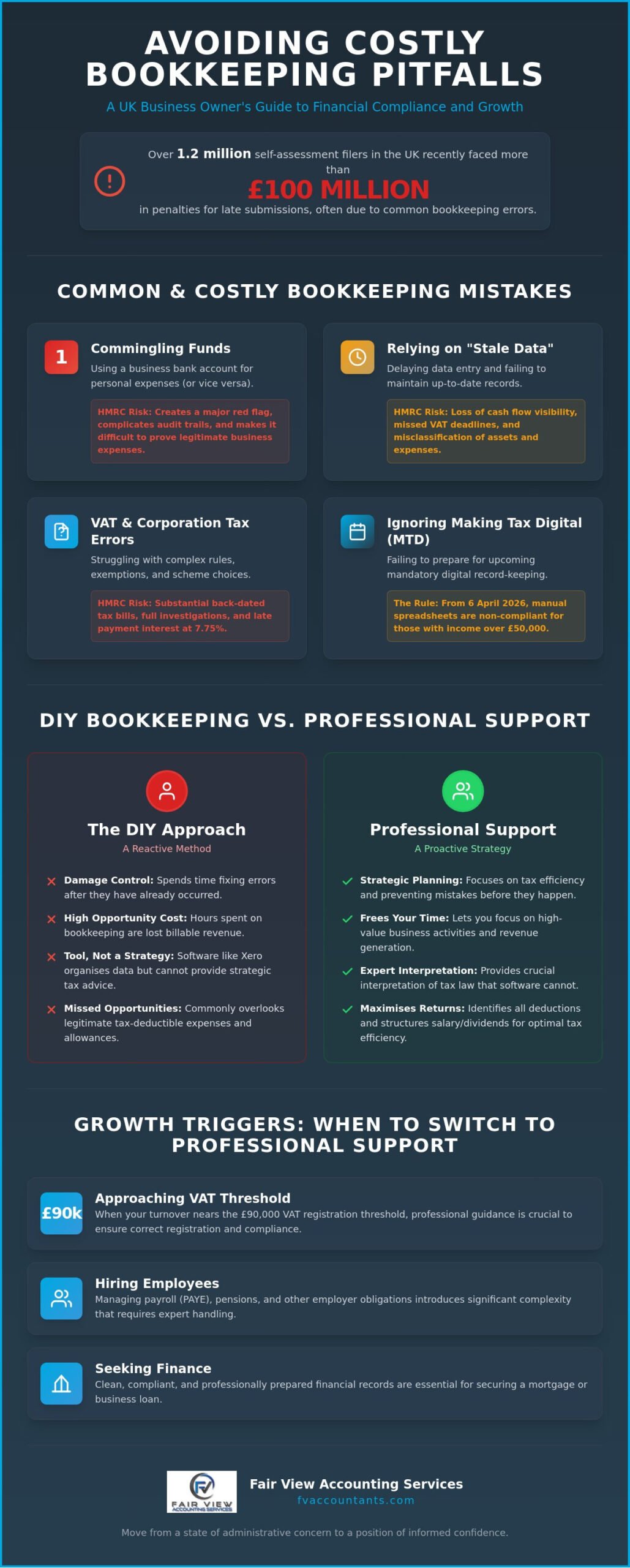
Over 1.2 million self-assessment filers in the UK recently faced more than £100 million in penalties for late submissions. This staggering figure is often the direct result of common bookkeeping mistakes uk business owners make when trying to manage complex HMRC requirements alongside their daily operations. It’s a frustrating reality for many entrepreneurs who find themselves spending precious weekends buried in spreadsheets rather than focusing on billable work.
You may feel anxious about the evolving rules for Making Tax Digital (MTD) or remain unsure which business expenses are actually tax-deductible. We will help you identify these costly errors and determine whether a DIY approach or professional chartered support offers the most secure path for your business growth. Our aim is to move you from a state of administrative concern toward a position of informed confidence.
We’ll examine the specific pitfalls of manual record-keeping, the benefits of modern digital integration, and how clean, compliant financial records can maximise your tax efficiency while providing the verification you need for future mortgages or business loans.
Key Takeaways
- Identify the common bookkeeping mistakes uk business owners face, such as commingling personal and business funds, to avoid triggering HMRC investigations.
- Understand why cloud-based software is a vital tool for data entry but cannot replace the proactive tax planning and strategic oversight of a chartered accountant.
- Recognise the critical growth triggers, such as reaching the £90,000 VAT registration threshold or hiring employees, that signal it is time to move beyond DIY methods.
- Learn how transitioning from manual spreadsheets to a professional digital system ensures clean, compliant records that simplify mortgage applications and business loan approvals.
- Discover how professional support provides peace of mind by managing complex Making Tax Digital (MTD) requirements and maximising your overall tax efficiency.
Common Bookkeeping Mistakes UK Small Businesses Make (and the HMRC Risks)
Many business owners start with the best intentions, but the pressure of daily operations often leads to common bookkeeping mistakes uk entrepreneurs find difficult to untangle later. One of the most frequent traps is the “commingling” of funds. Using your business bank account for personal groceries or vice versa creates a major red flag for HMRC. This lack of separation complicates your audit trail and makes it nearly impossible to prove that expenses are wholly and exclusively for business purposes.
Relying on “stale data” presents another significant risk to your stability. When you delay data entry, you lose visibility over your actual cash flow and risk missing critical VAT deadlines. This often leads to misclassification errors, such as confusing capital assets with revenue expenses. By adhering to standard methods of bookkeeping, you ensure that every transaction is categorised correctly from the start. Failing to maintain these standards doesn’t just invite financial penalties; it creates a persistent sense of HMRC anxiety that drains your mental energy and focus.
The Knowledge Gap: VAT and Corporation Tax Errors
DIY owners frequently struggle with the complexities of VAT in the UK, particularly when approaching the £90,000 registration threshold. Errors regarding partial exemptions or incorrect scheme choices can lead to substantial back-dated tax bills. For Limited Companies, incorrect Corporation Tax filings are equally dangerous. Small inaccuracies in your annual accounts can trigger a full tax investigation, potentially resulting in late payment interest which currently sits at a steep 7.75%.
Making Tax Digital (MTD) Compliance in 2026
The regulatory landscape is shifting. From 6 April 2026, MTD for Income Tax Self Assessment (ITSA) becomes mandatory for self-employed individuals and landlords with a total gross income over £50,000. Under these rules, manual spreadsheets are no longer sufficient to meet HMRC’s “digital link” requirements. You must use compatible software to maintain records and submit quarterly updates. Ignoring these digital standards is one of the most pressing common bookkeeping mistakes uk businesses must address to avoid the new points-based penalty regime.
DIY Bookkeeping vs Hiring an Accountant: A Strategic Comparison
Choosing between managing your own books and partnering with a professional often comes down to a choice between being reactive or proactive. DIY bookkeeping is inherently reactive; you spend your time fixing errors after they’ve occurred. By contrast, professional support focuses on tax planning that prevents common bookkeeping mistakes uk business owners frequently encounter. This shift from damage control to strategic growth allows you to build a more resilient financial foundation.
Many entrepreneurs assume that a subscription to Xero or QuickBooks solves their compliance needs. However, software is merely a tool, not a strategy. Whilst these platforms help you meet HMRC record-keeping requirements, they don’t provide the interpretation of tax law necessary to maximise your position. Modern cloud tools like Dext and IRIS actually work best when they facilitate a seamless partnership, allowing your accountant to monitor your data in real-time and provide immediate, actionable advice.
The opportunity cost of DIY management is often higher than owners realise. If you spend five hours a month on bookkeeping instead of billable work, that time represents lost revenue that likely exceeds a monthly accounting fee. Outsourcing these tasks ensures your records are accurate whilst freeing you to focus on high-value business activities.
The ROI of Professional Tax Planning
Professional oversight often pays for itself through identified efficiencies. DIY owners frequently overlook legitimate tax-deductible expenses such as “use of home as office” calculations or specific industry-related capital allowances. A chartered accountant structures your dividends and salary to ensure you remain within the most tax-efficient bands whilst maintaining full compliance. This precise approach transforms your accounting from an overhead into a value-adding investment.
Software Subscriptions vs Comprehensive Accounting Fees
The cost of multiple DIY software add-ons for payroll, receipt scanning, and reporting can quickly spiral. An all-inclusive professional service often proves more economical by bundling these tools with expert human oversight. This is especially vital for those managing complex CIS returns or payroll, where a single mistake can lead to significant penalties. If you’re ready to reclaim your weekends from spreadsheets, our specialist bookkeeping services provide the clarity you need to scale with confidence.
When to Make the Switch: Transitioning for Business Growth
Recognising the right moment to move from DIY methods to professional support is a defining milestone for any growing enterprise. For many, the first trigger point is approaching the £90,000 VAT registration threshold. Attempting to manage VAT compliance without expert oversight is one of the most common bookkeeping mistakes uk business owners make, often leading to significant backdated tax liabilities. Other critical milestones include hiring your first employee, which introduces complex payroll and pension obligations, or the decision to incorporate as a Limited Company.
Transitioning from unorganised spreadsheets to a modern, cloud-based system doesn’t have to be disruptive. A professional firm handles the migration of your historical data into platforms like Xero or QuickBooks, ensuring no records are lost in the process. This shift aligns your business with the official government guidance on record-keeping, providing a robust audit trail that satisfies HMRC requirements. Beyond the technical setup, you gain a “tech-savvy guardian” who manages all HMRC correspondence on your behalf, providing the peace of mind needed to focus on your core operations.
Unlocking Finance with an Accountant’s Certificate
If you plan to apply for a mortgage or a business loan, your bookkeeping accuracy becomes a matter of public record. High-street lenders almost always reject DIY spreadsheets for financial verification because they lack the independent validation required for risk assessment. A professional Accountant’s Certificate provides the necessary assurance that your figures are accurate and compliant. This document is often the key to unlocking the capital you need for personal or professional expansion.
Choosing a National Chartered Partner
When selecting a partner to help you avoid common bookkeeping mistakes uk regulations might penalise, look for a firm with deep MTD expertise and a focus on digital integration. Your accountant should offer remote, online support that fits your schedule whilst providing sector-specific knowledge tailored to your industry. A smooth handover involves your new firm obtaining professional clearance from any previous providers and setting up automated data feeds to simplify your daily admin.
Ready to secure your financial future and eliminate administrative stress? Contact Fair View Accounting Services for a professional review of your bookkeeping and discover how our chartered expertise can facilitate your business growth.
Securing Your Financial Future and Compliance
Correcting the common bookkeeping mistakes uk entrepreneurs often make is the first step toward a more stable and scalable business. Whether it’s properly separating your personal and business finances or preparing for the mandatory 2026 MTD rollout, professional oversight transforms your administrative burden into a strategic growth asset. By moving away from reactive DIY habits and embracing proactive chartered support, you ensure your records are always audit-ready and tax-efficient.
As Chartered Accountants serving clients across the UK, we act as your tech-savvy guardians. We specialise in seamless Xero, QuickBooks, and Dext integrations to ensure your financial data is accurate and secure. If you’re looking to purchase a home or secure business funding, we also provide the specialist Accountant’s Certificates that high-street lenders require for verification.
You don’t have to navigate these complex regulations alone. With the right professional partner by your side, you can reclaim your time whilst maintaining the high standards of accuracy that HMRC demands. We look forward to supporting your journey toward financial clarity and long-term success.
Frequently Asked Questions
Is it legal to do my own bookkeeping for a UK Limited Company?
Yes, you can legally manage your own bookkeeping for a UK Limited Company. Whilst there’s no legal requirement to hire a professional, company directors remain legally responsible for the accuracy of financial records and statutory filings. If you choose the DIY route, you must ensure your records meet the strict standards required for Corporation Tax and Annual Accounts. Many owners find that the complexity of these requirements makes professional oversight a safer option for maintaining compliance.
How much does a small business accountant typically cost in the UK?
The cost of a small business accountant in the UK varies significantly depending on the volume of transactions and the specific services you require. Most firms offer tiered monthly packages that scale as your business grows. Factors such as payroll management, VAT returns, and the level of digital integration will influence the final fee. Investing in a professional service often offsets the potential costs associated with common bookkeeping mistakes uk businesses face, such as HMRC penalties or missed tax reliefs.
Can an accountant help me if I have already made mistakes in my past filings?
Yes, an accountant can help you rectify errors in previous submissions through a process of voluntary disclosure or by filing amended returns. We can review your historical data to identify inaccuracies and communicate with HMRC on your behalf to mitigate potential penalties. Addressing these issues proactively is always better than waiting for an official investigation. This transition ensures your future records are clean, compliant, and structured to support your long-term business goals.
What is the difference between a bookkeeper and a chartered accountant?
A bookkeeper primarily focuses on the daily recording of financial transactions and maintaining accurate ledgers. A chartered accountant provides a higher level of strategic oversight, interpreting that data to offer tax planning and business advice. Chartered status indicates that the professional is regulated by a recognised body and has completed rigorous training. While a bookkeeper keeps your data organised, an accountant ensures your business remains tax-efficient and compliant with the evolving regulatory landscape.
Disclaimer
The information provided in this article is for general guidance only and is not intended to constitute professional advice, tax advice, financial advice, legal advice, or any other form of regulated guidance. Although every effort has been made to ensure accuracy at the time of publication, Fair View Accounting Services, including its director, employees, contractors, writers, and content-creation team, accepts no responsibility for any loss, damage, penalty, or consequence arising from reliance on the information contained herein. UK tax legislation changes frequently, and HMRC interpretations, thresholds, and rules may vary depending on the individual circumstances of each taxpayer. Nothing in this article should be considered a substitute for obtaining formal, personalised advice from a qualified accountant or tax professional. Readers should not take action or refrain from taking action based solely on the content published on this website. Fair View Accounting Services does not guarantee the completeness, accuracy, or ongoing validity of the information provided and assumes no liability for omissions or errors, whether typographical, factual, or technical. By using this content, the reader acknowledges that all responsibility for decisions remains solely with the user.