

For over 300,000 UK employees, the era of claiming working from home tax relief directly from HMRC has officially come to an end. Following the abolition of this relief for the 2026/27 tax year, the landscape for remote workers has shifted from a simple flat-rate perk to a more technical area of compliance. It’s a significant change that leaves many wondering if they’ve lost out on valuable savings overnight.
We understand that the transition from pandemic-era flexibility to the current strict regulations is confusing, especially when you’re trying to manage rising household utility costs. This guide will clarify exactly where you stand, providing a definitive answer on your eligibility under the latest HMRC rules. You’ll learn how to qualify for and calculate your homeworking costs whilst ensuring every claim is backed by the necessary evidence. We’ll also preview the step-by-step process for backdating claims for previous years and explain how self-employed individuals can still maximise their tax efficiency through digital record-keeping.
Key Takeaways
- Determine your eligibility by distinguishing between mandatory remote contracts and optional hybrid working arrangements under the latest HMRC criteria.
- Learn why self-employed individuals and freelancers remain unaffected by the 2026 abolition and how to continue claiming expenses through your annual accounts.
- Compare the £6 weekly flat rate against the actual costs method to ensure you are maximising your working from home tax relief whilst maintaining full compliance.
- Discover the step-by-step process for submitting claims via form P87 or your tax code, including how to backdate claims for up to four previous tax years.
- Explore how modern digital record-keeping tools can simplify the calculation of complex utility costs, making your financial management seamless and accurate.
Determining Your Eligibility for Homeworking Tax Relief
Working from home tax relief serves as a vital mechanism within the UK tax system to help individuals offset the additional household costs incurred while performing their professional duties. Traditionally, this relief covered the incremental rise in heating, electricity, and metered water bills. However, the landscape shifted significantly on 6 April 2026. HMRC abolished the ability for employees to claim this relief directly from the government for the 2026/27 tax year. This change followed findings that over half of reviewed claims were ineligible.
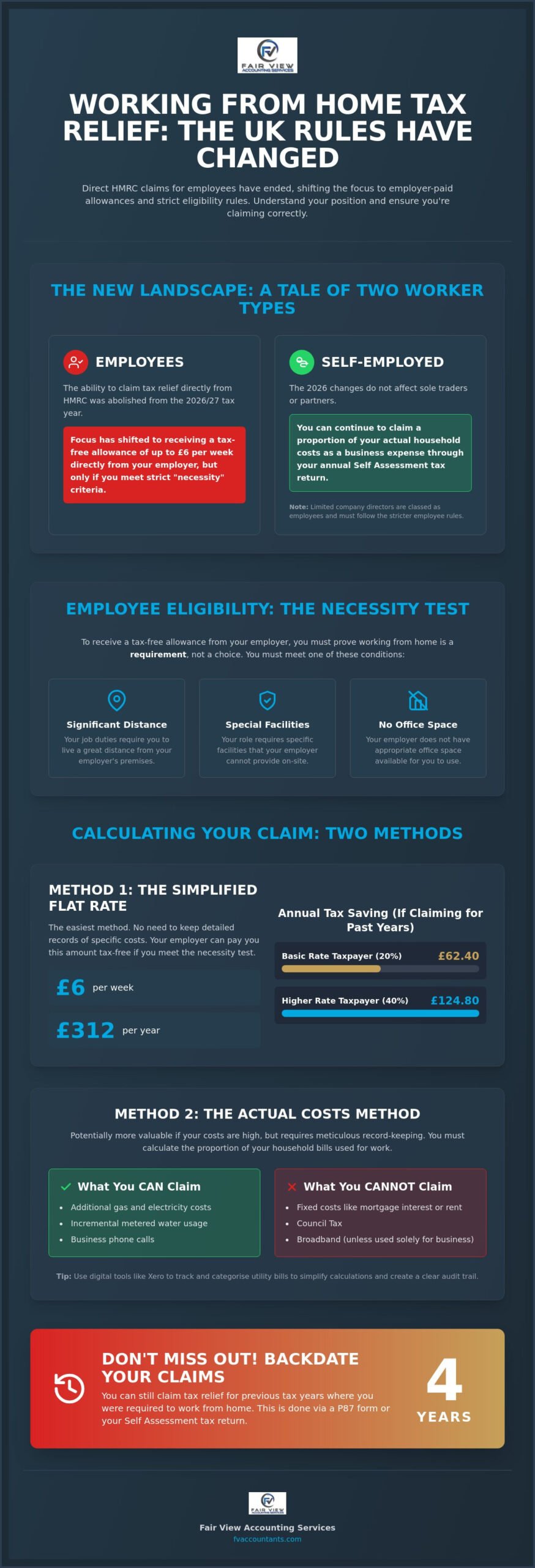
Despite this abolition, the criteria for eligibility remain critical. They now determine whether your employer can pay you a tax-free allowance of up to £6 per week. If you don’t meet the “Necessity Test,” any payment from your employer for home working costs is treated as taxable income. Understanding these boundaries ensures you remain compliant whilst protecting your take-home pay.
The Necessity Test: Do You Actually Qualify?
To qualify for tax-free employer reimbursements or to backdate claims for previous years, you must prove that working from home is a requirement, not a choice. HMRC typically accepts three specific scenarios. First, your job duties must require you to live a great distance from your employer’s premises. Second, the nature of your role must require you to have specific facilities that your employer cannot provide on-site. Finally, you may qualify if your employer has no appropriate office space available for you to use. To safeguard your position, you should maintain a digital file containing:
- A formal employment contract stating your home is your permanent workplace.
- Letters or emails from HR confirming the lack of office facilities.
- Records of your home address in relation to the nearest company hub.
Rules for the Self-Employed and Freelancers
The 2026 changes do not affect those who are self-employed. If you operate as a sole trader or a partner, you don’t need to prove necessity. You only need to demonstrate that your home is used for business purposes. This flexibility allows you to claim working from home tax relief through your annual accounts based on a fair and reasonable proportion of your actual bills. Keep in mind that limited company directors are legally classified as employees. Consequently, they must follow the stricter necessity rules rather than the more generous self-employed standards.
How to Calculate Your Claim: Flat Rate vs. Actual Costs
Calculating working from home tax relief accurately is the only way to ensure you don’t leave money on the table whilst remaining fully compliant with HMRC. For the 2026 tax year, the benchmark remains the flat-rate amount of £6 per week. This fixed sum is designed to cover additional household expenses without the administrative burden of tracking every receipt. You can find more detail in the Official government guidance on homeworking tax relief, which outlines the standard expectations for these claims.
The Simplified Expenses Method
The primary advantage of this method is its total simplicity. You don’t need to provide receipts or perform complex calculations, making it a low-risk option during an HMRC enquiry. If you’re a basic-rate taxpayer, the £312 annual allowance reduces your tax bill by £62.40. Higher-rate taxpayers benefit from a £124.80 saving. It’s a straightforward “set and forget” approach that suits most remote workers who don’t want to spend hours on spreadsheets.
The Actual Costs Method: Apportioning Your Bills
If your heating and electricity costs have risen significantly, calculating actual costs may yield a higher return. You must apportion your bills using a logical formula: divide your total utility bill by the number of rooms in your home, then multiply that by the percentage of time those rooms are used for work. Allowable household expenses include the business-use portion of heating, lighting, and metered water increments. Fixed costs such as mortgage interest, rent, or council tax are strictly excluded from these calculations.
Organising these figures doesn’t have to be a manual chore. Modern cloud platforms like Xero allow you to categorise utility bills as they arrive, providing a clear audit trail for your Self Assessment or employer reimbursement claims. This digital approach ensures your figures are precise and ready for submission well before the deadline.
How to Claim Your Relief and Maximise Your Tax Position
Once you have determined your eligibility and calculated your costs, the final step is to formalise your claim with HMRC. For employees, the process is typically handled through a P87 form. If your claim is successful, HMRC will usually adjust your tax code, meaning you pay less tax on your monthly salary. However, if you are claiming for previous years, you might receive a direct repayment instead. It’s vital to remember that you can claim retrospectively for up to four previous tax years, which is a significant opportunity for those who haven’t yet utilised working from home tax relief.
For freelancers, contractors, and high-earners, the Self Assessment return remains the most robust and transparent way to claim. This method allows you to present a comprehensive view of your business expenses alongside your income. If you operate as a sole trader, you should refer to the rules for Simplified expenses for the self-employed to decide if the flat-rate approach or actual cost method serves your business better.
Step-by-Step: Submitting Your Claim to HMRC
The Government Gateway portal is your primary tool for submission. Log in using your credentials and navigate to the “Check if you can claim work-related expenses” section. You will need to select the relevant tax year and enter your calculated figures. If you are using the flat-rate method, simply enter the total based on £6 per week. For actual costs, ensure your digital records are ready in case of an enquiry. Most claimants see a tax code adjustment within a few weeks, though direct refunds can take longer during peak periods.
Integrating WFH Relief into Your Annual Tax Planning
Viewing your homeworking costs in isolation can lead to missed opportunities. A professional review of your wider tax profile can uncover additional savings, such as the marriage tax allowance 2026, which benefits many qualifying couples. Our accounting services focus on this holistic approach, ensuring that your WFH claims don’t conflict with employer-paid allowances. We also help you navigate complex areas like Capital Gains Tax, particularly if you use a dedicated part of your home exclusively for business. Precision in these areas prevents “double-claiming” and secures your long-term compliance.
Securing Your Remote Work Tax Efficiency
Success in claiming working from home tax relief in 2026 depends on two critical factors: proving contractual necessity for employees or maintaining precise digital records for the self-employed. You now have the framework to decide between the simplified £6 weekly flat rate and the more detailed actual costs method. Whilst the rules have become stricter, these savings remain accessible to those who approach their compliance with diligence and accuracy.
Fair View Accounting Services operates as a dedicated partner for remote workers across the country. As Chartered Accountants with national UK coverage, we specialise in remote cloud-based accounting to make your financial management seamless. Our proactive approach to tax planning ensures that every available relief is identified and correctly applied to your specific circumstances.
Managing your tax obligations shouldn’t be a source of stress. By following these guidelines and utilising modern digital tools, you can navigate the 2026 regulations with confidence and ensure you never pay more tax than is strictly necessary.
Frequently Asked Questions
Can I claim WFH tax relief if I only work from home part-time?
You can still receive tax-free payments from your employer if you work part-time, as long as a formal homeworking agreement is in place. Since the 6 April 2026 changes, employees can’t claim this relief directly from HMRC. Instead, your employer can pay you the £6 weekly allowance tax-free for the time you spend working remotely. Self-employed individuals can continue to claim a fair proportion of their bills through their annual accounts based on usage whilst performing business duties.
Does my employer have to pay me the WFH allowance directly?
Your employer isn’t legally required to pay the homeworking allowance. It’s a discretionary payment they can choose to offer as a tax-free benefit. If your employer doesn’t provide this payment, you can’t claim the working from home tax relief from HMRC for the 2026/27 tax year. This legislative shift places the decision to cover remote working costs entirely in the hands of the business owner rather than the tax system.
What happens if I work from home by choice rather than necessity?
You won’t qualify for tax-free reimbursements if your remote work is a personal choice rather than a contractual necessity. HMRC’s criteria require that your home is your required workplace because your employer lacks suitable office space or you live too far away to commute. Any allowance paid for voluntary remote work is treated as a taxable benefit. Consequently, these payments will be subject to Income Tax and National Insurance via your monthly payslip.
Can I claim for equipment like a new desk or laptop through WFH relief?
You can’t claim for furniture or hardware like desks and laptops through the standard working from home tax relief. This relief only covers the additional cost of household utilities like heating, lighting, and metered water. If you’re an employee, your company is responsible for providing the equipment you need to work safely. Self-employed people should categorise these items as capital allowances amongst other business expenses to reduce their overall tax liability.
Disclaimer
The information provided in this article is for general guidance only and is not intended to constitute professional advice, tax advice, financial advice, legal advice, or any other form of regulated guidance. Although every effort has been made to ensure accuracy at the time of publication, Fair View Accounting Services, including its director, employees, contractors, writers, and content creation team, accepts no responsibility for any loss, damage, penalty, or consequence arising from reliance on the information contained herein. UK tax legislation changes frequently, and HMRC interpretations, thresholds, and rules may vary depending on the individual circumstances of each taxpayer. Nothing in this article should be considered a substitute for obtaining formal, personalised advice from a qualified accountant or tax professional. Readers should not take action or refrain from taking action based solely on the content published on this website. Fair View Accounting Services does not guarantee the completeness, accuracy, or ongoing validity of the information provided and assumes no liability for omissions or errors, whether typographical, factual, or technical. By using this content, the reader acknowledges that all responsibility for decisions remains solely with the user.