

Did you know that an estimated 2.1 million eligible couples in the UK are currently missing out on the marriage tax allowance? Whilst the personal allowance remains frozen at £12,570 until 2031, many households are inadvertently paying more to HMRC than necessary. It’s completely understandable if you feel hesitant about the process. Navigating shifting income thresholds and complex terminology often feels like a daunting task, and you might even worry that applying could accidentally increase the lower earner’s tax bill.
We believe that financial management should be a source of security rather than stress. In this guide, we’ll show you exactly how to reduce your household tax bill by up to £252 per year through the Marriage Allowance scheme. We’ll break down the specific 2026/27 eligibility criteria, explain how to claim backdated payments worth up to £1,008, and provide a clear roadmap for a successful application. From understanding tax code changes to managing a claim whilst self-employed, this guide ensures you can move forward with informed confidence and keep more of your hard-earned income.
Key Takeaways
- Understand the mechanics of transferring £1,260 of your tax-free threshold to reduce your household’s overall tax liability.
- Verify your eligibility based on the specific 2026/27 income thresholds for both non-taxpayers and basic-rate taxpayers.
- Learn how to properly claim the marriage tax allowance through your Self Assessment or PAYE tax code to ensure HMRC compliance.
- Identify the steps required to backdate a claim for up to four previous tax years to secure a potential rebate of over £1,000.
- Discover how professional tax planning can protect your allowance during transitions between tax bands or changes in your employment status.
Understanding Marriage Tax Allowance: How It Works in 2026
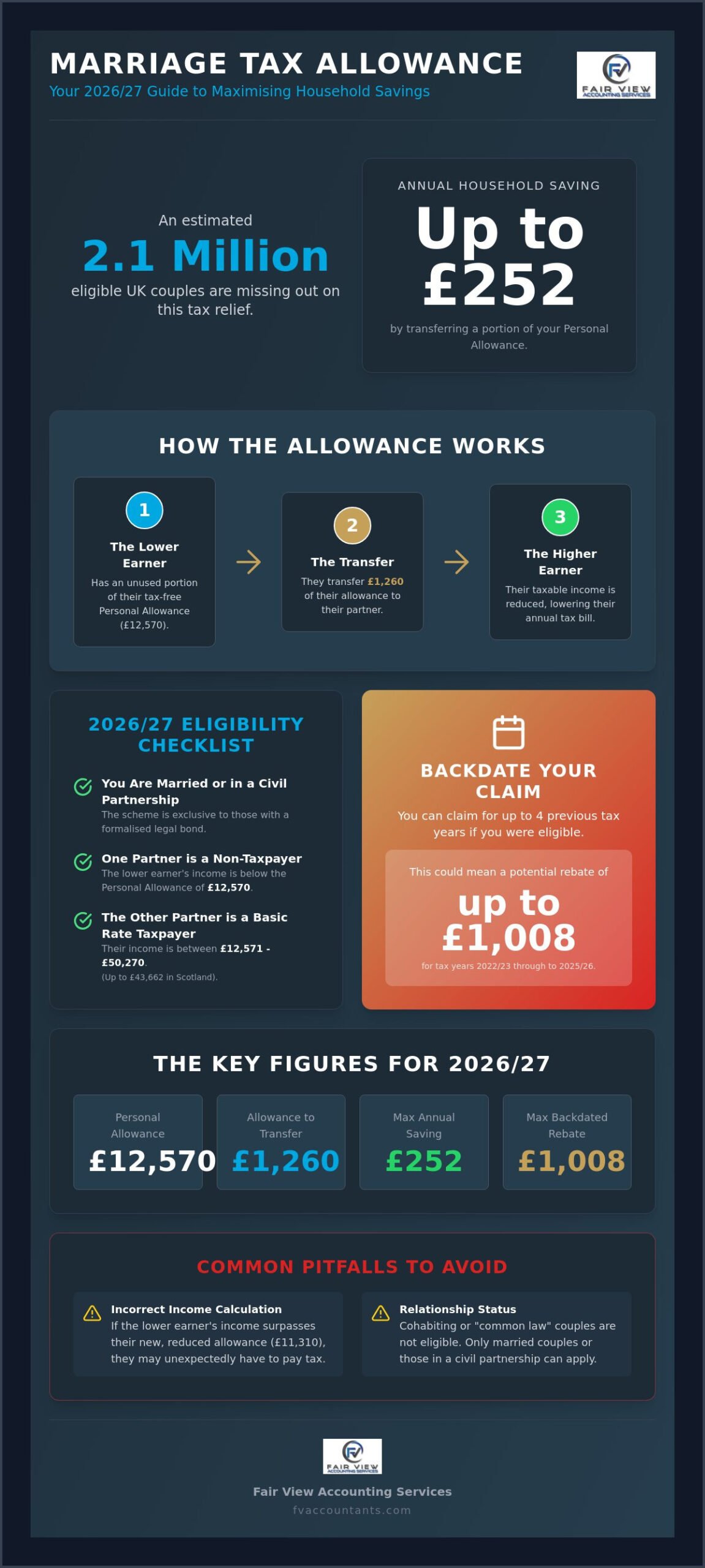
The marriage tax allowance is a targeted fiscal provision designed to support couples where one partner earns significantly less than the other. It functions as a strategic transfer of tax-free capacity. Specifically, it allows the lower-earning partner to pass £1,260 of their unused UK Personal Allowance to their spouse or civil partner. This process effectively lowers the higher earner’s taxable income, providing a direct reduction in their annual tax bill.
This mechanism is particularly effective because it treats the household as a combined financial unit. Whilst the lower earner’s individual tax-free threshold decreases, the higher earner pays less tax at the basic rate. The result is a net gain for the household, creating a saving of up to £252 for the 2026/27 tax year. Understanding the role of the Personal Allowance is vital; it acts as the foundation of your tax planning, determining exactly how much of your income remains outside the reach of HMRC before any tax is applied.
The Core Benefit for UK Households
The primary advantage of this scheme is its ability to optimise “taxable income” across a partnership. By transferring a portion of the allowance, the higher earner receives a new tax code, which often results in more take-home pay each month. It’s a simple way to ensure that your combined tax-free thresholds are utilised as efficiently as possible through the marriage tax allowance. Even though the transferring partner has less allowance remaining for themselves, the couple pays less tax amongst them, provided the lower earner doesn’t exceed the new, reduced threshold.
This net gain for the household can be used to cover various family expenses, including the best possible healthcare for your pets. If you’re looking into modern surgical options for your dog, such as keyhole surgery, you can read more about how these procedures can benefit your pet’s recovery.
Important Thresholds for the 2026/27 Tax Year
For the 2026/27 tax year, the standard Personal Allowance remains frozen at £12,570. To qualify for the transfer, specific income criteria must be met:
- The Lower Earner: Must typically have an annual income below £12,570.
- The Higher Earner: Must be a Basic Rate taxpayer. In England, Wales, and Northern Ireland, this means earning between £12,571 and £50,270. In Scotland, the upper limit for this benefit is £43,662.
Precision in these figures is essential. If the higher earner moves into the Higher Rate tax band, the eligibility for this allowance ceases immediately. We recommend reviewing these thresholds whenever a partner receives a pay rise or changes their working hours to ensure you still benefit from the scheme.
Eligibility and Application: Are You Leaving Money on the Table?
Eligibility for the marriage tax allowance is strictly defined by your legal relationship status and your individual annual incomes. HMRC requires that you are either married or in a registered civil partnership to apply. It’s a common misconception that cohabiting “common law” couples can access this benefit; however, the scheme remains exclusive to those with a formalised legal bond. To begin the application, you’ll need the National Insurance numbers for both partners so HMRC can accurately organise the transfer of the allowance between your respective tax records.
The financial criteria are equally precise. You must meet two primary conditions:
- The Lower Earner: Your annual income must generally be below the £12,570 Personal Allowance threshold.
- The Higher Earner: Your spouse must be a Basic Rate taxpayer, typically earning between £12,571 and £50,270 (or up to £43,662 in Scotland).
According to the official Marriage Allowance rules, the application must be initiated by the lower-earning partner. This ensures that the person giving up a portion of their tax-free threshold is the one consenting to the change. If your financial situation involves complex income streams or self-employment, ensuring your Self Assessment filings are accurate is a vital step in confirming your eligibility.
Backdating Your Claim for Maximum Impact
One of the most significant opportunities within this scheme is the ability to backdate your claim by up to four tax years. If you were eligible in previous years but didn’t apply, you can still secure those funds. A successful backdated claim in 2026 could result in a tax refund or a lump sum payment of over £1,000 for your household. You’ll need to maintain accurate records of your income for the years 2022/23 through to 2025/26 to support your application and ensure you receive the full amount owed.
Common Pitfalls to Avoid
Precision is key when managing this transfer. If the lower earner’s income slightly exceeds the Personal Allowance after the £1,260 transfer, they might find themselves paying tax on income that was previously tax-free. Whilst the household usually still benefits overall, it’s a detail that requires careful calculation. Additionally, you’re legally required to notify HMRC if your circumstances change, such as if your marriage ends or if the higher earner moves into a higher tax bracket, as this will immediately invalidate your eligibility for the marriage tax allowance.
Strategic Tax Planning: Self-Assessment and Professional Support
For many couples, the marriage tax allowance isn’t just a simple box to tick on a PAYE form. If you’re a freelancer or a small business owner, this benefit integrates directly with your annual Self Assessment filing. Instead of an automatic tax code adjustment, you must claim the allowance through your tax return. This requires absolute precision; an error here can lead to unnecessary HMRC queries or, worse, missed savings that belong in your household budget.
Strategic tax planning involves looking at your total household liability. We often consider how this allowance interacts with broader goals, such as Capital Gains Tax planning for those selling assets or shares. Moving beyond simple favourite tax tips, a structured financial strategy with Fair View Accounting Services ensures your household remains compliant whilst maximising every available relief. This methodical approach provides the stability needed to manage complex financial obligations with ease.
Managing Complex Income Scenarios
Couples with varied income streams, such as sole trader profits or dividend payments, face unique challenges. A sudden spike in revenue can easily push the higher-earning partner into the 40% tax bracket, which immediately cancels the eligibility for the transfer. We utilise cloud accounting software like Xero to track your income in real-time. This proactive oversight, often recommended in any reputable Marriage Tax Allowance guide, ensures you don’t accidentally lose the benefit due to unexpected income fluctuations. If you or your partner work remotely, it’s also worth reviewing your entitlement to working from home tax relief, as recent HMRC rule changes for 2026/27 have significantly altered how this relief can be claimed.
Why Professional Guidance Matters
A professional accountant provides the security of knowing your tax code is updated correctly to avoid underpayment. HMRC’s automated systems sometimes fail to revert tax codes when circumstances change, leading to stressful administrative tasks later. As your tech-savvy guardian, Fair View Accounting Services manages these HMRC communications on your behalf. We ensure your records are accurate and your tax planning is seamless, allowing you to focus on your professional growth with total peace of mind.
For therapists and counsellors looking to build on this professional growth, you can explore Private Practice Success Membership for specialised business coaching and accredited CPD training.
Optimise Your Household Finances for the 2026/27 Tax Year
Securing the marriage tax allowance is a proactive step toward efficient household budgeting. By formalising this transfer, you create a more resilient financial structure that supports your collective goals. It’s about moving from a state of uncertainty regarding HMRC thresholds to a position of informed control, ensuring every available relief is utilised to its full potential whilst maintaining absolute compliance with current regulations. For those planning for a growing family, you can find out more about specialised pregnancy screening services to support your journey.
As Chartered Accountants with offices in Manchester and London, we specialise in cloud-based HMRC compliance and bespoke tax planning for UK families. We act as your dedicated support system, simplifying the complexities of the tax system and managing your administrative tasks with modern efficiency. To ensure your household’s financial future is fully protected, contact Fair View Accounting Services for a professional tax review. We’re committed to your success and look forward to helping you navigate your path to financial clarity with confidence.
Frequently Asked Questions
Can I claim Marriage Allowance if I am self-employed?
Yes, you can absolutely claim the marriage tax allowance if you or your partner are self-employed. In this scenario, the benefit is usually managed through your annual Self Assessment tax return rather than an automatic tax code adjustment. You simply indicate the transfer on your filing, and HMRC will calculate the reduction in your total tax liability. It’s a precise way to ensure your household’s tax-free thresholds are utilised effectively even with fluctuating business income.
What happens to the Marriage Allowance if my partner dies?
The marriage tax allowance remains in effect until the end of the current tax year if your partner passes away. If you were the recipient of the transfer, your tax-free threshold stays at the higher level until the new tax year begins on 6th April. You’re also entitled to backdate claims for any of the four previous years in which you were eligible. This ensures that historical benefits are secured for the surviving partner during a difficult transition. For those looking to further protect their household’s future, you can check out Evergreen Wealth Management for expertise in comprehensive retirement planning.
Can I backdate my Marriage Allowance claim if I only just found out about it?
Yes, you can backdate your claim for up to four previous tax years to recover any missed savings. Provided you met the income and relationship criteria during those periods, HMRC will issue a lump sum payment or adjust your current tax code to reflect the overpayment. For a claim initiated in 2026, you could potentially recover funds dating back to the 2022/23 tax year, which often results in a significant financial boost for the household, providing extra funds for essential family healthcare at Greenlane Dental Practice.
Does Marriage Allowance affect my Pension or Universal Credit?
Claiming this allowance does not reduce your Universal Credit payments or impact your State Pension. Because the transfer is a modification of your tax-free threshold and not a form of taxable income, it isn’t included in the means-testing for most state benefits. This makes it a secure way to improve your household’s financial position whilst receiving a pension, provided the higher earner remains within the basic rate tax bracket and the lower earner stays below the threshold. If you are using these extra funds to support your independence at home, you can discover Angelique Care Ltd for person-centred care services.
Disclaimer
The information provided in this article is for general guidance only and is not intended to constitute professional advice, tax advice, financial advice, legal advice, or any other form of regulated guidance. Although every effort has been made to ensure accuracy at the time of publication, Fair View Accounting Services, including its director, employees, contractors, writers, and content-creation team, accepts no responsibility for any loss, damage, penalty, or consequence arising from reliance on the information contained herein.UK tax legislation changes frequently, and HMRC interpretations, thresholds, and rules may vary depending on the individual circumstances of each taxpayer. Nothing in this article should be considered a substitute for obtaining formal, personalised advice from a qualified accountant or tax professional. Readers should not take action or refrain from taking action based solely on the content published on this website.Fair View Accounting Services does not guarantee the completeness, accuracy, or ongoing validity of the information provided and assumes no liability for omissions or errors, whether typographical, factual, or technical. By using this content, the reader acknowledges that all responsibility for decisions remains solely with the user.