

Why does a low-cost accountancy quote often end up costing more in the long run than a comprehensive fixed-fee package? Most directors find that limited company accountant fees are treated like a black box, filled with opaque structures and hidden charges for basic advice. You likely started your business to build something meaningful, not to spend your evenings deciphering VAT rules or worrying about the latest HMRC penalties. It’s a common frustration to feel that your accountant is a distant figure who only appears when a deadline is looming.
We’ve designed this guide to help you regain control. You’ll discover how to evaluate quotes with confidence, understand the impact of the 2026 Making Tax Digital rollout, and identify which services actually drive growth. We’ll explore the shift toward cloud-based efficiency and fixed-fee certainty, ensuring you find a tech-savvy partner who acts as a guardian for your compliance. From Corporation Tax nuances to the benefits of a proactive Accountant’s Certificate, we’ll show you how to turn your accountancy spend from a mandatory cost into a strategic investment.
Key Takeaways
- Understand why transaction volume and sector-specific requirements, such as CIS or e-commerce, dictate your fee structure more than turnover alone.
- Learn how to evaluate limited company accountant fees by prioritising fixed-fee certainty over unpredictable hourly rates to ensure long-term budget stability.
- Identify the essential “Compliance Minimum” services, including statutory accounts and Corporation Tax filings, to protect your company from HMRC penalties.
- Discover how integrating cloud platforms like Xero or QuickBooks automates data entry and reduces professional time costs whilst providing real-time financial visibility.
Factors Influencing Limited Company Accountant Fees in 2026
Understanding limited company accountant fees requires looking beyond your annual turnover. While your total revenue provides a baseline, professional firms primarily assess the volume of administrative work and the technical complexity of your financial records. A Chartered Accountant will typically examine how many invoices, receipts, and bank transactions occur each month to determine a fair, transparent price.
The frequency of your reporting also dictates the final cost. A director who only requires an annual “compliance-only” service for statutory accounts will pay less than one who needs monthly management accounts. However, monthly oversight often prevents expensive errors and helps you identify tax-saving opportunities before the financial year ends. Modern firms act as tech-savvy guardians, using digital integration to keep your business compliant whilst you focus on growth.
The Impact of Turnover vs. Activity
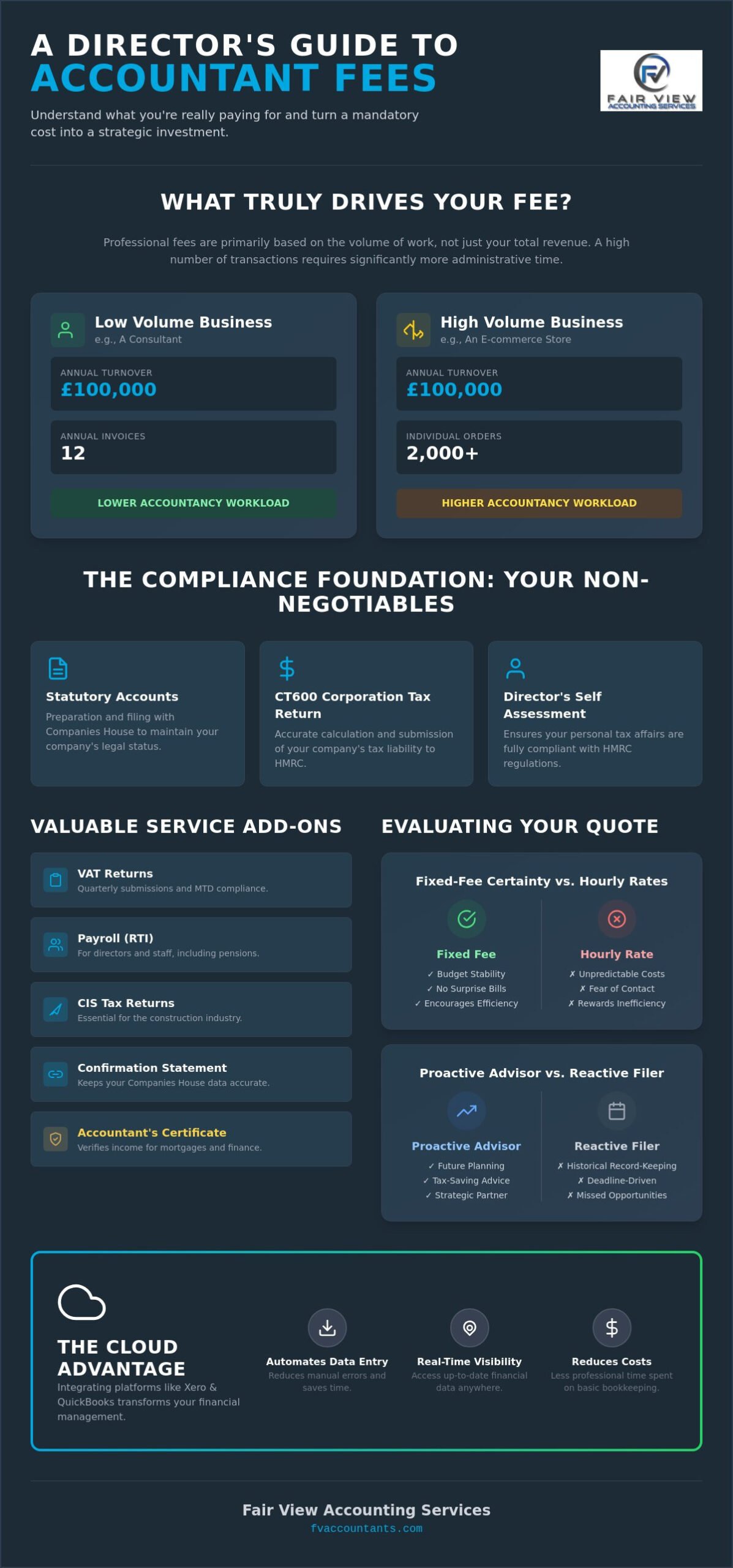
Transaction volume often dictates professional hours more than raw turnover figures do. A consultant earning £100,000 might only issue twelve invoices a year, whereas an e-commerce shop with the same turnover could process thousands of individual orders. High-volume businesses require more robust bookkeeping support to ensure every digital transaction is accurately reconciled and categorised for HMRC.
Additional Service Add-ons
Specific requirements can add layers to your initial quote, so it’s vital to identify which services are essential for your operations. Common extras include:
- Payroll: Managing RTI submissions and pension contributions for directors and staff.
- VAT Returns: Navigating complex schemes and ensuring MTD compliance.
- CIS Tax: Handling subcontractor verifications and monthly statements for construction firms.
- Confirmation Statements: Ensuring your Companies House records remain accurate and up to date.
You should also consider the value of an Accountant’s Certificate if you plan to apply for a mortgage or business finance. This specialised document provides the professional security lenders require, acting as a verified seal of approval on your personal and business income. Including this in your service package ensures you’re prepared for opportunities without the stress of last-minute paperwork.
Evaluating Accountancy Quotes: A Buying Guide for UK Directors
Comparing professional quotes can feel like an exercise in frustration if you don’t know which services are included as standard. When reviewing limited company accountant fees, you should almost always prioritise a fixed-fee structure over hourly rates. Fixed pricing aligns your accountant’s efficiency with your own business goals, providing budget certainty whilst removing the fear of being billed for every short phone call or email query.
Transparency is the foundation of a healthy partnership. Some firms might offer an attractive headline rate but add hidden costs for cloud accounting software licences, HMRC investigation cover, or “ad-hoc” advice. It is also vital to verify that you are hiring a firm with professional indemnity insurance and regulatory oversight. This ensures you have a tech-savvy guardian protecting your interests rather than an unqualified provider who lacks formal accountability.
The Essential Service Checklist
A comprehensive, “all-inclusive” quote should provide a clear roadmap for your financial year. Bundling your personal and business requirements is often more cost-effective than managing them separately. Ensure your agreement includes:
- Statutory Accounts: Preparation and filing with Companies House.
- CT600 Corporation Tax Return: Accurate calculation of your company’s tax liability.
- Director’s Self Assessment: Personal tax filing to ensure total compliance.
- VAT Management: Regular submissions to keep you on the right side of HMRC.
- Payroll: Handling monthly RTI submissions for directors and staff.
Proactive Advice vs. Reactive Filing
There is a significant difference between an accountant who simply records the past and one who helps you plan the future. A proactive partner identifies tax-saving opportunities and provides the ROI that justifies their fees. For example, a specialist who understands the importance of an Accountant’s Certificate can save you weeks of stress when you eventually apply for a mortgage or business loan. If you want to move away from opaque pricing and reactive service, you can explore our transparent fixed-fee packages designed for modern UK directors.
Maximising Value: How Cloud Integration and Expertise Reduce Costs
Technology has fundamentally changed the way directors manage their finances. Digital integration isn’t just about convenience; it’s a direct lever to lower limited company accountant fees. When you automate repetitive tasks, you stop paying for a professional’s time to manually type in numbers and start paying for their high-level expertise. Understanding how to evaluate accountant fees involves looking at how much manual work is removed from the equation through modern software.
Modern platforms like Xero and QuickBooks provide real-time visibility into your cash flow and tax liabilities. This proactive oversight ensures you never miss a deadline, helping you avoid the interest and late filing penalties that often plague businesses using traditional, paper-based methods. Fair View Accounting Services combines this digital speed with the professional security of a chartered firm, offering UK-wide support that feels dedicated and highly personalised. Switching to a tech-enabled accountant is simpler than most directors realise, as we handle the digital migration to ensure a seamless transition.
Automation as a Cost-Saver
Tools like Dext completely remove the “shoebox of receipts” fee premium that traditional accountants often charge for manual data entry. By simply snapping a photo of an invoice, the data flows directly into your ledger without human intervention. Automated bank feeds ensure every transaction is captured for VAT accuracy, which significantly reduces the professional time required for reconciliation and lowers your overall limited company accountant fees.
Securing Your Financial Future
Investing in professional expertise is about more than just filing returns. It’s about having the right documentation, such as an Accountant’s Certificate, ready for when you want to scale your business or secure a personal mortgage. This forward-thinking approach ensures your financial foundation is stable and ready for growth, providing the peace of mind that comes from a tech-savvy guardian managing your compliance.
Get a transparent, fixed-fee quote from Fair View Accounting Services today and experience the clarity of a modern, tech-enabled partnership.
Empowering Your Business with Financial Clarity
Navigating the landscape of limited company accountant fees doesn’t have to be a source of constant stress. By prioritising fixed-fee certainty and embracing cloud-based automation through tools like Xero, QuickBooks, and Dext, you transform your accounting from a mandatory compliance burden into a strategic asset. You now understand how transaction volume and service complexity drive costs, and how a proactive partner identifies tax-saving opportunities that reactive firms often overlook.
As Chartered Accountants providing UK-wide support, we act as your tech-savvy guardian. Whether you need precise statutory accounts or a specialised Accountant’s Certificate for a director mortgage, our methodical approach ensures you remain fully compliant whilst focusing on your business growth. Don’t let opaque pricing or manual bookkeeping hinder your progress in 2026.
Request a Transparent Fixed-Fee Quote for Your Limited Company
Your business deserves the stability and precision of a modern, professional partnership. We look forward to helping you navigate the complexities of the UK tax system with absolute confidence.
Frequently Asked Questions
Are limited company accountant fees tax deductible?
Yes, limited company accountant fees are fully tax-deductible as a legitimate business expense. You can offset these professional costs against your company profits to reduce your Corporation Tax liability. If your accountant also handles your personal Self Assessment, that specific portion of the fee is typically treated as a personal expense rather than a company one. It is vital to have your invoice clearly itemised to ensure your records remain compliant with HMRC standards.
Do I legally need an accountant for my UK limited company?
You aren’t legally required to hire a professional, but you are legally responsible for the accuracy of all filings and meeting strict deadlines. Directors often find that the complexity of Corporation Tax and Companies House requirements makes DIY filing a risky choice. A professional ensures you remain compliant whilst identifying tax efficiencies that often outweigh the cost of the service. Most businesses find that the security provided by a tech-savvy guardian is essential for sustainable growth.
What is the average cost of an accountant for a small limited company in 2026?
The cost of professional support in 2026 depends on your transaction volume, payroll complexity, and whether you require monthly management accounts. Whilst industry averages vary for basic compliance and monthly packages, your specific quote will reflect the level of digital integration you use. Firms that leverage tools like Xero or QuickBooks can often offer more competitive limited company accountant fees because automation reduces the manual hours required to manage your records with precision.
Can I switch accountants mid-year if I am unhappy with the fees?
You can switch accountants at any point during the financial year if you feel the service or fee structure no longer meets your needs. The process is straightforward; your new firm will manage the “professional clearance” process to transfer your records seamlessly. It’s often better to switch mid-year rather than waiting for year-end deadlines. This allows your new partner to organise your digital records and identify tax-saving opportunities well before your final filings are due.
Disclaimer
The information provided in this article is for general guidance only and is not intended to constitute professional, tax, financial, or legal advice, or any other form of regulated guidance. Whilst every effort has been made to ensure accuracy at the time of publication, Fair View Accounting Services, including its director, employees, contractors, writers, and content-creation team, accepts no responsibility for any loss, damage, penalty, or consequence arising from reliance on the information provided herein.UK tax legislation changes frequently, and HMRC interpretations, thresholds, and rules may vary depending on the individual circumstances of each taxpayer. Nothing in this article should be considered a substitute for obtaining formal, personalised advice from a qualified accountant or tax professional. Readers should not take action or refrain from taking action based solely on the content published on this website.Fair View Accounting Services does not guarantee the completeness, accuracy, or ongoing validity of the information provided and assumes no liability for omissions or errors, whether typographical, factual, or technical. By using this content, the reader acknowledges that all responsibility for decisions remains solely with the user.