
The cheapest accountant you can find might actually be the most expensive mistake your business makes this year. You have likely spent your recent evenings hunched over complex spreadsheets or worrying about the 6 April 2026 Making Tax Digital deadline, feeling that every pound spent on professional fees is a pound taken away from your profit. It’s a common frustration, especially whilst you’re trying to manage a growing business alone. We understand that you want your finances to be a source of stability rather than a source of stress.
Understanding the accountant for sole trader cost is about more than just a monthly invoice; it’s about the value of your time and the peace of mind that comes from expert compliance. This guide will help you discover the typical costs for sole trader accounting services in 2026 and show you how to choose a package that balances tax efficiency with modern digital requirements. We’ll explore how fixed-fee cloud accounting provides predictability for those over the £50,000 MTD threshold, ensuring you stay ahead of HMRC regulations without losing your evenings to administrative tasks. By the end, you’ll have a clear roadmap to manage your financial obligations with confidence.
Key Takeaways
- Understand the difference between one-off Self Assessment filings and all-inclusive monthly packages to choose a service level that suits your specific business needs.
- Learn how your transaction volume and VAT registration status directly impact the accountant for sole trader cost and your overall annual budget.
- Discover why fixed-fee arrangements provide greater financial certainty than hourly rates, protecting you from unexpected bills for simple professional queries.
- Identify how cloud-based automation and real-time data insights help you stay compliant with Making Tax Digital requirements whilst identifying tax-saving opportunities early.
Typical Accountant Fees for Sole Traders in 2026
The financial landscape for small businesses has shifted significantly. With the full implementation of Making Tax Digital for Income Tax Self-Assessment (MTD for ITSA) in April 2026, the way you manage your records has changed. Before diving into the numbers, understanding the sole trader structure is essential to appreciate why fees vary so much. You are essentially paying for two things: the time required to process your data and the expertise needed to keep you compliant with HMRC.
A primary factor in the accountant for sole trader cost is the choice between a one-off annual service and an all-inclusive monthly retainer. Whilst a one-off fee might seem like the most economical choice, it often excludes proactive tax planning. This means you might miss out on legitimate tax-saving opportunities that a year-round partner would identify. Many low-cost, online-only providers offer very attractive entry rates, but these can hide additional charges for basic advice or phone consultations. Choosing a transparent fee structure ensures you won’t face unexpected bills during the busy January period.
One-off Self Assessment Costs
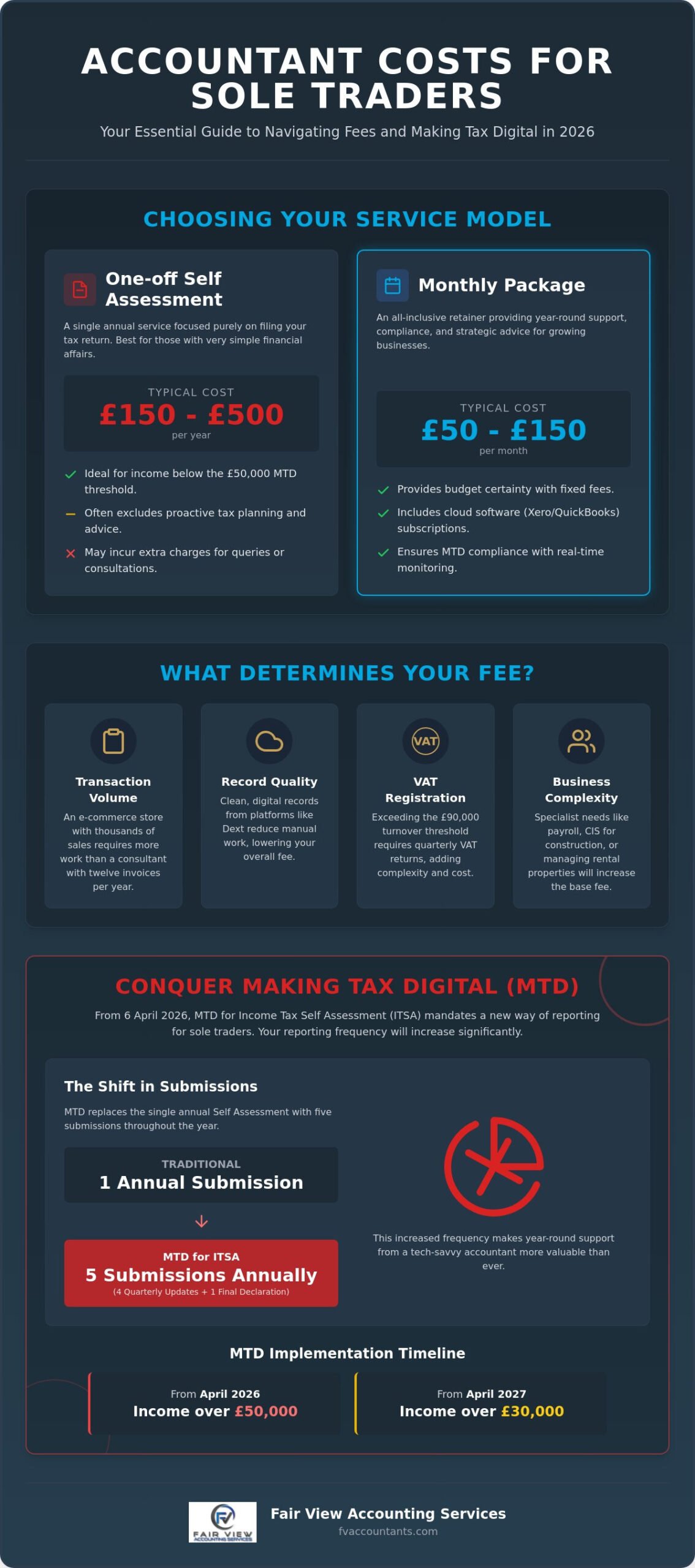
For individuals with simple financial affairs who fall below the £50,000 MTD threshold, a one-off filing service remains a popular option. Industry data suggests that a basic tax return typically ranges from £150 to £500 per year. This price often increases if your situation is more complex. Factors that typically drive up the cost include:
- Managing multiple income streams, such as rental property or dividends.
- Calculating Capital Gains Tax on sold assets.
- Claiming specific professional expenses that require detailed reconciliation.
Monthly Accountancy Packages
Monthly retainers are becoming the standard for modern businesses seeking budget certainty. These packages usually range from £50 to £150 per month for basic support. This model provides year-round access to a professional, which helps you avoid the “January panic.” Most monthly fees also include subscriptions to cloud platforms like Xero or QuickBooks. By integrating these tools, your accountant can monitor your finances in real-time, providing a level of accuracy and stability that a once-a-year check-up simply cannot provide.
What Determines the Cost of Your Accountancy Package?
Determining your specific fee involves looking at the moving parts of your business. Many providers use turnover to set prices, but this is often a blunt instrument. A consultant earning £80,000 might only issue twelve invoices a year, whereas an e-commerce seller with the same turnover could process thousands of small transactions. The latter requires significantly more bookkeeping time, which naturally increases the accountant for sole trader cost.
Record quality also plays a vital role in fee calculation. If you provide a disorganised box of receipts, your accountant must spend hours manually categorising expenses. Using digital tools like Dext or QuickBooks allows for automated data capture. This efficiency reduces manual labour, allowing your professional to focus on high-value tax planning instead of data entry. If you are looking to streamline these processes, a specialised sole trader accountant can help you implement the right tools from the start.
VAT registration adds another layer of complexity. If your turnover exceeds the £90,000 threshold on a rolling 12-month basis, you must file quarterly returns. This regular reconciliation requires consistent attention throughout the year, which is reflected in a higher service fee compared to non-registered businesses. Your accountant must verify that every input and output tax claim is accurate to avoid HMRC penalties.
The Impact of Making Tax Digital for Sole Traders
From 6 April 2026, the landscape changes for approximately 780,000 individuals. Those with qualifying income over £50,000 must transition to MTD for ITSA. This mandate requires digital record-keeping and quarterly updates to HMRC. Because this increases the frequency of submissions from once a year to five times a year, many accountants are adjusting their package structures to cover this extra work. For those with income over £30,000, the requirement begins in April 2027.
Complexity and Additional Services
Your base fee may increase if your business requires specialist support. Construction workers under the CIS scheme or businesses with employees need regular payroll management. Similarly, if you manage rental properties alongside your main trade, your accountant must consolidate these different income streams into your final declaration. These additional services ensure your entire financial profile remains compliant, preventing costly errors across different tax regimes.
Fixed Fees vs Hourly Rates: Finding the Best Value
Choosing the right billing structure is as important as the service itself. Traditionally, the accounting industry relied on hourly rates, but this model often creates a conflict of interest. When you are billed by the minute, a quick phone call to discuss a new business idea can result in an unexpected invoice. This uncertainty makes it difficult to manage your cash flow effectively. For most, the accountant for sole trader cost is far more manageable when structured as a fixed monthly fee.
Value should be measured by the total financial benefit provided, not just the lowest price. A professional who identifies a specific tax relief you had overlooked often saves you more than their annual fee. This proactive approach turns a compliance cost into a strategic investment. If you want a transparent partner who prioritises your growth, you can get a fixed-fee quote tailored to your business profile.
Why Fixed Fees Favour the Small Business
Fixed fees provide budget certainty and encourage a stronger partnership. You don’t have to worry about “bill shock” at the end of the financial year because your costs are spread evenly. A standard fixed-fee agreement usually includes:
- Preparation and filing of your annual Self Assessment.
- Ongoing support for basic tax queries throughout the year.
- Integration and maintenance of your cloud accounting software.
- Quarterly reviews to ensure your records remain accurate.
The Hidden Costs of DIY Accounting
Many sole traders attempt to manage their own books to save money, but this often leads to the “DIY trap.” The time you spend wrestling with spreadsheets is time you aren’t spending earning. If your hourly rate is £50 and you spend five hours a month on bookkeeping, your “free” accounting is actually costing you £3,000 a year in lost revenue.
Beyond the opportunity cost, the risk of errors is high. HMRC penalties for late or inaccurate submissions can quickly wipe out any perceived savings. Professionals stay updated on the latest “favourite” tax reliefs and allowances, ensuring you never pay more than is legally required. This expertise provides a level of security that software alone cannot match.
Choosing a Tech-Savvy Accountant for Long-Term Savings
Modern accountants leverage automation to keep their own overheads low. This efficiency directly impacts the accountant for sole trader cost; you aren’t paying for manual data entry, but for professional insight. By automating bank feeds and receipt capture, a tech-savvy firm reduces the risk of human error and keeps your records accurate in real-time. This streamlined approach ensures that your fees remain predictable whilst the quality of your financial data improves.
Accessing real-time data allows you to see your estimated tax liability at any point in the year. You no longer have to wait until the end of the tax year to discover how much you owe HMRC. This visibility provides a sense of stability and allows for better cash flow management. At Fair View Accounting Services, we combine these digital tools with a supportive human touch, acting as a guardian for your financial health and compliance.
A professional Accountant’s Certificate is a vital asset if you plan to apply for a mortgage or business finance. Many lenders require this specific verification from a chartered firm to prove your income. Having a tech-savvy accountant ensures that your digital records are robust enough to generate these certificates quickly when an opportunity arises, providing the credibility needed to secure your personal or professional future.
The Role of Cloud Accounting Software
Integrating platforms like Xero or QuickBooks simplifies the entire Self Assessment process. These tools allow your accountant to access your data securely from any location, facilitating a more collaborative partnership. Digital records are no longer a matter of preference. They are a necessity for compliance with the 2026 MTD regulations. Using these platforms ensures your business remains future-proof and organised.
Positioning Your Business for Growth
Moving beyond basic compliance allows you to focus on strategic tax planning. A chartered firm provides the professional credibility needed when dealing with banks or investors. By maintaining high-quality digital records, you position your business as a reliable entity. This professional standing is essential for long-term success and scaling your operations beyond the sole trader structure. You gain a partner dedicated to your growth, not just a service that crunches numbers.
Securing Your Financial Future in a Digital Landscape
Navigating the transition to Making Tax Digital doesn’t have to be a source of anxiety. By choosing a partner who understands the 2026 regulatory changes, you transform a compliance burden into a streamlined business process. Fixed-fee arrangements provide the budget certainty you need, ensuring the accountant for sole trader cost remains a predictable investment rather than a fluctuating expense. This proactive approach allows you to plan your business growth with confidence.
Professional support offers more than just filed returns. It provides the real-time data and chartered credibility required for mortgage applications and future finance. As specialists in Xero and QuickBooks integration, Fair View Accounting Services ensures your records are always accurate. Our national UK coverage and fixed-fee packages are specifically designed to support the unique needs of freelancers and small businesses.
Get a tailored quote for your sole trader accounting today to secure your compliance and peace of mind. Your business deserves a steady, tech-savvy guardian to handle the complexities whilst you focus on what you do best.
Frequently Asked Questions
Is an accountant’s fee tax-deductible for a sole trader?
Yes, you can claim the full cost of your accountancy fees as a tax-deductible business expense on your Self Assessment return. HMRC classifies these as professional fees, meaning they reduce your taxable profit and effectively lower your final tax bill. You should record these costs accurately under the legal and professional charges section of your accounts.
Do I really need an accountant if my turnover is below the VAT threshold?
Professional support is often essential even if your turnover is below the £90,000 VAT threshold. The 2026 Making Tax Digital requirements mandate quarterly digital updates for anyone with a qualifying income over £50,000, which is significantly lower than the VAT limit. An accountant also identifies specific tax reliefs and provides the professional credibility needed for mortgage applications through an Accountant’s Certificate.
What is the average monthly cost for a sole trader accountant in the UK?
Most small businesses pay between £50 and £150 per month for a standard support package. This accountant for sole trader cost usually covers your annual tax return filing, cloud software subscriptions, and basic tax advice throughout the year. Your specific fee will depend on the volume of your monthly transactions and whether you require additional services like payroll or CIS management.
Can an accountant help me switch from a sole trader to a limited company?
Yes, an accountant can manage the entire transition process to ensure it is handled at the most tax-efficient moment for your business. They will oversee the registration with Companies House and set up your new Corporation Tax and payroll systems. This professional guidance ensures you don’t fall foul of complex transition rules whilst your business structure evolves.
What happens if I don’t follow Making Tax Digital rules in 2026?
Failing to comply with the MTD for ITSA rules from 6 April 2026 will likely result in financial penalties under HMRC’s points-based system. If your qualifying income is over £50,000, you must use compatible software to keep digital records and submit quarterly updates. Missing these deadlines or providing inaccurate data can lead to significant fines and increased scrutiny from tax authorities.
Disclaimer
The information provided in this article is for general guidance only and is not intended to constitute professional advice, tax advice, financial advice, legal advice, or any other form of regulated guidance. Although every effort has been made to ensure accuracy at the time of publication, Fair View Accounting Services, including its director, employees, contractors, writers, and content-creation team, accepts no responsibility for any loss, damage, penalty, or consequence arising from reliance on the information contained herein. UK tax legislation changes frequently, and HMRC interpretations, thresholds, and rules may vary depending on the individual circumstances of each taxpayer. Nothing in this article should be considered a substitute for obtaining formal, personalised advice from a qualified accountant or tax professional. Readers should not take action or refrain from taking action based solely on the content published on this website. Fair View Accounting Services does not guarantee the completeness, accuracy, or ongoing validity of the information provided and assumes no liability for omissions or errors, whether typographical, factual, or technical. By using this content, the reader acknowledges that all responsibility for decisions remains solely with the user.