

Could your current accounting setup survive a rigorous HMRC audit of your cross-border sales? Many UK sellers discover too late that a generalist accountant often lacks the technical depth to reconcile platform fees, digital wallets, and complex VAT integrations. With the UK ecommerce market continuing its rapid expansion in 2026, the risk of overpaying tax due to poor data flow is a genuine threat to your bottom line. You need a specialist ecommerce tax accountant who acts as a tech-savvy guardian, ensuring your financial data remains precise across every marketplace you use.
We recognise that navigating the shift to Making Tax Digital for Income Tax whilst managing international growth is a significant challenge. This guide provides a clear framework for choosing a partner who understands your specific platforms and automates your bookkeeping to ensure it just works. We will explore how the right specialist protects your margins through proactive tax planning and provides the total HMRC compliance you need to scale with confidence.
Key Takeaways
- Learn why traditional bank-statement accounting fails online sellers and how to accurately reconcile complex marketplace fees.
- Discover the essential “cloud-first” criteria for selecting an ecommerce tax accountant who is proficient in Xero, QuickBooks, and Dext.
- Understand how to navigate international VAT complexities, including OSS and IOSS, to protect your business from HMRC penalties.
- Identify the automation strategies that bridge the “data gap” between your sales platforms and your financial records.
- See how a tech-savvy, remote-first approach provides the precision of a chartered firm whilst supporting your growth across the United Kingdom.
Why Traditional Accounting Fails the Modern Ecommerce Seller
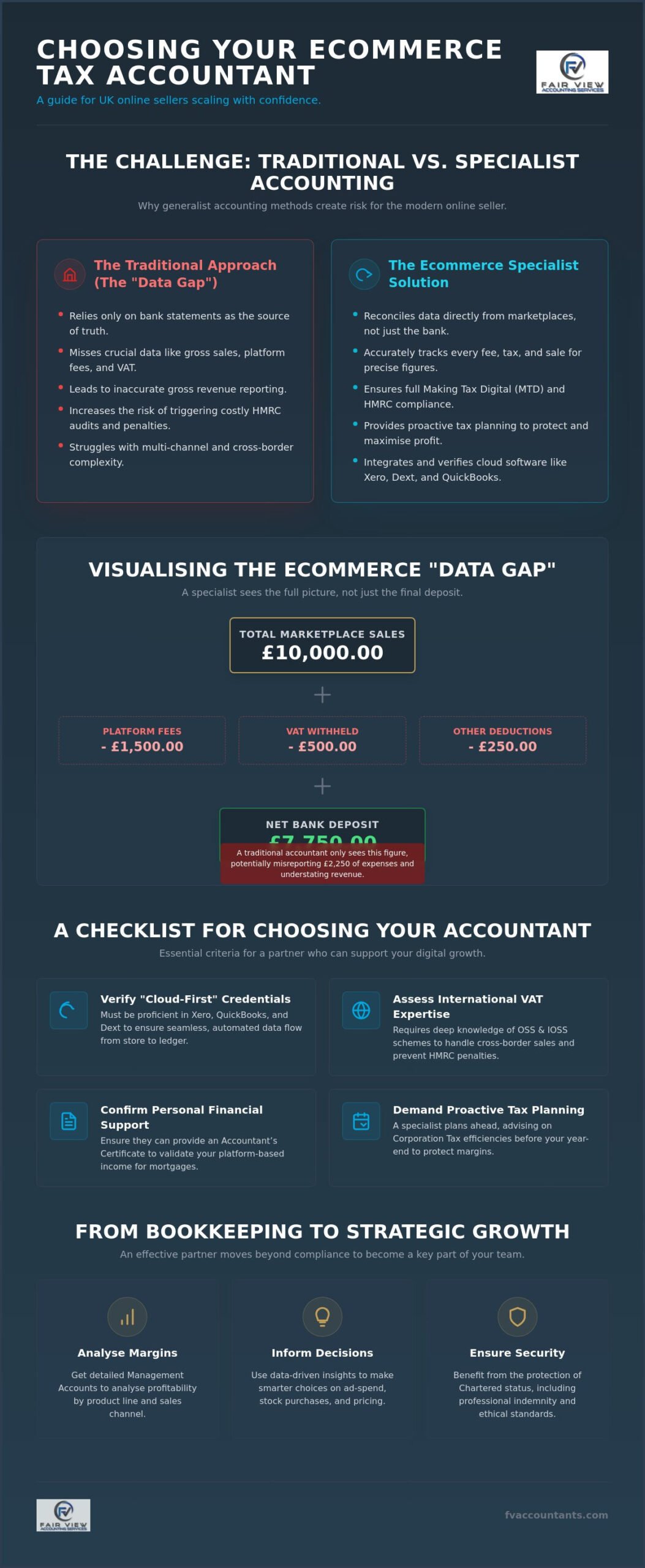
Traditional accounting methods often fall short when applied to the high-volume, multi-channel environment of online retail. Most generalist firms rely on bank statements as their primary source of truth. However, for an online business, a bank deposit is merely the final result of a complex series of transactions. It doesn’t account for gross sales, platform fees, or taxes withheld at the source. This “Data Gap” creates a significant risk for your business, as bank records alone are insufficient for full tax compliance.
If you sell on Amazon or eBay, these platforms deduct various fees before transferring funds to your account. Without a specialist ecommerce tax accountant, these deductions are often missed or miscategorised. This leads to inaccurate reporting of your gross revenue, which can trigger red flags during an HMRC audit. Proper financial management requires a deeper dive into understanding Value-Added Tax (VAT) and how it applies to each specific marketplace. Tracking the cost of goods sold (COGS) across multiple territories adds another layer of difficulty that generalist systems simply aren’t designed to handle.
The Risk of Automated Integration Errors
Many sellers believe that connecting Shopify or Etsy to their accounting software solves every problem. In reality, “set and forget” integrations often lead to duplicated sales records or missed VAT liabilities. A specialist performs rigorous monthly reconciliations between your store and your ledger. This ensures that every penny is accounted for, preventing the technical glitches that often lead to expensive tax corrections. We don’t just trust the software; we verify the data flow to maintain absolute precision.
HMRC Compliance in a Digital-First World
HMRC increasingly uses “discovery assessments” to investigate online businesses where digital records appear inconsistent. A specialist ecommerce tax accountant provides the chartered oversight necessary to ensure your systems meet strict Making Tax Digital (MTD) requirements. We act as your tech-savvy guardian, auditing your software integrations as rigorously as your tax returns. This proactive approach ensures your records are robust enough to withstand any regulatory scrutiny whilst you focus on scaling your operations across the United Kingdom.
Choosing the Right Ecommerce Tax Accountant: A Specialist Checklist
Selecting the right financial partner involves more than just checking a professional directory. You need a partner who understands the digital architecture of your business. Use the following checklist to ensure your ecommerce tax accountant possesses the technical depth required to support your growth.
- Verify “Cloud-First” credentials: Your accountant must be proficient in Xero, QuickBooks, and Dext. These tools form the backbone of modern automation, ensuring your data flows seamlessly from your store to your ledger without manual entry errors.
- Assess VAT expertise: Cross-border sales require specific knowledge of OSS and IOSS schemes. Whilst you can review official government guidance on VAT, your accountant must apply these rules to your specific multi-channel setup to prevent overpayments or HMRC penalties.
- Confirm personal financial support: Many online sellers struggle to secure mortgages because lenders don’t always understand platform-based income. Ensure your firm can provide an Accountant’s Certificate to validate your earnings for personal finance needs.
- Demand proactive tax planning: A specialist should look ahead to protect your margins. They shouldn’t just file historical data; they should advise on Corporation Tax efficiencies before your year-end arrives.
Beyond Bookkeeping: Strategic Growth Advice
An effective ecommerce tax accountant helps you analyse margins by product line and sales channel. By providing regular Management Accounts, they enable you to make informed decisions regarding monthly ad-spend and stock purchases. This data-driven approach ensures you aren’t just increasing turnover, but actually retaining more profit. It’s about moving from simple record-keeping to strategic financial oversight.
The Importance of Chartered Status
A Chartered Accountant offers a level of security that uncertified bookkeepers cannot provide. This status includes professional indemnity insurance and a commitment to rigorous ethical standards. This authority is vital during complex HMRC negotiations or tax investigation services, where expert representation is required to protect your business interests. Choosing a chartered firm ensures your compliance is handled with the highest level of professional precision.
How Fair View Accounting Services Secures Your Online Growth
Fair View Accounting Services operates as your tech-savvy guardian, bridging the gap between digital innovation and chartered precision. We provide seamless remote support to ecommerce sellers throughout the United Kingdom, removing the need for physical meetings whilst maintaining a dedicated, personal service. This modern approach allows you to focus on sales and strategy while we handle the complexities of your financial obligations.
As a specialist ecommerce tax accountant, we ensure your QuickBooks or Xero setup is perfectly synchronised with your various sales channels. This integration is vital for accuracy, especially as platforms now share data under the UK government guidance on selling online. Our team verifies that every transaction is captured correctly, preventing the common data gaps that lead to HMRC scrutiny. We also implement tailored tax planning strategies designed to reduce Corporation Tax and optimise your Self-Assessment, ensuring you retain more of your hard-earned profit.
A Partner for Every Stage of the Journey
We support your business from the initial startup bookkeeping phase through to managing complex VAT returns for established international brands. If your growth requires expanding your team, our recurring payroll and CIS services provide the administrative stability you need to hire with confidence. We adapt our support as your turnover increases, providing the steady oversight required to navigate the transition from a small venture to a high-volume retailer.
Your Next Steps to Compliance
Switching to a specialist ecommerce tax accountant is a straightforward and managed process. We handle the entire transfer of information from your previous provider to ensure no historical data is lost or miscalculated during the transition. Booking an initial consultation allows our chartered team to identify immediate tax-saving opportunities within your online store. We will help you establish a robust digital framework that protects your margins and secures your long-term compliance.
Securing Your Financial Future in the Digital Marketplace
Adopting a digital-first approach to your finances is no longer optional; it’s a fundamental requirement for any serious online retailer. The “data gap” and VAT complexities we’ve discussed can quickly erode your profits if left unmanaged. By following a specialist checklist and prioritising technical integration, you ensure your business remains compliant whilst you scale across new territories and platforms.
At Fair View Accounting Services, we act as your dedicated partner, providing the chartered oversight and software expertise necessary to protect your margins. Our role as your ecommerce tax accountant is to transform complex financial data into clear, actionable insights. We provide national support across the United Kingdom, ensuring that your Xero or QuickBooks setup remains precise and fully optimised for growth.
Book a consultation with our ecommerce tax specialists today to identify immediate tax-saving opportunities and streamline your digital records. Establishing a robust financial foundation today provides the peace of mind you need to focus on your future sales. We look forward to helping you navigate the complexities of the 2026 ecommerce landscape with confidence.
Frequently Asked Questions
Do I need a specialist ecommerce accountant if I only sell on Amazon?
Yes, selling on Amazon involves unique accounting challenges that generalists often overlook. Amazon FBA settlement reports include various fees, refunds, and advertising costs that must be reconciled against gross sales to ensure your VAT reporting is accurate. A specialist understands how to extract this data correctly, preventing you from overpaying tax on revenue you didn’t actually retain.
How does an ecommerce tax accountant help with VAT on international sales?
They manage the complexities of cross-border regulations such as the One-Stop Shop (OSS) and Import One-Stop Shop (IOSS) schemes. By ensuring you apply the correct VAT rates for different territories, your ecommerce tax accountant prevents your customers from facing unexpected import charges. This expertise is vital for maintaining a smooth customer experience whilst staying compliant with both UK and EU tax authorities.
Can an ecommerce accountant help me get a mortgage?
Yes, we support your personal financial goals by providing a formal Accountant’s Certificate. UK mortgage lenders often find it difficult to assess the income of online sellers due to fluctuating margins and platform-based payouts. As a chartered firm, we provide the verified financial statements and tax records that banks require to approve your application with confidence.
What is the best accounting software for UK ecommerce businesses in 2026?
Xero and QuickBooks remain the industry standards because they offer the most robust integrations with marketplaces like Shopify, eBay, and Amazon. These platforms are fully compatible with Making Tax Digital requirements, allowing for automated data flows that reduce manual entry errors. When paired with Dext for digital record-keeping, they provide a comprehensive and secure audit trail for your business.
How much does an ecommerce tax accountant typically cost?
Fees are generally structured as monthly packages that scale alongside your transaction volume and the number of sales channels you use. This subscription model provides you with predictable costs and ongoing access to expert advice rather than a large, unexpected year-end bill. Most firms provide bespoke quotes based on whether you require basic compliance or more advanced management accounts and tax planning.
What is the difference between a bookkeeper and an ecommerce tax accountant?
A bookkeeper focuses on the daily recording of transactions and bank reconciliations, whereas an ecommerce tax accountant provides high-level strategic oversight and chartered tax expertise. While bookkeeping ensures your records are tidy, an accountant handles your Corporation Tax returns, represents you in HMRC investigations, and provides the proactive tax planning necessary to increase your long-term profitability.
Disclaimer
The information provided in this article is for general guidance only and is not intended to constitute professional advice, tax advice, financial advice, legal advice, or any other form of regulated guidance. Although every effort has been made to ensure accuracy at the time of publication, Fair View Accounting Services, including its director, employees, contractors, writers, and content-creation team, accepts no responsibility for any loss, damage, penalty, or consequence arising from reliance on the information contained herein.UK tax legislation changes frequently, and HMRC interpretations, thresholds, and rules may vary depending on the individual circumstances of each taxpayer. Nothing in this article should be considered a substitute for obtaining formal, personalised advice from a qualified accountant or tax professional. Readers should not take action or refrain from taking action based solely on the content published on this website.Fair View Accounting Services does not guarantee the completeness, accuracy, or ongoing validity of the information provided and assumes no liability for omissions or errors, whether typographical, factual, or technical. By using this content, the reader acknowledges that all responsibility for decisions remains solely with the user.